
What Is Digital Transformation in Practice?



Share the раgе:
Digital transformation is used to describe everything from a new CRM to a rebuilt operating model, which is why boards approve it and then cannot say what finished looks like. A working definition: a change that alters how a decision is made, who makes it, or the information it is made on. If none of those move, you have a technology upgrade, which may be a fine investment but is a different project with different governance. Gartner now expects worldwide IT spending to reach $6.37 trillion in 2026, and its own analyst warns that budgets are strained rather than flush. The definition matters because it decides what you are buying. This guide separates digitization, digitalization, and transformation, gives a three-question test, and states the benefits in terms you can measure.
Introduction
Ask five people in the same steering committee what digital transformation means and you will get a CRM migration, a cloud move, a customer portal, "becoming data-driven," and a shrug. All five are funded under the same line item.
That is not a vocabulary problem. It is a governance problem, because a project nobody can define is a project nobody can declare finished, over budget, or off course.
So here is a definition with a test attached.
What is digital transformation?
Digital transformation is a change to how an organization operates that alters at least one of three things: how a decision is made, who is allowed to make it, or the information it is made on. Technology is the means. The change in decision-making is the transformation.
The test is deliberately narrow. A new system that lets the same people make the same decisions on the same information, faster and with a better interface, is a technology upgrade. It can be worth doing. It is not a transformation, and it should not be governed, funded, or measured as one.
Three examples of changes that pass the test:
- A field technician approves a warranty replacement on site from a tablet, where previously the request went to head office and came back in four days. The decision moved to a different person.
- Pricing on an e-commerce platform adjusts from a rules engine fed by live inventory and competitor data, where previously a category manager set it weekly. The information the decision is made on changed, and so did the decision maker.
- A claims triage step that used to be a manual review queue now routes low-complexity claims straight to payment based on defined criteria. The decision itself was redesigned.
And one that does not: replacing an on-premise ERP with the same vendor's cloud edition, configured to mirror the existing processes. The infrastructure changed. Nothing about how the organization decides anything did.
Key Takeaway: If you cannot name the decision that changes, you are describing an upgrade. Upgrades are fine. Call them what they are.
Not sure which side your initiative is on? Our Discovery & Strategy practice answers that question before the budget is committed. Book a free consultation.
What is the difference between digitization, digitalization, and digital transformation?
The three words get used interchangeably. They describe three different sizes of change, and the confusion between them is where most "transformation" budgets go to fund something smaller.
The first two are prerequisites for the third and are often the right place to start. The mistake is not doing them. The mistake is funding a digitalization project under a transformation budget, with transformation-sized expectations, and being surprised when the operating model looks the same at the end.
In software terms, the question "what is digital transformation in software" usually resolves to the same test. New software that reproduces the old process is digitalization. New software that lets the process be redesigned, and a business owner who redesigns it, is transformation. The software is never the deciding factor. The redesign is.
Key Takeaway: Digitization and digitalization are IT projects. Transformation is a business change project that happens to need IT. Fund and govern them differently.
Why does the definition matter for the budget?
Because the money is large and the scrutiny is increasing at the same time.
Gartner's July 2026 forecast puts worldwide IT spending at $6.37 trillion for the year, up 14.2% on 2025, its fourth upward revision since October. The same release is careful to say that this is not a market where every budget is growing, and that technology spending is being squeezed by inflation, hardware costs, and competing AI priorities.
Read those two facts together and the position of a sponsor becomes clear. More is being spent, and each line is being examined harder. A programme that cannot say which decisions it changes cannot say what value it produces, which makes it the easiest item to cut when the next quarter's review arrives.
The pattern we see is not that transformation programmes fail loudly. It is that they get quietly reclassified as infrastructure spend at year two, once everyone has stopped pretending the operating model was going to change.
Key Takeaway: In a scrutinised budget, a precise definition is a survival tool. Vague programmes get cut first because nobody can defend them.
What are the benefits of digital transformation, stated so they can be measured?
Every benefit that gets listed for digital business transformation is real. Most are stated in a form that cannot be checked, which is why benefit realization reviews so often conclude nothing.
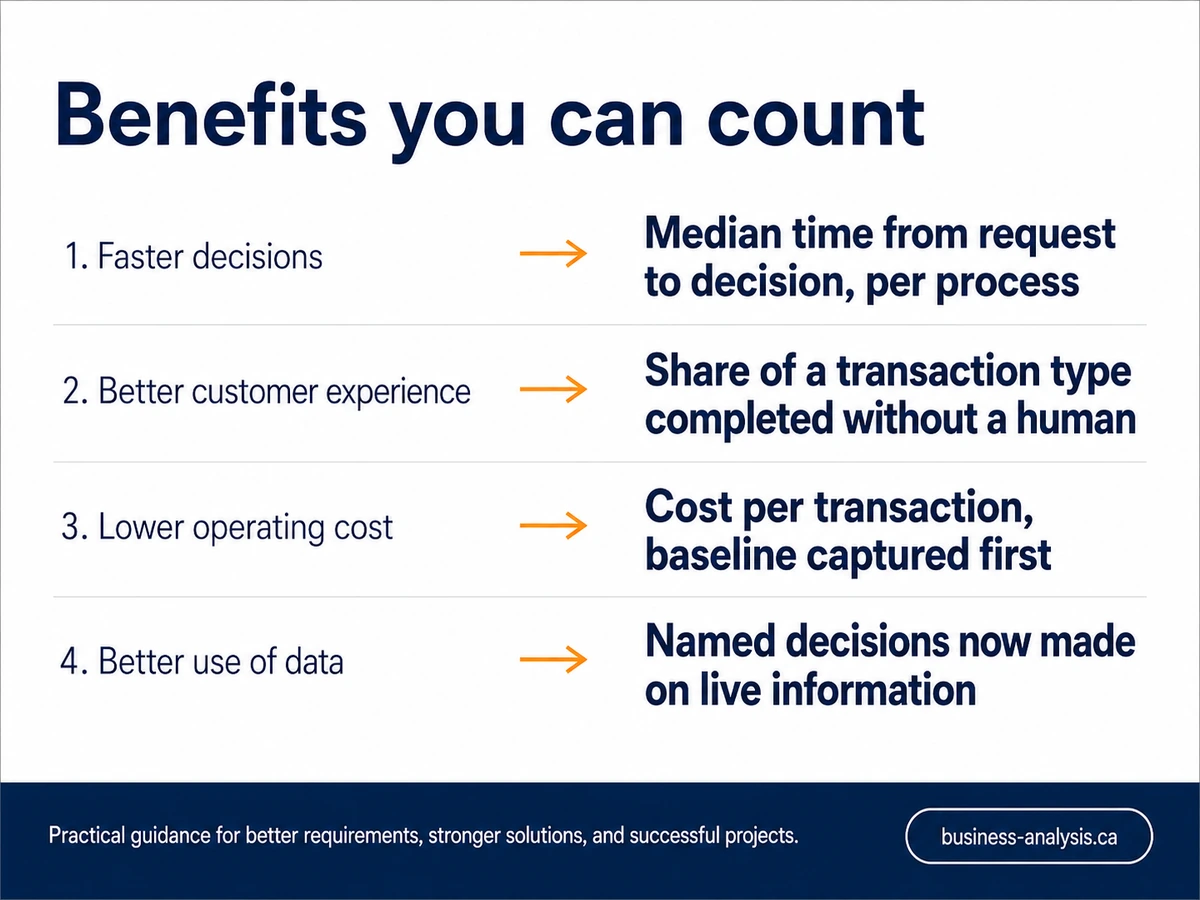
Four benefits, each restated as something a person can count:
- Faster decisions becomes: median time from request to decision for a named process, measured before and after.
- Better customer experience becomes: the share of a named transaction type completed without human intervention, and the complaint rate for that type.
- Lower operating cost becomes: cost per transaction for the redesigned process, with the baseline captured before the change starts.
- Better use of data becomes: the number of named decisions now made on live information that were previously made on a monthly report.
Each of these is a decision-level measure, which is not a coincidence. If the transformation changes how decisions are made, the benefits have to be measured at the decisions. Measuring system uptime or user logins tells you the technology works. It tells you nothing about whether the organization changed.
Key Takeaway: State each benefit as a number attached to a named decision or process, captured before you start. Anything else is a hope.
How do you tell whether your initiative is a digital transformation?
Ask three questions before funding, and write the answers down.
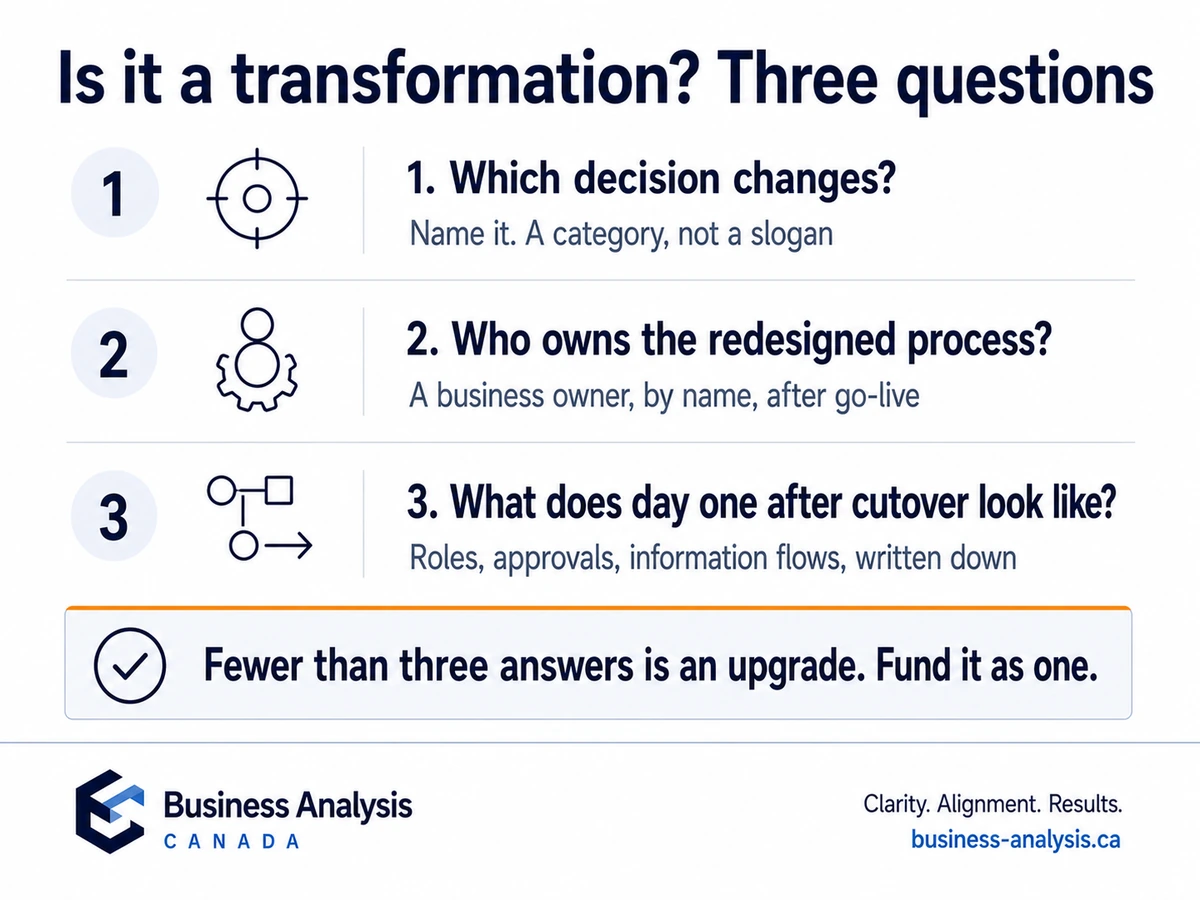
- Which decision changes? Name it. "Warranty approval under $500" is a decision. "Customer engagement" is not.
- Who owns the redesigned process? A business owner, by name, who will still be accountable after go-live. If the only owner is the IT delivery lead, you are looking at an upgrade.
- What does the operating model look like on day one after cutover? Roles, approvals, and information flows, written down. If the honest answer is "the same, but on a new system," the label is wrong.
Two out of three is not a pass. All three answered is the minimum for calling something a transformation and governing it as one. Fewer than three is a legitimate IT project that should be scoped, funded, and reported as exactly that.
Key Takeaway: The test takes twenty minutes and saves the argument at month eighteen about what the programme was supposed to deliver.
Frequently Asked Questions
What is digital business transformation, and how is it different from digital transformation?In practice they are the same idea with a different emphasis. "Digital business transformation" stresses that the change is to the business model or operating model, with technology as the enabler. Some organizations use the longer term specifically to distinguish operating model change from technology modernization. Under the definition in this guide, both describe a change to how decisions are made, who makes them, or the information behind them.
Is moving to the cloud a digital transformation?Not on its own. Cloud migration changes where systems run and how they are paid for, which is infrastructure. It becomes part of a transformation when it enables a decision to be made differently, such as giving a regional team live access to data that previously arrived as a monthly extract. The migration is the prerequisite. The changed decision is the transformation.
How long does a digital transformation take?Longer than the technology delivery, because the operating model has to change and people have to work differently. A realistic view treats the system go-live as roughly the midpoint, with adoption and benefit realization taking as long again. Programmes that declare victory at go-live usually find the old process running in parallel a year later.
Does every organization need a digital transformation?No. Many need digitalization, which is cheaper, faster, and lower risk. The honest starting point is to ask which decisions the organization currently makes badly or slowly, and whether technology is the constraint. If the decisions are fine and the systems are old, modernize the systems and call it modernization.
Conclusion
The word will keep being used to mean everything, and that is fine as marketing. It is not fine as governance.
Before the next programme is funded, name the decision that changes, the business owner who redesigns it, and the operating model on the day after cutover. If those three answers exist, you have a transformation. If they do not, you have a worthwhile IT project wearing the wrong label, and the label is the cheapest thing to fix.
If you would like an independent view on which one you are looking at, book a free consultation.
Sources
- Gartner, Gartner Forecasts Worldwide IT Spending to Grow 14.2% in 2026, Totaling $6.37 Trillion, press release, July 27, 2026. https://www.gartner.com/en/newsroom/press-releases/2026-07-27-gartner-forecasts-worldwide-it-spending-to-grow-14-point-2-percent-in-2026-totaling-6-point-37-trillion