
Guarding the Gate: The Value of a Project Discovery Phase in IT Strategy



Share the раgе:
Discovery is usually sold as understanding the problem, which sounds like a delay to anyone holding a budget. A better description is that it is the cheapest place to cancel a bad idea. A discovery phase should end in a decision, not a document, and one of the available decisions has to be "do not build this" or the exercise is theatre. Four deliverables carry the weight: a problem statement with a measurable outcome, a scoped option set with costs, a risk and constraint register, and an estimate someone will stand behind. Timebox it, name the decision maker, and require a recommendation.
Introduction
The objection to discovery is always the same, and it is a reasonable one. We know what we need. Why are we paying you to tell us what we already know before anyone writes a line of code.
Sometimes that objection is correct. Not every initiative needs a discovery phase, and I have sat in discoveries that should have been a two-hour conversation.
But the objection assumes the purpose of discovery is to learn something. Its real purpose is to make a decision defensible before it becomes expensive, and that includes the decision not to proceed.
What is the discovery phase of a project?
The discovery phase of a project is a timeboxed period before build commitment, used to define the problem in measurable terms, identify and cost the realistic options, surface the constraints that will shape delivery, and produce a recommendation the sponsor can approve or reject.
Three things distinguish it from ordinary planning.
It happens before the solution is chosen. Once a platform is selected or a vendor signed, discovery becomes requirements gathering, which is a different activity with a narrower question. The point of discovery is that "which solution" is still open.
It is timeboxed. An untimeboxed discovery is analysis paralysis with a project code, and it is the reason the practice has a bad name in some organizations.
It ends in a decision. Not a report that circulates for comment, and not a backlog. A decision, made by a named person, on a date agreed at the start.
Key Takeaway: If the solution is already chosen, you are not in discovery. Call it what it is and move faster.
Facing an initiative where the right approach is not yet obvious? Our Discovery & Strategy practice runs timeboxed engagements that end in a recommendation. Book a free consultation.
What are the deliverables of a project discovery phase?
Four, and each one has a test for whether it is finished. If a deliverable cannot pass its test, discovery is not complete regardless of how many workshops were held.
The second row is where most discoveries go soft. An option set without a do-nothing baseline is a sales document. Costing the status quo honestly is uncomfortable, because it occasionally reveals that the problem is cheaper to live with than to fix. That is a legitimate finding and you paid for it.
The fourth row is the other one people avoid. A discovery that presents options without a recommendation has moved the hard part back onto the sponsor, who has less information than the team that just spent six weeks on it.
Key Takeaway: Four deliverables, four tests. Workshops held is not a measure of progress.
Why does discovery get cut, and what does it cost?
It gets cut because it is the only phase whose value is invisible when it works. A discovery that prevents a bad project produces no system, no launch, and nothing to point at in a year-end review. A discovery that is skipped produces a project, which looks like progress until it does not.
The cost shows up in predictable places. Requirements that turn out to be contradictory once someone tries to build both. A vendor selected against a demo rather than against your constraints. An integration nobody scoped because the system it touches belonged to a team that was not in the room. A business case that quietly stopped being true four months in, with nobody in a position to say so.
Yesterday's point about root causes applies directly here. Decisions with no named owner, requirements that were never testable, and status that is opinion rather than evidence are all cheapest to prevent during discovery and most expensive to fix during build.
There is a second failure mode worth naming, because pretending it does not exist is how discovery loses credibility. Discoveries do run long, produce documents nobody reads, and delay decisions that were straightforward. That happens when there is no timebox, no named decision maker, and no obligation to recommend. Those are fixable design flaws, not arguments against the practice.
Key Takeaway: Both failure modes are real. Skipping discovery is expensive, and running an open-ended one is also expensive. The fix for both is the same three constraints.
What should a discovery phase end with?
One of four decisions, made by a named person, on the date set at the start.
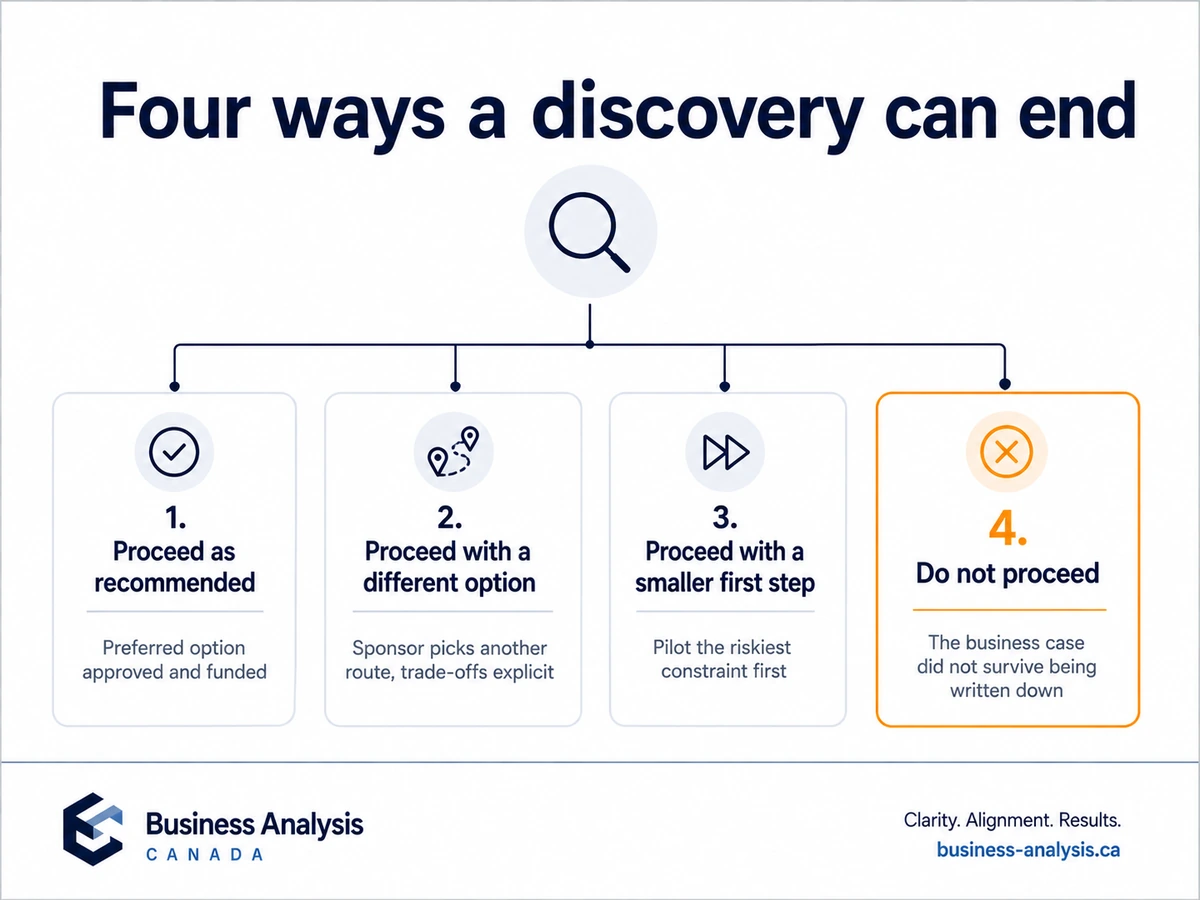
Proceed as recommended. The preferred option is approved, funded, and the constraints register transfers to the delivery team as an opening risk log.
Proceed with a different option. The sponsor picks another route from the set. Fine, and better than fine, because the trade-offs are now explicit.
Proceed with a smaller first step. Common and often correct. A pilot, a single business unit, or a proof against the riskiest constraint before committing the full budget.
Do not proceed. The problem is not worth the cost, the constraints cannot be removed, or the business case did not survive being written down.
If the fourth outcome is not genuinely available, discovery is a formality and everyone involved knows it. Teams learn quickly whether a recommendation can change anything, and they calibrate their honesty accordingly.
Key Takeaway: A discovery that can only conclude "yes, build it" was not a gate. It was a runway.
How do you run a discovery phase that is not a delay?
Three constraints, set before it starts, in writing.
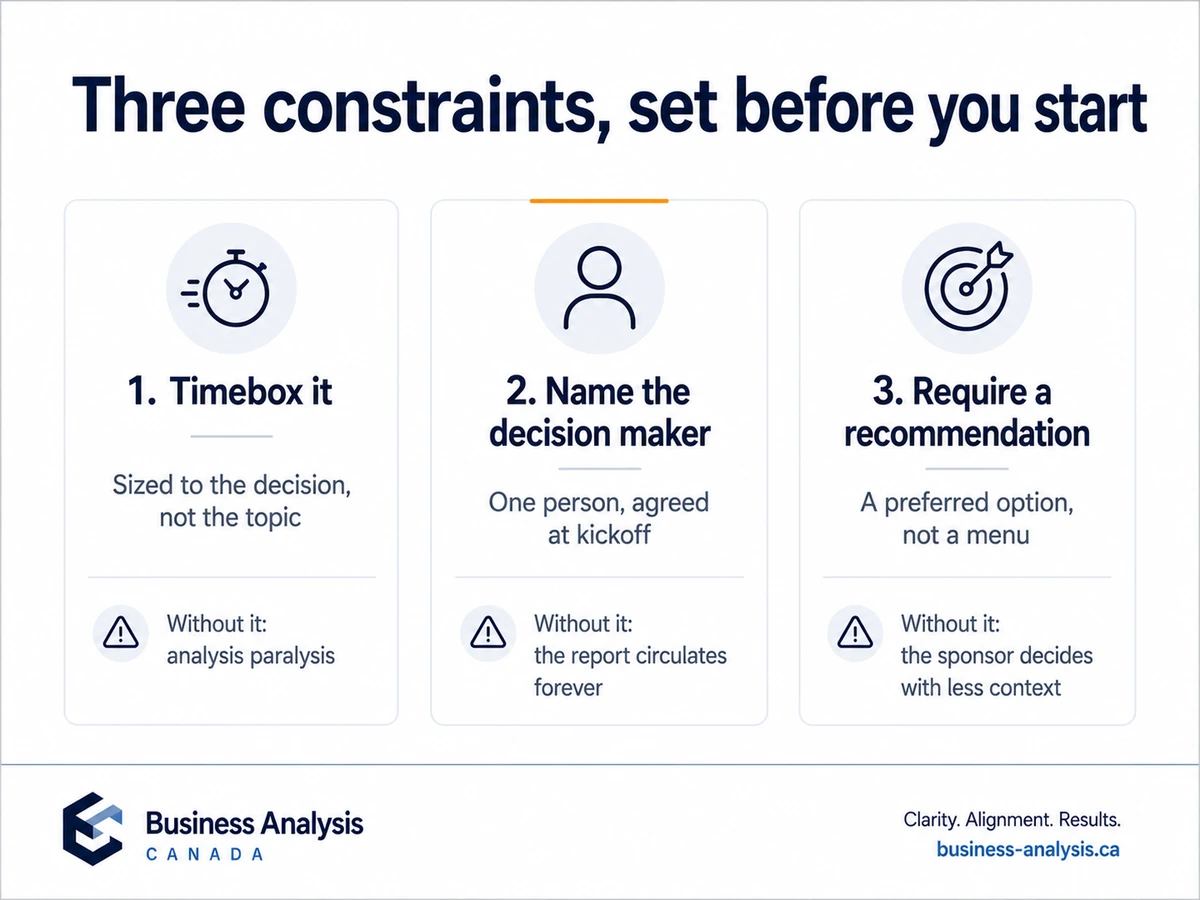
- Timebox it, and size the box to the decision. A single-system change might need two weeks. A platform replacement affecting several business units might need six to eight. Set the number before you begin and treat overrun as a finding worth escalating rather than a schedule adjustment.
- Name the decision maker at kickoff. One person, not a committee, who will accept or reject the recommendation on the agreed date. If nobody can be named, that is the most useful thing discovery has found and it should be escalated immediately.
- Require a recommendation, not a menu. The team doing the work has the most context. Making them commit to a preferred option is the discipline that keeps discovery from becoming a survey.
Two further habits help. Run it with the people who will deliver, because a discovery handed over cold loses most of its value in translation. And write the constraints register as you go rather than at the end, since the constraint you find in week one is the one most likely to be forgotten by week five.
Key Takeaway: Timebox, named decision maker, mandatory recommendation. Discoveries that go wrong are usually missing at least two of the three.
Frequently Asked Questions
How long should a project discovery phase last?Long enough to answer the decision in front of you and no longer. A contained change to one system might need two weeks. A platform replacement crossing several business units might need six to eight. The right way to set it is backwards from the decision date the sponsor needs, then check whether the four deliverables can plausibly be produced in that window. If they cannot, the honest answer is to narrow the question rather than to extend the timebox indefinitely.
Is discovery the same as requirements gathering?No. Discovery asks whether and what, with the solution still open. Requirements gathering asks how, once the solution is chosen. Running requirements gathering and calling it discovery is common and produces a predictable outcome: a detailed specification for something nobody confirmed was worth building. The two activities are sequential, and skipping the first does not make the second faster.
Who should be involved in the discovery phase of project management?A business analyst leading, the sponsor or their delegate, representatives from each affected business area, someone technical who knows the current systems, and access to whoever owns the data. Keep the working group small and the consultation wide. The most common staffing mistake is omitting the technical voice, which produces an option set that looks reasonable until someone checks whether the integrations are possible.
Can you skip discovery on a small project?Often, yes. If the problem is clear, the solution is obvious, one team is affected, and the cost of being wrong is low, a short scoping conversation is enough. Discovery earns its cost when the solution is genuinely undecided, when several groups are affected, or when the cost of the wrong choice is large. Applying it uniformly to every initiative is how it acquires a reputation as overhead.
Conclusion
Discovery is not about learning more before starting. It is about making the decision reversible while reversing it is still cheap.
Timebox it. Name the person who decides. Require a recommendation, and make sure "do not build this" is a decision they are allowed to make.
If you are looking at an initiative where the right approach is not yet clear, book a free consultation and we will tell you whether it needs a discovery phase or a two-hour conversation.