Capital Investment Governance for a Mining Operator
How our business analysts built CAPEX evaluations, business cases, ROI models and stage-gate governance for a mining operator's capital project portfolio.
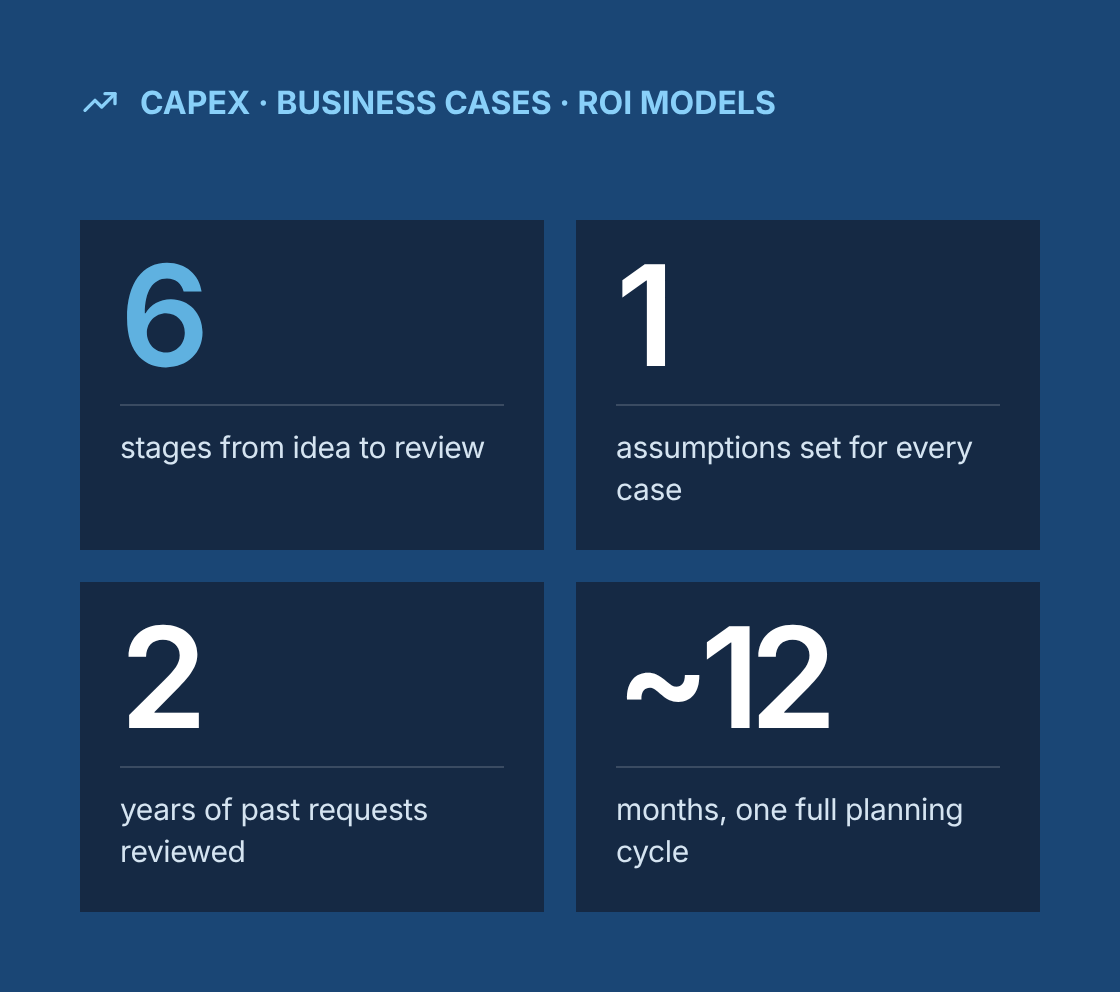
- 6 stages, from idea to post-investment review
- 1 set of planning assumptions behind every business case
- 2 years of past capital requests reviewed
- ~12 months, covering a full annual capital planning cycle
Project at a glance
- Client
A US mining operator running several open-pit and processing sites, with a large annual capital budget split between sustaining capital and growth projects - Solution
A structured capital investment process covering opportunity identification, CAPEX evaluation, business cases, ROI and value models, portfolio prioritization and executive reporting - Engagement
Business analysis and financial modelling support for the capital planning function, delivered remotely from Canada with site visits during key planning cycles - Duration
About 12 months, covering one full annual capital planning cycle and the mid-year review - Our role
Lead business analyst, working with the CFO's office, the capital planning team, site general managers, engineering, operations, maintenance, procurement and the executive investment committee - Scope
Process assessment, investment governance design, business case and model templates, CAPEX and feasibility analysis, market and production research, portfolio prioritization and executive reporting
The challenge
What problem was the client trying to solve?
Capital requests competed for funding on the strength of whoever made the case, not on comparable evidence.
- Every request in its own format
Each site and department prepared funding requests in its own format, with different assumptions and levels of detail. - Rough estimates, then overruns
Some projects were approved with order-of-magnitude estimates, then came back for more money once detailed engineering started. - Safety work judged on payback
Growth projects and sustaining capital, such as fleet replacement or tailings work, were compared on the same simple payback measure, which undervalued safety, compliance and risk reduction. - Assumptions that didn't match
Commodity price, production and cost assumptions varied between business cases, so returns could not be compared fairly. - Decisions buried in documents
Executives received long technical documents with the key decision points buried inside them. - No look back after completion
Approved projects were rarely reviewed after completion, so the business did not learn whether forecast benefits were delivered.
Our business analysis approach
How did we approach the engagement?
We treated capital allocation as a business process with clear stages, standard inputs and decision points, then built the analysis tools that each stage needed.
- Current-state assessment
We interviewed finance, site leadership, engineering and investment committee members and reviewed two years of past capital requests. We mapped the as-is request and approval process in BPMN and recorded where estimates, assumptions and approvals broke down. - Opportunity identification
With site teams we built a pipeline of investment opportunities from asset condition data, production bottlenecks, maintenance history, regulatory requirements and strategic plans. Each opportunity had a sponsor, a problem statement and an early estimate. - Stage-gate governance design
We defined a gated process from idea to scoping, prefeasibility, feasibility, execution and post-investment review. Each gate specified the required deliverables, the minimum estimate quality, the decision-maker and the approval limit. - Standard assumptions
We agreed a single assumptions set with finance, covering commodity price scenarios, discount rate, inflation, exchange rates, production plans and unit costs. Every business case used the same base, so returns could be compared on equal terms. - CAPEX evaluation and feasibility analysis
For each candidate project we reviewed cost estimates, schedules and scope with engineering. We assessed technical and operational feasibility, and flagged estimates that did not meet the maturity required for the gate. - Financial modelling
We built a standard project evaluation model calculating NPV, IRR, payback and cash flow profile. Sensitivity and scenario analysis showed how returns changed with price, grade, throughput, cost and schedule. - Business value models
For projects whose value is not mainly revenue, such as safety, environmental compliance, reliability and avoided downtime, we built value models. These put risk reduction and avoided costs in terms the investment committee could compare with growth projects. - Market and production research
We researched commodity market trends, cost inflation in equipment and consumables, and historical production and recovery data. The findings informed assumptions and the strategic case for growth projects. - Portfolio prioritization
We designed a scoring model that combined financial return, strategic fit, risk, safety and compliance need, and execution readiness. Projects were ranked and tested against the capital budget and cash constraints to form a recommended portfolio. - Executive reporting
We prepared investment committee packs with a one-page decision summary for each project, portfolio views and scenario comparisons. Detailed analysis sat in appendices for those who wanted it.
Solution
What did we deliver?
Area
Problem
What was delivered
Governance framework
Inconsistent request and approval process
Stage-gate process with required deliverables, estimate maturity, decision rights and approval limits at each gate
Business case template
Requests in different formats
Standard business case template covering problem, options, scope, cost, schedule, benefits, risks and recommendation
Project evaluation model
Returns calculated in different ways
Standard financial model with NPV, IRR, payback, cash flow profile, sensitivity and scenario analysis
Business value model
Safety and reliability projects undervalued
Value models for risk reduction, avoided downtime, compliance and asset life extension
Assumptions book
Different price, cost and production assumptions
Single controlled set of planning assumptions, owned by finance and versioned each cycle
Opportunity pipeline
Ideas raised informally
Register of investment opportunities by site, category, sponsor, stage and estimated value
Portfolio prioritization
Funding based on advocacy
Scoring and ranking model tested against budget and cash constraints
Executive reporting
Decisions buried in technical documents
Investment committee packs with one-page decision summaries and portfolio dashboards
Post-investment review
No check on delivered benefits
Review template and schedule comparing actual cost, schedule and benefits with the approved business case
Governance
How did we keep the process governed and consistent?
The aim was a process that keeps working after the first cycle, not a one-off set of analyses.
- Every capital request was tracked through the gates with its status, decision and supporting documents in one register.
- Business case templates, models and the assumptions book were version-controlled, with finance as the owner of any change.
- Gate reviews used a standard checklist, so projects could not move forward with missing deliverables or immature estimates.
- Cross-department workshops brought site, engineering, maintenance and finance together to agree priorities before projects reached the committee.
- A RACI matrix set out who prepares, reviews, approves and is informed at each stage.
- A process guide and short training sessions prepared sponsors and site teams to use the new templates in the next planning cycle.
Which BA techniques and tools did we use?
Techniques
- Stakeholder interviews and workshops
- BPMN process modelling
- Stage-gate process design
- Business case development
- Financial modelling
- NPV and IRR analysis
- Sensitivity and scenario analysis
- Business value modelling
- Market research
- Multi-criteria decision analysis
- Portfolio prioritization
- RACI
- Executive reporting
Tools
- Microsoft Excel
- Power BI
- PowerPoint
- Microsoft Visio
- SharePoint
Results
What were the results?
- 6 stages, from idea to post-investment review
- 1 set of planning assumptions behind every business case
- 2 years of past capital requests reviewed
- ~12 months, covering a full annual capital planning cycle
A single, structured process for evaluating, justifying and approving capital projects across all sites.
- Business cases built on common assumptions, so projects could be compared fairly for the first time.
- Improved financial planning, with better-quality estimates required before major funding decisions.
- Sustaining, safety and compliance projects evaluated on their real value, not just payback.
- A prioritized capital portfolio aligned with strategic priorities and operational needs.
- Clearer, faster investment committee decisions based on concise executive reporting.
- A post-investment review process to improve future estimates and maximize long-term value from capital spending.
“
Lessons learned
What can other capital-intensive organizations learn from this project?
- Agree the assumptions before reviewing the business cases. Most disagreements about returns are really disagreements about inputs.
- Match estimate quality to the decision. Funding a project on a rough estimate guarantees a budget overrun later.
- Give safety, compliance and reliability projects a value model. Without one, they lose to growth projects on paper and win back attention only after an incident.
- Write the executive summary for the decision, not for the analyst. One page per project is enough for most committee members.
- Close the loop with post-investment reviews. They are the only way to know whether the process is improving the business case quality.
Do your capital requests compete on evidence or advocacy?
Talk to a senior business analyst about stage-gate governance, standard business cases and ROI models that help you fund the right projects.
Capital Investment Governance for a Mining Operator
Project Description
This initiative centered on supporting capital investment planning and business analysis for mining operations. The goal was to improve how capital projects were evaluated, justified, and governed, ensuring alignment with both strategic priorities and operational realities. The project involved identifying and assessing investment opportunities, performing detailed CAPEX evaluations, and crafting strong business cases to support funding decisions. As a result, the organization improved its financial planning capabilities, introduced structured investment governance, and maximized long-term value from its capital spending.
Delivered Value
- Creation of well-researched business cases to support investment decisions
- Thorough financial modeling and CAPEX performance analysis
- Research into market trends and production data to inform strategy
- Assessment of capital project feasibility and ROI potential
- Collaboration across departments to ensure unified investment priorities
- Design of custom business models to guide financial and operational planning
- Development of business value models for clearer ROI communication
- Preparation of executive-level reports and presentations to drive informed decisions