Business Development Cases for Mining Assets
How our business analysts built development cases for each mining asset from production, market and financial analysis, with every CAPEX proposal approved.
- 100% of CAPEX proposals approved by the executive team
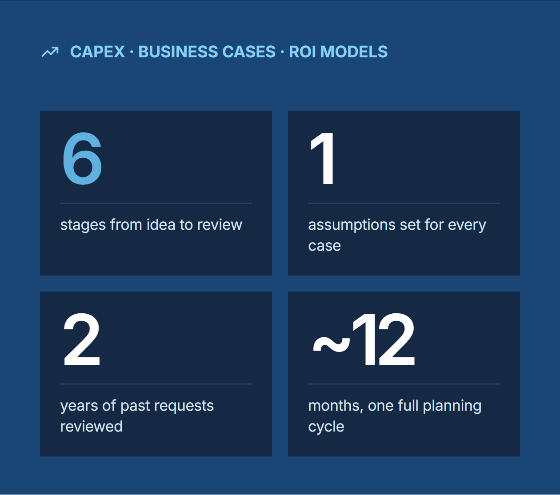
- 5 development options compared for each asset
- 1 agreed set of assumptions across the business
- ~8 months, aligned with the annual CAPEX approval cycle
Project at a glance
- Client
A US mining company operating several mine sites and processing plants, with each asset at a different stage of its life - Solution
An asset-by-asset business development case for every site, built on production capacity, market conditions and financial viability, supported by operational, financial and value models - Engagement
Business analysis and investment case development for the corporate development and finance teams, delivered remotely from Canada with site visits - Duration
About 8 months, aligned with the company's annual strategic planning and CAPEX approval cycle - Our role
Lead business analyst, working with corporate development, finance, mine planning, processing, maintenance, sales and marketing, site general managers and the executive team - Scope
Production assessments, capacity planning reviews, market and competitive analysis, development option analysis, financial and operational models, value models, stakeholder alignment and executive recommendations
The challenge
What problem was the client trying to solve?
The company had several assets with growth potential, but no consistent way to decide which ones to develop, how, and in what order.
- Every site with its own ideas
Each site proposed its own development ideas, such as expansions, debottlenecking or life extensions, with different levels of analysis behind them. - Plans built on nameplate capacity
Development proposals were often based on nameplate capacity rather than what the operation actually achieved. - Untested market assumptions
Market assumptions about demand, pricing and customers were not tested, so revenue forecasts were optimistic. - Three views of every asset
Operations, finance and sales each had their own view of what an asset could deliver, and these views did not agree. - Proposals sent back for more work
Executives found it hard to compare proposals across assets, and earlier CAPEX requests had been sent back for more work. - No long-term plan per asset
The company needed development plans for each asset that supported its long-term production and growth objectives.
Our business analysis approach
How did we approach the engagement?
We built every case from the ground up: first what the asset can really produce, then what the market will take, then what it is worth.
- Asset baseline
For each asset we gathered the mine plan, reserves and resources summary, historical production, processing throughput and recovery, maintenance records, cost data and current CAPEX commitments. We confirmed the baseline with site teams before any options were analyzed. - Production assessment
We compared nameplate capacity with actual performance across the value chain, from mining and haulage to crushing, processing and shipping. We identified the real bottleneck at each asset and the losses from downtime, rate and quality. - Capacity planning review
We reviewed how much additional output each asset could support through debottlenecking, equipment additions, plant upgrades or mine plan changes, and what each step would require in capital, people and time. - Market and competitive analysis
We analyzed demand trends, price outlooks, customer requirements, logistics constraints and competing supply in the company's target markets. This showed how much additional volume the market could absorb and at what realistic price. - Development options
For each asset we defined and compared options: continue as is, debottleneck, expand, extend mine life, or reposition the product. Each option had a scope, schedule, cost estimate, production profile and key risks. - Operational models
We built operational models linking mine production, fleet capacity, plant throughput, recovery and maintenance availability. These tested whether each option's production profile was achievable in practice. - Financial models
We built financial models for each option with CAPEX, operating costs, revenue, cash flow, NPV, IRR and payback. Sensitivity and scenario analysis covered price, volume, cost, recovery and schedule changes. - Value models
We created value models that combined financial returns with strategic and operational value, such as reduced reliance on one site, lower unit costs, extended asset life and improved customer supply security. - Cross-departmental alignment
We ran workshops with operations, finance, sales and corporate development to agree assumptions, preferred options and priorities before anything went to executives. - Executive recommendations
We prepared a business development case for each asset and a portfolio summary showing recommended options, sequencing, capital requirements and expected value. We presented these to the executive team and stakeholders ahead of CAPEX approval.
Solution
What did we deliver?
Area
Problem
What was delivered
Asset baselines
Inconsistent starting data across sites
Verified baseline for each asset covering production, capacity, costs and constraints
Production assessments
Plans based on nameplate capacity
Bottleneck analysis across the value chain, with realistic achievable capacity for each asset
Capacity plans
No clear view of how to grow output
Step-by-step capacity options with capital, timing and resource requirements
Market analysis
Untested revenue assumptions
Demand, price, customer and competitor analysis setting realistic volume and price assumptions
Development options
One idea per site, not compared
Option analysis for each asset comparing scope, cost, production, risk and value
Operational models
No check that plans were achievable
Models linking mining, fleet, processing and maintenance to test production profiles
Financial models
Different calculation methods by site
Standard financial models with NPV, IRR, payback, sensitivity and scenarios
Value models
Strategic benefits left unquantified
Value models combining financial return with strategic and operational benefits
Business development cases
Proposals sent back for more work
A complete case for each asset, aligned with long-term company objectives
Executive pack
Proposals hard to compare
Portfolio summary with recommended options, sequencing and capital plan
Governance
How did we keep the cases consistent and credible?
Executives approve cases they trust, so every number had to be traceable to its source and agreed by the people who own it.
- One assumptions book covered prices, exchange rates, discount rate, inflation and unit costs, owned by finance and used in every model.
- Production assumptions were signed off by site and processing leads, and market assumptions by sales and marketing.
- Each model had a source log and version history, so reviewers could follow any figure back to its data.
- Models were reviewed by a second analyst before release, with checks on formulas, links and totals.
- A decision log recorded which options were rejected and why, so the reasoning was available when executives asked.
Which BA techniques and tools did we use?
Techniques
- Stakeholder interviews and workshops
- Data analysis
- Bottleneck and capacity analysis
- Value chain analysis
- Market and competitive analysis
- Options analysis
- Operational modelling
- Financial modelling
- NPV and IRR analysis
- Sensitivity and scenario analysis
- Value modelling
- Decision logging
- Executive presentation
Tools
- Microsoft Excel
- Power BI
- PowerPoint
- Microsoft Visio
- SharePoint
Results
What were the results?
- 100% of CAPEX proposals approved by the executive team
- 5 development options compared for each asset
- 1 agreed set of assumptions across the business
- ~8 months, aligned with the annual CAPEX approval cycle
- 100% of CAPEX proposals approved by the executive team
- 1 agreed set of assumptions used by operations, finance, sales and corporate development
- A business development case for every mining asset, validated against production capacity, market conditions and financial viability.
- CAPEX initiatives aligned with the company's long-term production and growth objectives.
- Improved investment planning and resource allocation, with capital directed to the options with the strongest case.
- Operational models the company can reuse for future planning cycles.
- A clear development sequence across assets for the coming years.
“
Lessons learned
What can other resource companies learn from this project?
- Start from demonstrated capacity, not nameplate. Cases built on what the asset really does survive executive scrutiny.
- Find the true bottleneck before proposing growth. Spending on the wrong part of the value chain adds cost without adding output.
- Test volume against the market. Extra production is only valuable if customers will buy it at the assumed price.
- Compare options for every asset, including doing nothing. It shows executives the recommendation was chosen, not assumed.
- Get operations, finance and sales to agree the assumptions before the executive meeting. Not during it.
Which of your assets should you develop next?
Talk to a senior business analyst about development cases built on real capacity, tested market assumptions and models your executives will approve.
Business Development Cases for Mining Assets
Project Description
The engagement produced business development cases for the client's mining assets, each one tested against production capacity, market conditions, and financial viability. Every proposed CAPEX initiative was tied to the company's long-term objectives before it reached executives. Working with several departments, the team built the business cases and the operational models behind them, which strengthened investment planning and resource allocation. The CAPEX proposals were approved, and strategic goals and operational execution are now better aligned.
Delivered Value
- Built business development cases for each mining asset from production and market data
- Ran production assessments and capacity planning for the assets under review
- Analyzed market and competitive conditions to set the development strategy
- Developed financial and operational models for each proposal
- Produced value models that made the investment case for each CAPEX proposal
- Facilitated agreement across departments on one set of business goals
- Presented recommendations to executives and stakeholders ahead of CAPEX approval