
The Standard Behind the Role: The BABOK Guide for People Who Hire Business Analysts



Share the раgе:
The BABOK Guide is the reference standard for business analysis, published by the International Institute of Business Analysis. Almost everything written about it is exam preparation for analysts. This is the other version, for the person hiring one. The guide organizes the work into six knowledge areas, and a hiring manager can use them to decide which kind of analyst a project needs, write a job description that describes work rather than adjectives, and run an interview that tests for it. IIBA's own 2025 survey found 76% of practitioners reporting that business analysis plays a larger role in strategic decision-making, which is another way of saying the role has widened and the job title no longer tells you what you are getting. The knowledge areas do.
Introduction
Two job postings, both titled Senior Business Analyst. One wants someone to run discovery workshops with executives and write a business case. The other wants someone to specify API contracts and write acceptance criteria for a build team. The same candidate is unlikely to be strong at both, and the postings do not say which one they mean.
The BABOK Guide is the document that would have told both hiring managers what to ask for. It is sitting on the desk of every certified analyst they interview, and almost no hiring manager has read it.
What is the BABOK Guide?
The BABOK Guide, in full the Guide to the Business Analysis Body of Knowledge, is the reference standard published by the International Institute of Business Analysis that defines what business analysis is, what tasks it comprises, and what skills it requires. It is the basis for the CBAP and CCBA certifications and the closest thing the profession has to an agreed definition of the work.
Three things a hiring manager should know about it before anything else.
It is a description of the work, not a method. The guide does not tell an analyst how to run a project. It defines the tasks, their inputs and outputs, and the competencies behind them, in a way that applies whether the project is agile, waterfall, or a rescue. That is what makes it useful for hiring: it describes what the person will do, independent of your delivery method.
It is organized into six knowledge areas. Each one is a cluster of related tasks. A given project leans on some more than others, and a given analyst is stronger in some than others. Matching the two is the hiring decision.
It widens the role beyond requirements. IIBA's 2025 Global State of Business Analysis report, based on its annual survey of the profession, found that 76% of respondents see business analysis playing a larger role in strategic decision-making than before. The guide reflects that: two of the six areas are about strategy and evaluation, not specification. A hiring manager who thinks of the role as "the person who writes the requirements" is describing a third of it.
Key Takeaway: The guide describes the work, in six areas, independent of method. Use it to say which parts of the work you are hiring for.
Not sure which kind of analyst a project needs? Our BA Roles placements are scoped by knowledge area before a candidate is proposed. Book a free consultation.
What do the six knowledge areas mean on a real project?
Each area below is described in terms of what it looks like when it is happening on your project and what goes wrong when it is not. The descriptions are ours, not IIBA's, and a hiring manager does not need the formal definitions to use them.
Read the right-hand column as a diagnostic. If two or three of those signals describe a project you are running, the gap is a business analysis gap, and the row tells you which kind.
Most job descriptions ask for all six areas at senior level, which no single candidate delivers and which guarantees the interview tests for none of them. The useful move is to rank the areas for the project at hand and hire against the top two. ID Business Analysis Canada scopes every BA Roles placement with a role profile that ranks the six knowledge areas for the specific engagement, so that a client running a package selection is proposed a strategy analysis specialist and a client mid-build is proposed a requirements and design specialist, rather than both receiving the same "senior BA."
Key Takeaway: Six areas, ranked for your project, hire against the top two. A posting that asks for all six at senior level is asking for nobody in particular.
Which knowledge areas does your project need?
It depends on where the project is, and the answer changes as it moves.
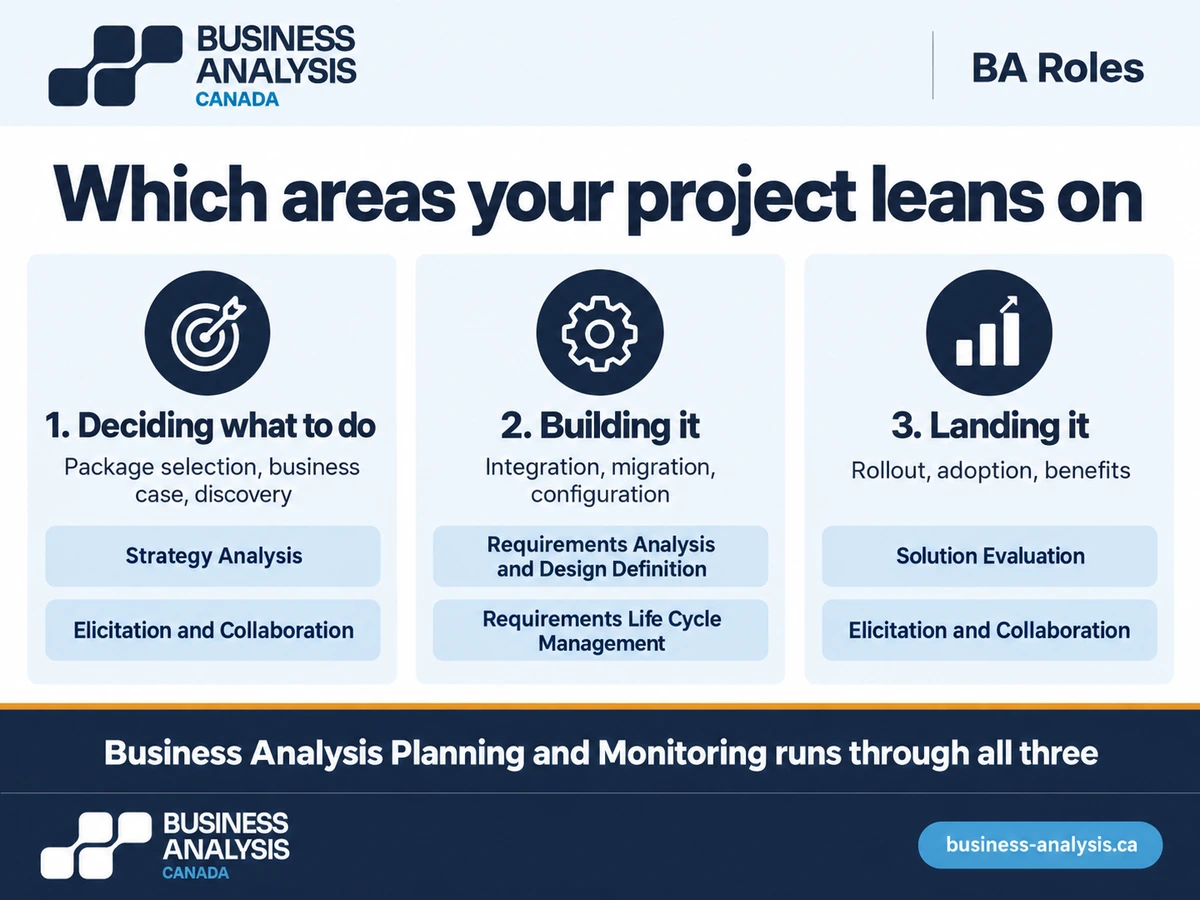
Three common shapes, and the areas each leans on:
- Deciding what to do. Package selection, business case, discovery, transformation scoping. Leans on Strategy Analysis and Elicitation and Collaboration. The analyst spends their time with executives and operations leaders, measuring the current state and comparing options. Specification skills matter less at this stage than the ability to run a room and write a defensible recommendation.
- Building it. Integration, migration, custom development, configuration of a selected platform. Leans on Requirements Analysis and Design Definition and Requirements Life Cycle Management. The analyst spends their time with developers, architects, and testers, producing specifications and holding traceability. This is where the technical business analyst lives.
- Landing it. Rollout, adoption, benefits realization, operational handover. Leans on Solution Evaluation and Elicitation and Collaboration again, now with end users. The analyst measures whether the thing works in practice and what to change. This is the phase most organizations do not staff at all.
Business Analysis Planning and Monitoring runs through all three, and it is the area most often assumed rather than checked. An analyst who cannot say how requirements will be approved and versioned on your project will produce good work that nobody can find.
Key Takeaway: Deciding, building, landing. Each phase leans on two areas. Hire for the phase you are in, or for the phase that is about to start.
How do you use the BABOK Guide to write a job description and interview?
Replace adjectives with knowledge areas, and replace competency questions with a task from each area you ranked.
For the job description, three changes:
- State which two or three knowledge areas the role leads on, in plain language. "Leads strategy analysis and elicitation for a platform selection" says more than "strong analytical and communication skills."
- Name the deliverables. Business case, options assessment, functional requirements document, interface specification, traceability matrix, benefits review. Candidates self-select accurately against a list of artifacts and inaccurately against a list of virtues.
- Say which phase the project is in. Analysts know the difference between joining a discovery and joining a build in month seven, and the good ones will tell you if they are wrong for it.
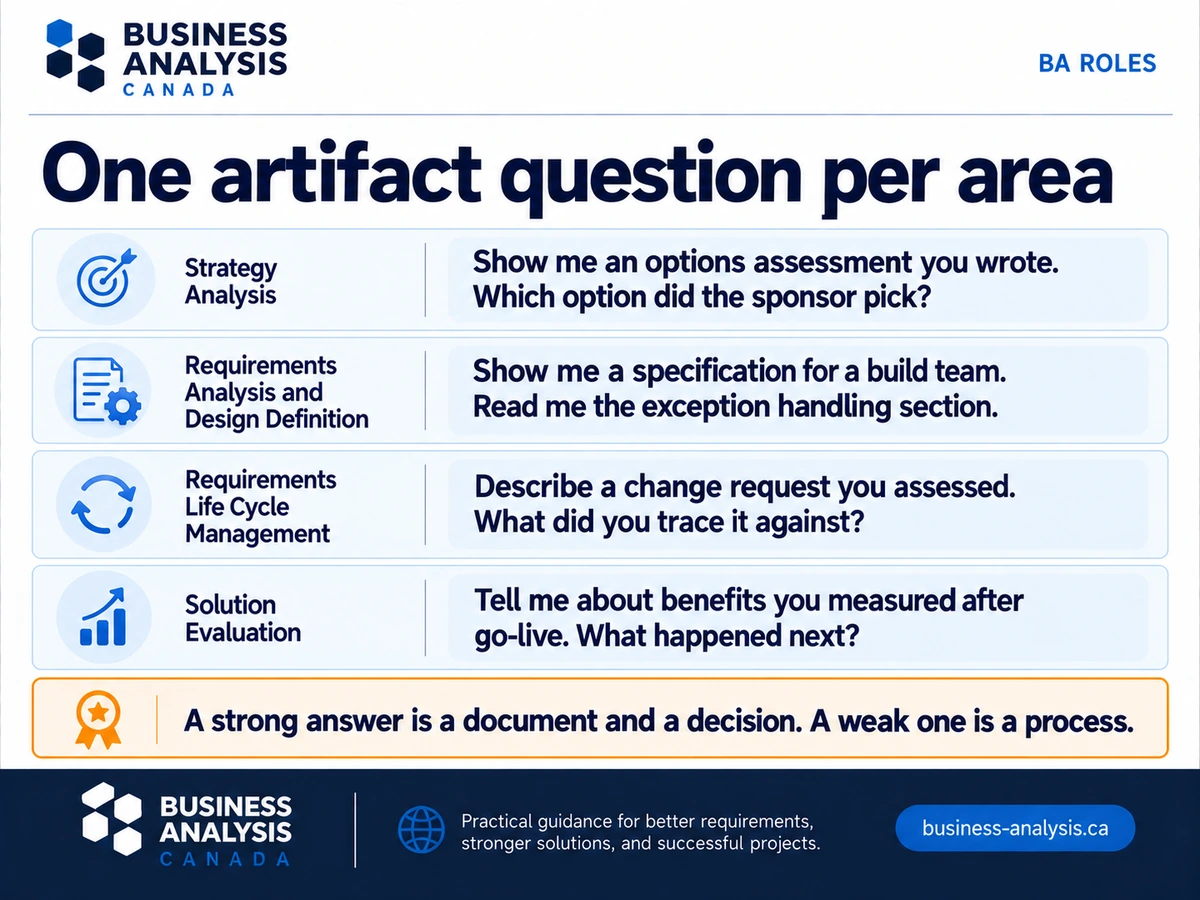
For the interview, one question per ranked area, each asking for an artifact the candidate produced and a decision it changed:
- Strategy Analysis. "Show me an options assessment you wrote. Which option did the sponsor pick, and was it the one you recommended?"
- Requirements Analysis and Design Definition. "Show me a specification you wrote for a build team. Read me the exception handling section."
- Requirements Life Cycle Management. "Describe a change request you assessed. What did you trace it against, and what did you tell the change board?"
- Solution Evaluation. "Tell me about a project where you measured benefits after go-live. What did you find, and what happened next?"
A candidate who is strong in an area answers with a specific document and a specific outcome. A candidate who is not answers with process.
Key Takeaway: One artifact-based question per knowledge area you ranked. The answer is a document and a decision, or it is a description of a process.
What does CBAP or CCBA tell you, and what does it not?
A CBAP tells you the holder has documented several years of business analysis experience across the knowledge areas and passed an exam on the guide. A CCBA tells you the same at an earlier career stage. Both are administered by IIBA, and both are legitimate signals of breadth and of the holder's investment in the profession.
What neither tells you:
- Domain fit. A CBAP earned in retail banking does not transfer automatically to a public sector ERP migration. Ask about the sector.
- Technical depth. The guide is method-neutral and technology-neutral by design. Whether the candidate can read an API specification or a data model is a separate question, and for a build-phase role it is the more important one.
- Which areas they are strong in. The credential covers all six. The candidate is strong in two or three. The interview questions above find out which.
Treat the credential as a filter that reduces the risk of hiring someone who does not know what the work is. Treat the interview as the test of whether they can do the part of it you need.
Key Takeaway: The credential proves breadth and commitment. It does not prove domain fit, technical depth, or which areas the person is strong in. Interview for those.
Frequently Asked Questions
Is the BABOK Guide the same as PMI-PBA?No. The BABOK Guide is IIBA's standard, and CBAP and CCBA are certifications against it. PMI-PBA is the Project Management Institute's business analysis certification, drawing on PMI's own business analysis guide. The two bodies of knowledge overlap heavily in content and differ in emphasis: PMI's frames business analysis within the project and program context, IIBA's treats it as a discipline in its own right. A candidate holding either has demonstrated the same core competence. Neither is the wrong choice for a hiring manager to look for.
How do we start using the BABOK Guide to hire a business analyst?Rank the six knowledge areas for the project you are staffing, name the top two, and rewrite the job description so it leads with those areas and the deliverables they produce. ID Business Analysis Canada does this as the first step of every BA Roles placement, producing a role profile that ranks the areas, lists the artifacts the role will own, and sets the interview questions, and it can produce the same profile for a role you intend to fill directly. The profile usually takes a day and removes most of the mismatch between what was posted and what was needed.
Do we need a certified business analyst?Not necessarily, and it depends on the phase. For strategy and discovery work, breadth across the knowledge areas matters and a credential is a reasonable filter. For a build-phase specification role, technical depth in your systems and a portfolio of specifications matter more than the credential, and some of the strongest technical analysts are not certified. Use the credential as one input to the shortlist, not as the gate.
Does the BABOK Guide apply to agile projects?Yes. The guide is written to be independent of delivery method, and IIBA publishes an agile extension that maps the knowledge areas onto agile practice. On an agile team the same six areas are present, usually distributed across a product owner, a business analyst, and the team, and often less visibly documented. The hiring question is the same: which areas does this team lack, and which artifacts, whether user stories with acceptance criteria or a lightweight options assessment, will the new person own.
Conclusion
The guide exists so that the profession can say what business analysis is. A hiring manager can use it for the narrower and more useful purpose of saying which business analysis a project needs, and then testing for it.
If you have a role to fill and the posting currently asks for all six knowledge areas at senior level, ID Business Analysis Canada's BA Roles practice will produce the ranked role profile, the artifact list, and the interview questions, and propose a candidate against them or hand the profile to your own recruiter. Book a free consultation and bring the posting.