
Where to Start: Digital Transformation Domains and the Plan That Sequences Them



Share the раgе:
Every consulting deck slices digital transformation into the same five domains: customer, operations, workforce, data, and technology. None of them says which one to start with, which is the only question a sponsor has. The answer is a sequencing rule rather than a domain: start where a decision is currently made badly, on bad information, and where a wrong first move can be undone. That usually points at a data or operations problem underneath a customer symptom, and it almost never points at technology first. This guide sets out the five domains in terms of the decisions each one changes, the dependencies between them, a four-question rule for choosing the first, and what a transformation plan looks like when it is a sequence rather than a list.
Introduction
The steering committee has agreed that the organization needs a digital transformation. Someone has produced a slide with five boxes on it. The boxes are labelled customer, operations, workforce, data, and technology, and each box has three or four initiatives inside it.
Then the room goes quiet, because the slide does not say which box goes first, and every executive in the room owns a different one.
That silence is the transformation plan. Everything after it is sequencing.
What are the digital transformation domains?
The domains are the areas of the organization in which transformation changes how decisions are made. Five appear in almost every model, and while the labels vary, the underlying set is stable.
- Customer. How the organization decides what to offer, to whom, at what price, through which channel, and how it responds when the customer acts. Transformation here moves those decisions closer to real-time and closer to the individual customer.
- Operations. How work flows, where it waits, who approves what, and how exceptions are handled. Transformation here removes waits, moves decisions to the point of work, and replaces manual reconciliation with designed flows.
- Workforce. How people are hired, deployed, developed, and managed, and how much of their day is spent on judgement versus transcription. Transformation here changes what the job is, not only which tool it uses.
- Data. What information decisions are made on, how current it is, who can see it, and whether two people looking at the same question see the same number. Transformation here is the precondition for most of the others.
- Technology. The platforms, integrations, and infrastructure that the other four run on. Transformation here is enabling, and it is the domain most often mistaken for the whole thing.
The definition post on this site set a test for whether a change counts as transformation at all: does it alter how a decision is made, who makes it, or the information it depends on. The domains are where you look for those decisions.
Key Takeaway: Five domains, one question in each: which decisions are made here, and which of them are made badly?
Sitting on a five-box slide with no sequence? Our Discovery & Strategy practice turns the boxes into an ordered plan. Book a free consultation.
Which domain should you start with?
The one where a decision is currently made badly on bad information, and where the first fix can be reversed if it is wrong. That is a rule, not a domain, and it produces a different answer in every organization.
Four questions, asked of every candidate initiative on the slide:
Run the whole slide through those four questions and a short list falls out. It is almost never the technology box, because technology initiatives rarely name a decision, and it is rarely the customer box first, because the customer problem usually turns out to sit on top of a data or operations problem that has to move first.
The pattern we see most often is a sponsor who wants to start with the customer domain, because that is where the pressure is, and an analysis that shows the customer decisions are being made on data three systems and two days old. Fixing the customer experience before the data means building a better interface onto the same wrong numbers. ID Business Analysis Canada runs a Discovery Sprint to settle exactly this question before any initiative is funded, with a business analyst tracing each candidate on the slide back to the decision it changes and the data that decision depends on, so the first move lands on the dependency rather than the symptom.
Key Takeaway: Start where a decision is bad, the information is worse, and the first move can be undone. It is usually one layer below where the pressure is.
How do the domains depend on each other?
In a fairly consistent order, which is why the plan is a sequence and not a portfolio.
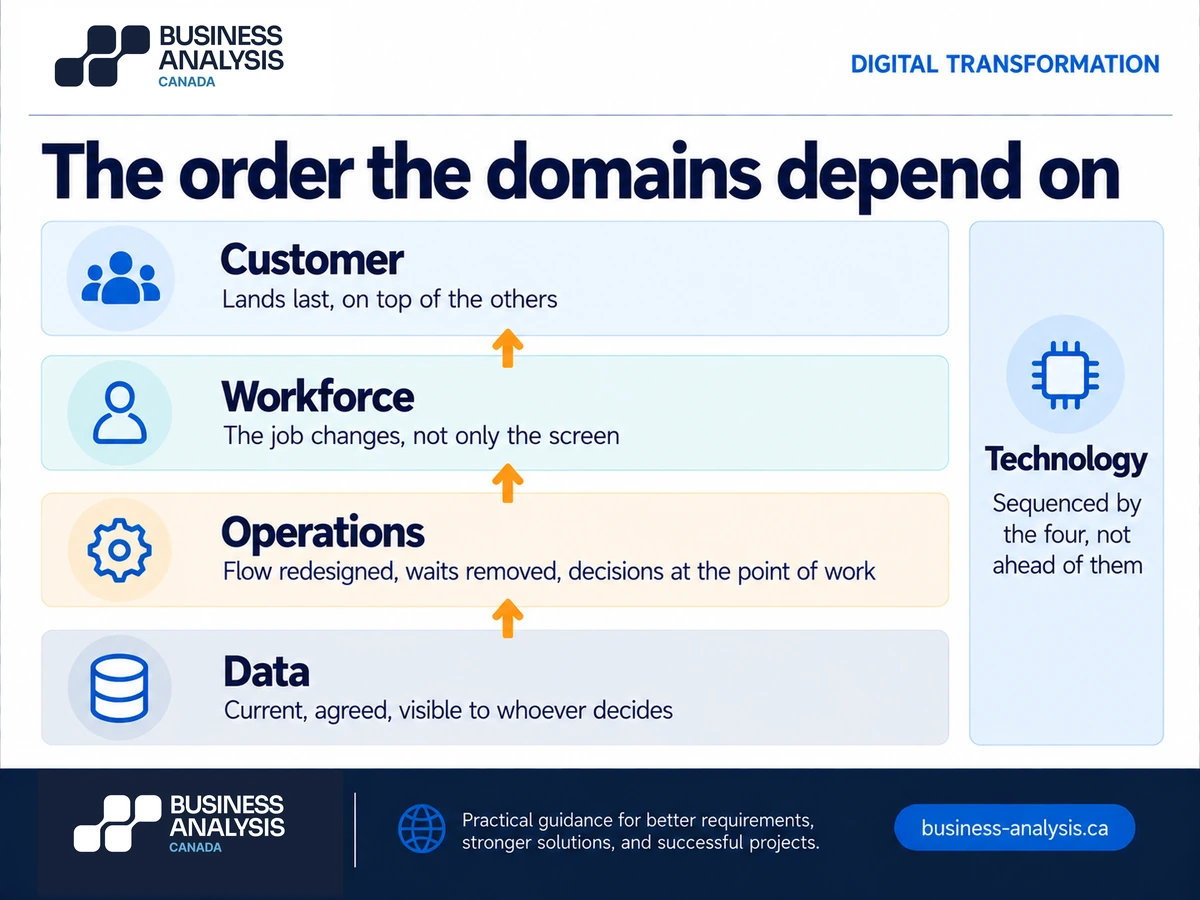
- Data comes before customer and operations. A decision moved closer to the customer or the point of work is only better if the information it uses is current and agreed. Most customer and operations initiatives have a data prerequisite that was not on the original slide.
- Operations comes before workforce. Changing what a job is only holds if the flow of work has been redesigned around it. A workforce initiative on top of an unchanged process produces retraining for the same job with a new screen.
- Technology supports all four, and is sequenced by them. The platform decision should follow from which decisions are changing and what data they need, not precede it. When technology goes first, the organization gets a platform and then looks for a transformation to justify it.
- Customer is usually last to land, not first to start. The visible change the sponsor wants arrives once the data and operations changes beneath it are stable. Starting there produces a launch that looks like progress and a set of downstream fixes that do not.
Two initiatives can run in parallel when neither depends on the other. Three usually cannot, because the shared dependency is nearly always data, and one data initiative cannot serve three consumers at once without becoming the bottleneck for all of them.
Key Takeaway: Data first, then operations, then workforce, with technology sequenced by the others and customer landing last. Parallel only where there is no shared dependency.
What does a transformation plan look like as a sequence?
Three to five initiatives in order, each with a decision it changes, a domain it lands in, a dependency it clears, and a point at which it is done.
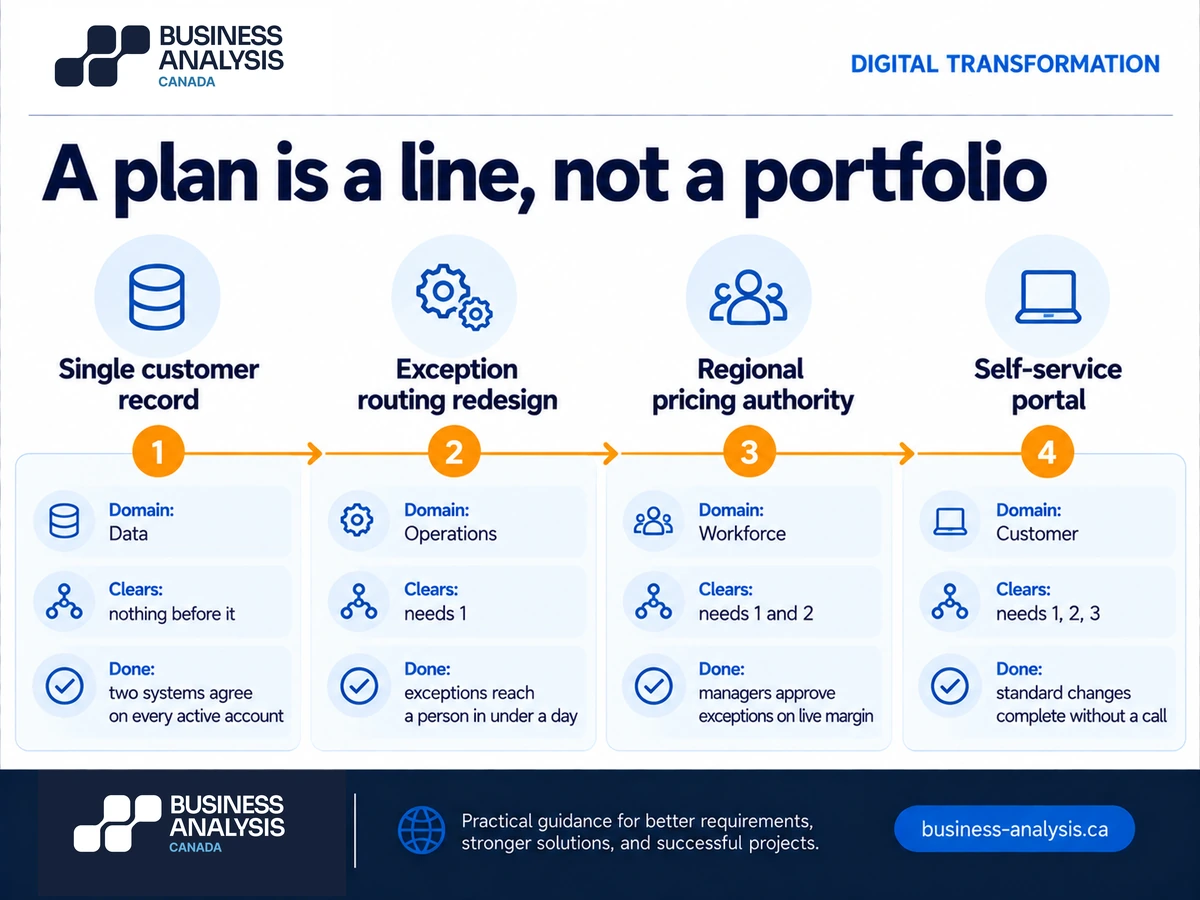
A plan of that shape fits on one page. It replaces the five-box slide with a line, and every executive who owned a box can see where their box sits on the line and why.
Two attributes make it hold up in a steering committee:
- Each initiative has a done condition stated as a changed decision. "The regional manager approves pricing exceptions from live margin data rather than the monthly report" is done or not done. "Data platform phase two" is neither.
- Each dependency is named and owned. If the operations initiative waits on the data initiative, the plan says so, says who owns the handover, and says what date the second one is blocked past if the first one slips.
The plan will change. Sequences get reordered as the first initiative reveals what the second one needs. That is the plan working, and a plan written as a sequence can absorb it. A plan written as a portfolio of parallel boxes cannot, because nothing in it says what waits on what.
Key Takeaway: One page, three to five initiatives in order, a changed decision as the done condition for each, and every dependency named.
Where do HR and IT transformation fit?
Both are domains with a specific trap, and both get named on the slide more often than they get sequenced correctly.
HR digital transformation sits in the workforce domain, and the trap is treating it as an HR systems project. Replacing the HRIS changes how HR administers people. Transformation changes how managers decide about people: who to hire, who to develop, where to deploy capacity, on what information. If the initiative does not name a manager decision, it is a systems upgrade in the HR department, and it should be scoped and funded as one.
IT digital transformation sits in the technology domain, and the trap is the inverse. IT is asked to lead the transformation because it owns the technology, and the result is a platform-first sequence in which the decisions that were supposed to change never get named. IT's role in the sequence is to provide the platform the other domains need, at the point they need it. The decisions belong to the business owners in the other four domains.
On trends: the technologies being adopted this year, whether AI agents, low-code platforms, or unified data layers, change the options in the technology domain and do not change the sequencing rule. On adoption: the pace at which an organization can absorb change is set by the workforce and operations domains, and accelerating a transformation past that pace produces the customer-first failure described above, faster.
Key Takeaway: HR transformation needs a manager decision underneath it. IT transformation is the platform, not the plan. Neither goes first on its own.
Frequently Asked Questions
What is the difference between a digital transformation plan and a digital transformation strategy?The strategy says why the organization is transforming and what it will look like when done: the target operating model, the decisions that will be made differently, and the value expected. The plan is the sequence of initiatives that gets there, with dependencies and done conditions. Organizations often have a strategy and a portfolio of initiatives, and no plan, because nobody has sequenced the portfolio. The plan is the missing middle.
How do we start sequencing our digital transformation initiatives?Take the current list, and for each item name the decision it changes, the information that decision depends on, whether the first move can be reversed, and what else on the list waits on it. ID Business Analysis Canada does this as a Discovery Sprint, with a business analyst producing the dependency map across the five domains and a one-page sequenced plan with a done condition for each initiative, in a fixed timebox before any of them is funded. The output is usually shorter than the input, because several items turn out to be the same dependency.
Should technology be chosen before or after the domains are sequenced?After. The platform decision depends on which decisions are changing and what data they need, and both come from the sequence. Choosing the platform first means the sequence is reverse-engineered to justify it, and the initiatives that do not fit the platform quietly disappear from the plan. Where a technology decision is genuinely urgent, such as a platform reaching end of support, treat it as a constraint the sequence has to respect, not as the first initiative.
How long should the first initiative take?Long enough to change one decision and prove it, and no longer. A first initiative that runs for eighteen months before anything is different has been scoped as a programme rather than a first move. The point of the reversibility question is that the first initiative is small enough to be wrong cheaply, which usually means one decision, one unit, and a result inside two quarters.
Conclusion
The five boxes are not wrong. They are unordered, and an unordered transformation is a portfolio of parallel projects sharing the same data dependency and blaming each other for the delay.
If your transformation plan is currently a slide with five domains and no line through them, ID Business Analysis Canada's Discovery & Strategy practice runs the Discovery Sprint that produces the sequence, the dependency map, and the done condition for each initiative, in a fixed timebox before any of them is funded. Book a free consultation and bring the slide.