
Follow the Money: Revenue Leakage Examples and the Process Gaps Behind Them



Share the раgе:
Revenue leakage is money the organization earned and never collected, and every article on it lists the same causes: unbilled work, unapplied contract terms, discounts nobody approved, failed payments nobody chased. Useful, and it stops at the symptom. Each leak is a decision a person or a system made without the rule or the information it needed, and each has a specific report that would have caught it. This guide gives six worked examples from finance, professional services, and e-commerce, traces each one to the process gap behind it, and names the reconciliation that finds it, so a reader can go and look for the same leak in their own numbers this week.
Introduction
The finance director knew the number was wrong. Revenue was up, margin was flat, and nobody could explain the gap without a meeting. Three weeks and one reconciliation later, the gap had a name: 214 active contracts with a year-two price escalator that the billing system had never applied, because the escalator lived in a PDF and the billing system lived in a database, and nobody's job was to move it from one to the other.
That is what revenue leakage looks like from the inside. Not fraud, not a bug. A process with a gap in it, and money falling through the gap at the same rate every month.
What is revenue leakage?
Revenue leakage is revenue the organization has earned or is contractually entitled to and does not collect, because of a gap between what was agreed, what was delivered, what was invoiced, and what was paid. It is distinct from churn, which is a customer deciding to leave, and from bad debt, which is a customer who was invoiced correctly and did not pay. Leakage is the money that was never asked for.
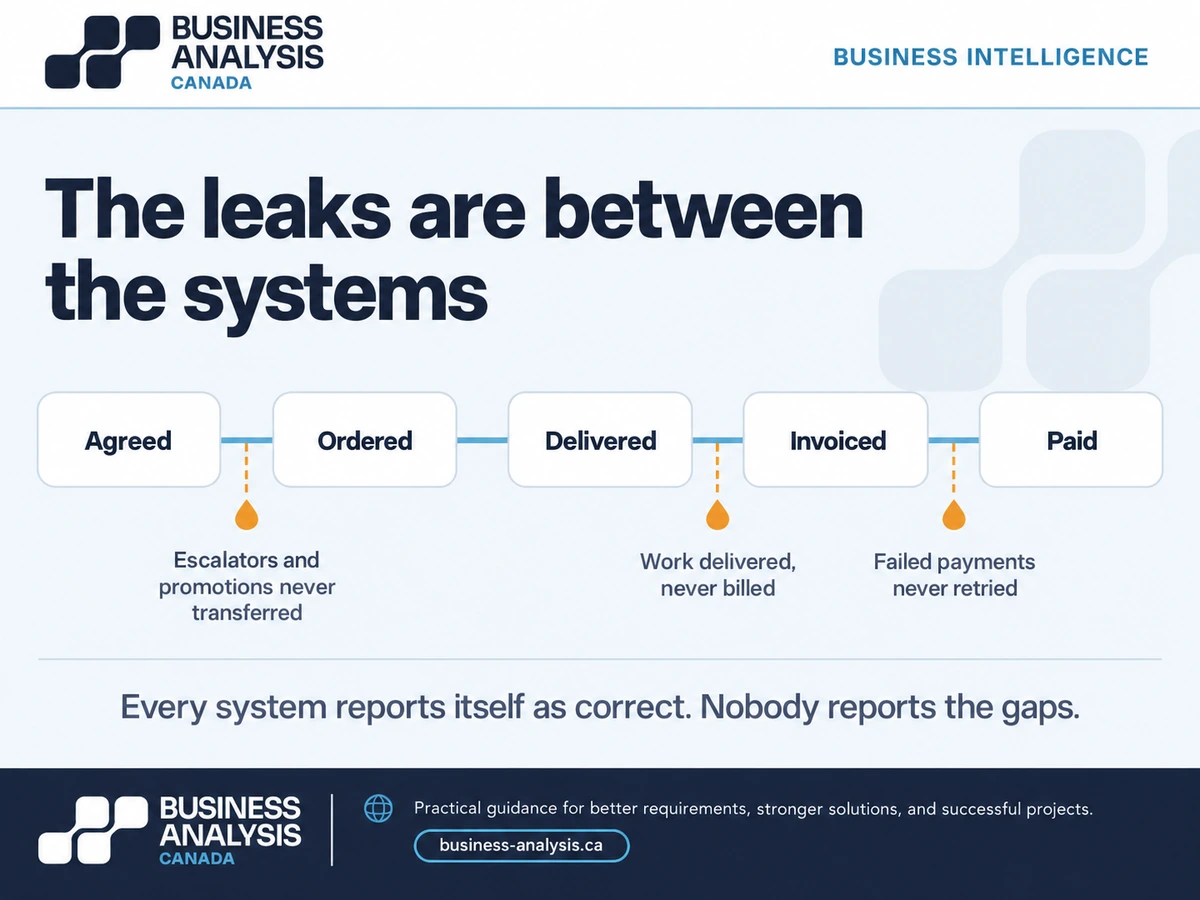
It is hard to see for a structural reason. Every system in the order-to-cash chain reports itself as correct. The CRM shows the deal at the right price. The delivery system shows the work done. The billing system shows every invoice issued. The gaps are between the systems, and no single system reports on the gaps.
That is why the useful unit of analysis is not the cause but the reconciliation. Every leak in the examples below is found by comparing two things that should match and do not.
Key Takeaway: Leakage lives between systems, not inside them. Every leak is found by a reconciliation that nobody currently runs.
Suspect the margin gap has a name? Our Business Intelligence practice builds the reconciliations that find it. Book a free consultation.
Six revenue leakage examples, and the gap behind each
Each row names the leak, the process gap that produces it, and the reconciliation that catches it.
Read the middle column again. Not one of the six gaps is a technology failure. Each is a place where a piece of information the process needed was in a different system, a different document, or a different person's head from the step that needed it. That is a process design gap, and process design gaps do not fix themselves with a new billing platform. They come across intact.
The right-hand column is the deliverable. Six reconciliations, each comparing two datasets that already exist. None of them needs new data. All of them need someone to decide that comparing the two is a job.
Most organizations know two or three of these leaks exist and have not sized them, because sizing requires the reconciliation and the reconciliation has no owner. ID Business Analysis Canada runs a Benefits Audit that starts with exactly these six comparisons, with a business analyst mapping the order-to-cash flow to find where each piece of commercial information is held and where it is needed, sizing each gap from the client's own transactions over the prior twelve months, and handing back a ranked list of leaks with the reconciliation specification for each.
Key Takeaway: Six leaks, six gaps, six reconciliations. None needs new data. All need an owner.
Three examples in detail
The table gives the shape. Three of the six are worth walking through, because they are the ones we find most often and the ones whose mechanism is least obvious from the outside.
Contract escalators. A three-year services agreement includes a 3% annual uplift. The uplift is in clause 7.2. The billing system was set up from the deal record in the CRM, which recorded the year-one price, and the CRM has no field for escalators. In year two, nothing changes, because nothing was told to. The account manager does not notice because the customer is paying on time. The customer does not mention it. The leak runs for the remaining two years and is discovered, if at all, at renewal, when finance prices the new agreement from the wrong baseline and compounds the loss. The gap is a field that does not exist and a handover that nobody owns.
Delivered work never invoiced. A professional services team logs hours in a time system. Invoicing is triggered monthly by a project manager who reviews the hours and marks them billable. Hours logged after the review, hours on a project the manager does not own, and hours coded to a task nobody mapped to a billing line stay in the time system as recorded and never become an invoice. The gap is a review step that is manual, monthly, and scoped to what the reviewer can see. The reconciliation, delivered hours against invoiced hours per project per month, is a single query, and in our experience it is the one that produces the largest number the first time it runs.
Failed payments. An e-commerce subscription business processes renewals on a card. A declined transaction produces an error in the payment gateway and nothing else. There is no retry, no email, no flag on the account, because the checkout process was designed for a customer at a keyboard who would try another card, and renewals have no customer at a keyboard. The subscription stays active for the grace period and then lapses as churn, which is how it appears in the reporting, so nobody calls it leakage. The gap is a process designed for one context and reused in another.
Key Takeaway: The escalator is a missing field, the unbilled hours are a manual review with a blind spot, the failed payment is a checkout process reused where no customer is present. Different mechanisms, same category: information the step needed was not where the step was.
Which reconciliations should you build first?
The three that compare what was agreed, what was delivered, and what was paid against what was invoiced, in that order.
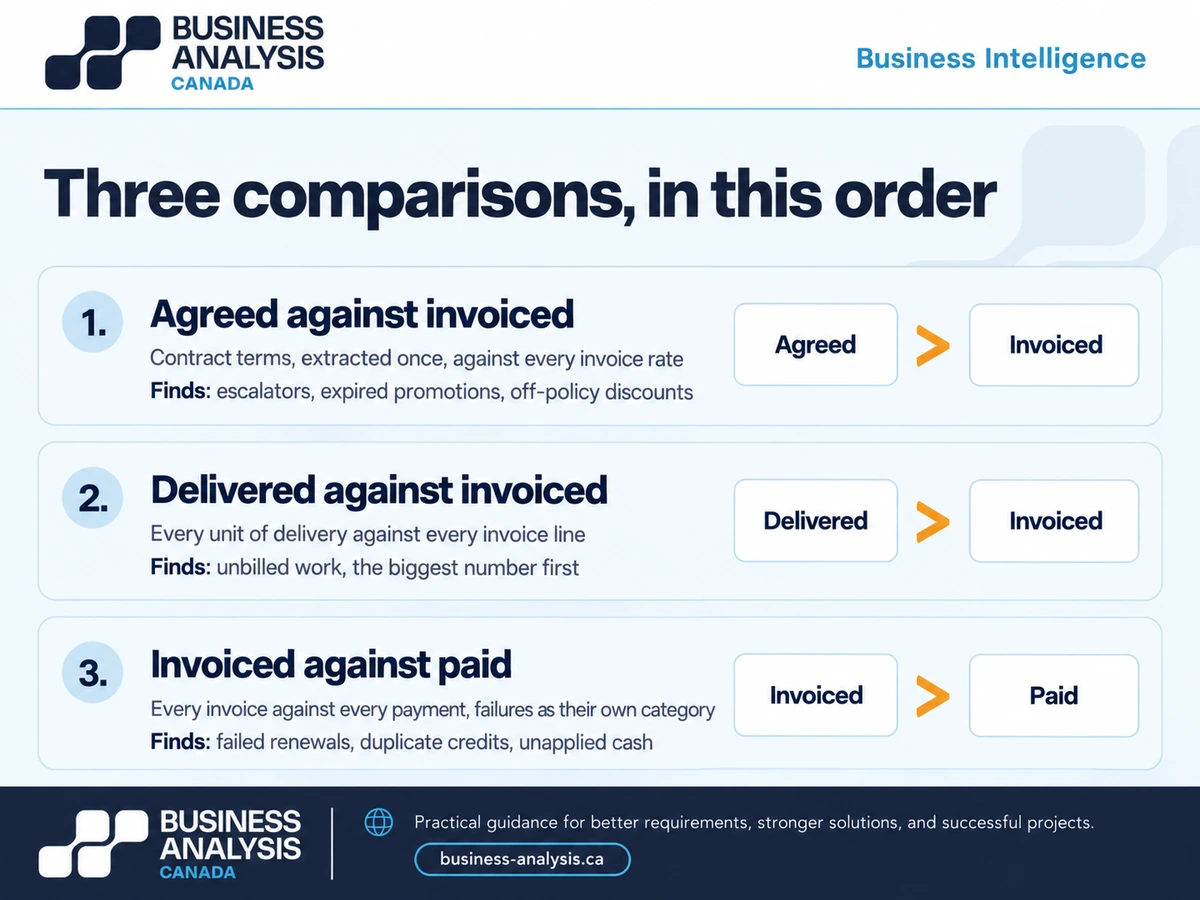
- Agreed against invoiced. Every active contract's commercial terms, extracted once into a structured table, compared to the rate on every invoice. Finds escalators, expired promotions, and discounts outside policy in one pass. This is the reconciliation most organizations have never run, because the contract terms have never been extracted.
- Delivered against invoiced. Every unit of delivery the organization records, compared to every invoice line. Finds unbilled work in every form. This is the one that returns the biggest number first.
- Invoiced against paid. Every invoice compared to every payment, with failed and partial payments as their own category rather than as ageing debt. Finds failed renewals, duplicate credits, and unapplied cash.
Build them in that order because the first one requires the most preparation and produces the most durable fix, the second produces the fastest recovery, and the third is usually partially in place already as an ageing report and needs only to be recut.
Each reconciliation, once built, is a report that runs monthly. The leak it found is then a control rather than a discovery, and the next question is whether the process gap gets closed or the report simply catches the leak every month. Closing the gap is cheaper. The report tells you where.
Key Takeaway: Agreed against invoiced, delivered against invoiced, invoiced against paid. Three comparisons, in that order, each becoming a monthly control.
Frequently Asked Questions
What is the difference between revenue leakage and churn?Churn is a customer's decision to stop buying. Leakage is money from a customer who is still buying, and still intends to pay, that the organization never invoiced or never collected because of a gap in its own process. The two get confused in subscription businesses because a failed renewal payment that nobody retries appears in the reporting as churn. Reclassifying those cases is often the first finding of a leakage audit and the one that changes the retention numbers.
How do we start finding revenue leakage in our own organization?Pick one of the three reconciliations, usually delivered against invoiced because it needs the least preparation, and run it for one month of data. The result will either be a number or a discovery that the two datasets cannot be joined, and the second is itself the finding: the process gap is that delivery and invoicing do not share a key. ID Business Analysis Canada runs this as the first two weeks of a Benefits Audit, with a business analyst mapping where each piece of commercial information sits across the order-to-cash systems, running the three reconciliations on twelve months of transactions, and returning a sized, ranked list of leaks with the specification for the monthly control that closes each one. The escalator finding alone usually covers the engagement.
Is revenue leakage a finance problem or a process problem?It is found by finance and caused by process. The leak appears in the numbers, and finance is usually the first to suspect it from a margin that does not move with revenue. The cause is a handover between systems or teams where a piece of commercial information did not travel, and that is process design. Fixing it means changing the handover, not adding a step to month-end close. Treating it as a finance problem produces a reconciliation that catches the leak every month. Treating it as a process problem closes the gap.
Does a new billing system fix revenue leakage?Not on its own, and it often carries the leaks across. A billing platform enforces the rules it is configured with, and if the contract escalator was never in a structured field before, it will not be in one after migration unless someone extracts it during the move. The migration is a good moment to close the gaps, because the terms have to be handled anyway. It is not a fix in itself, and vendor demos rarely mention the extraction work.
Conclusion
Two hundred and fourteen contracts with an escalator in a PDF. A time system full of hours that never met an invoice. Renewals declining in silence and appearing as churn. None of it was hidden. It was between the systems, where no report looked.
If your margin is not moving with your revenue and nobody can say why without a meeting, ID Business Analysis Canada's Business Intelligence practice runs the three reconciliations on your own transactions as a Benefits Audit and returns the leaks sized and ranked, with the monthly control specified for each. Book a free consultation and bring the margin report.