Mediroyal: Website and E-Commerce for an Orthoses and Rehabilitation Brand
How Business Analysis Canada specified, built and maintained Mediroyal's website and e-commerce, from catalogue and product pages to clinic and buyer orders.
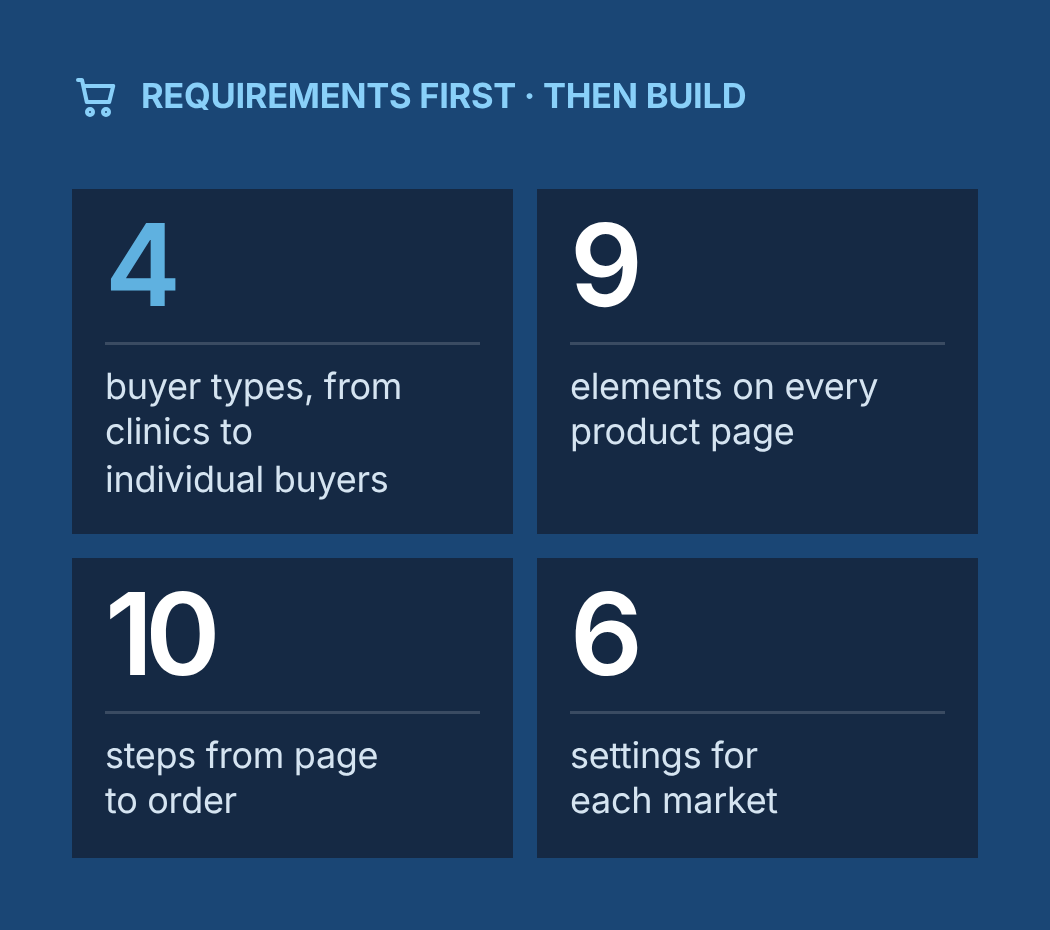
- 4 buyer types, from clinics to individual buyers
- 9 elements every product page had to show
- 10 steps specified from product page to order
- 6 settings defined for each market
Project at a glance
- Client
Mediroyal, a leading brand in orthoses and rehabilitation products, selling from Sweden into international markets - Scope
The website and e-commerce: catalogue, product pages, and the path from a clinic or a buyer to an order that reaches the team processing it - Buyers
Clinics and healthcare professionals, retailers and distributors, and individual buyers in markets served directly - Engagement
Requirements first, then build. Pages, catalogue and checkout were specified before they were changed, then built and maintained as live jobs. - Our role
Business analysis under the delivery work, website and e-commerce development, and fixes and changes handled by the same team - Confidentiality
Scope and commercial terms stay under NDA. This case study does not name the technology stack and does not quote conversion figures.
The challenge
What problem was the client trying to solve?
What problem was the brand trying to solve?
The site presented the range well, but it was not built to sell it. Buyers had to leave the site, or pick up the phone, to get from interest to an order.
- Product information spread out
Product information was spread across pages and downloadable brochures, so buyers could not compare supports easily. - Inconsistent product details
Choosing the right support depends on details such as body area, indication, support level, size and side, and these were not shown consistently. - Clinics buy differently
Clinics often ordered several sizes of the same product, reordered stock regularly, and expected trade prices and invoices. - Orders typed by hand
Orders arrived by email, phone and order forms, and were typed by hand into order handling, which led to wrong sizes and wrong sides. - International buyers and distributors
International buyers needed their language, currency, prices, VAT treatment and delivery options, and some countries were served through local distributors. - Medical device content rules
As medical devices, the products came with instructions for use and limits on what could be claimed about them, which the pages had to respect.
Our business analysis approach
How did we approach the engagement?
How did analysis sit under the work?
The analysis was part of the delivery, not a separate study. Each part of the site was specified before it was changed.
- Buyer elicitation
We interviewed sales, customer service and regulatory contacts, and spoke with a sample of clinics, retailers and distributors. We reviewed order emails, order forms and the most common reasons for returns and exchanges. - Buyer types and journeys
We mapped how each type of buyer finds a support, checks that it fits, orders it and reorders it. - Product information requirements
We defined what a buyer needs to see on a support before ordering, and in what order. - Catalogue structure
We defined categories by body area, filters by indication and support level, and the variant model for size, side and colour. - Cart and checkout requirements
We specified how a product moves into the cart, which choices must be made first, and how trade and individual buyers pay. - Order handover
We specified what an order contains when it reaches the team processing it, what confirmation the buyer receives, and which orders need a manual check. - Market settings
We defined language, currency, prices, VAT treatment and delivery options for each market, and how distributor countries are handled. - Regulatory content
We agreed with regulatory contacts which claims, warnings and documents each product page must show. - Acceptance criteria
Each requirement had acceptance criteria, and together they formed the baseline for the build and for later changes.
Buyers
Who was the site for?
Clinic professional
What they need
The right support for a patient, in the right size and side
What the site had to do
Show indications, support level and a clear size guide, with instructions for use on hand
Clinic purchaser
What they need
Regular stock in several sizes, at trade prices
What the site had to do
Offer trade accounts, quick reorder from order history, and payment by invoice
Retailer or distributor
What they need
Larger orders across the range, with product information to pass on
What the site had to do
Support bulk ordering by variant, and give access to product data and images
Individual buyer
What they need
A support for a specific need, with guidance on fit
What the site had to do
Explain the product in plain language, guide sizing, and offer card payment
Product pages
What did a buyer need to see on a support?
Body area and indication
Buyers start from the problem they are treating, not from the product name
Support level
Distinguishes light support from firmer stabilizing products in the same category
Size guide with measuring points
Wrong sizes were the most common reason for exchanges
Side and variants
Many supports come in left and right versions, and the cart had to make the choice clear
Materials and care
Clinics and buyers check materials for skin contact and washing
Instructions for use
Available as downloads in the buyer's language
Warnings and contraindications
Shown on the page, worded as agreed with regulatory contacts
Related products
Alternatives with more or less support, and accessories
Stock and delivery time
Shown for each variant, so buyers know when an order will arrive
Ordering path
How did a product move from the page to an order?
Variant selection
Size and side, where relevant, must be chosen before a product can be added to the cart
Quantities
Clinics can add several sizes of the same product in one step
Cart
The cart shows each variant clearly, with size and side on every line
Trade accounts
Approved clinics, retailers and distributors see trade prices and can pay by invoice
Individual buyers
Card payment, with delivery options and costs shown before payment
VAT
VAT applied by market and buyer type, including business buyers in other EU countries with a validated VAT number, as agreed with finance
Shipping outside the EU
Orders priced and documented for export, with the customs details the team needs
Order handover
Each order reaches the order team with buyer type, account, variants, delivery and payment details complete
Manual checks
Orders with an unvalidated VAT number or an unusual delivery address go to a review queue before processing
Confirmation
The buyer receives an order confirmation, and later dispatch and delivery updates
International markets
How were international markets handled?
Language
Product content, size guides and instructions for use in the market's language
Currency and prices
Price lists by currency, with separate trade and retail prices
VAT and invoicing
VAT treatment by buyer type and destination, and the invoice details each market needs
Delivery
Delivery options, costs and expected delivery times
Distributor countries
Product pages without checkout, with a "where to buy" route to the local distributor
Legal texts
Terms of sale, privacy information and returns rules for the market
Acceptance criteria
What did the acceptance criteria look like?
Size and side required
- Given a support is sold in sizes and in left and right versions
- When a buyer tries to add it to the cart without choosing both
- Then the product is not added
- And the buyer is shown which choice is missing
Trade account invoice payment
- Given a clinic has an approved trade account
- When they check out
- Then trade prices are applied
- And payment by invoice is offered
Business buyer in another EU country
- Given a business buyer in another EU country enters a VAT number
- When the number is validated successfully
- Then VAT is applied under the rules agreed with finance
- And the VAT number appears on the order and the invoice
Distributor country
- Given a buyer is browsing from a country served by a distributor
- When they open a product page
- Then checkout is not offered
- And the page shows how to buy through the local distributor
Order handover
- Given an order has been placed and paid, or approved for invoice
- When it reaches the order team
- Then it includes the buyer type, account, every variant with size and side, and the delivery details
Live jobs
How did the website and e-commerce run as live jobs?
Once the pages, catalogue and checkout were built, the work continued as live jobs, handled by the same team and checked against the baseline whenever one existed.
- Fixes, such as a variant missing from the size selector, checked against the catalogue and variant requirements.
- Catalogue updates: new products, retired products and updated size guides, checked against the product information requirements.
- Page changes, such as new landing pages for product ranges or seasonal campaigns, checked against the page templates and content rules.
- Checkout changes, such as a new delivery option or a change to invoice payment rules, checked against the cart, checkout and order handover requirements.
- Market changes, such as adding a market or moving a country to a distributor, checked against the market settings.
- Regulatory updates, such as new instructions for use or revised warnings, checked against the agreed regulatory content.
- Where an older part of the site had no written baseline, we agreed the expected behaviour first, recorded it, and then made the change.
Which BA techniques and tools did we use?
Techniques
- Stakeholder interviews
- Buyer research
- Order and returns analysis
- Journey mapping
- Product information requirements
- Catalogue and variant modelling
- Business rules analysis
- Checkout and order handover requirements
- Market configuration requirements
- Given/When/Then acceptance criteria
- Impact analysis
- Change control
Tools
- Jira
- Confluence
- Figma
- Miro
- Microsoft Excel
Results
What were the results?
- 4 buyer types, from clinics to individual buyers
- 9 elements every product page had to show
- 10 steps specified from product page to order
- 6 settings defined for each market
A website that sells the range, not just presents it.
Orders reaching the team complete, without being typed in by hand from emails and forms.
- Product pages that show buyers what they need to choose a support, including size, side and instructions for use.
- One ordering path for clinics, retailers, distributors and individual buyers, with trade accounts and invoice payment.
- Market settings for language, currency, VAT, delivery and distributor countries.
- Fixes and changes handled by the same team that built the site, checked against the agreed baseline.
- Product claims and documents aligned with what regulatory contacts approved.
“
Lessons learned
What can other medical device brands learn from this project?
- Start product pages from the buyer's problem. Clinics look for the body area and indication first, not the product name.
- Treat size and side as requirements, not design details. Most exchanges come from the wrong variant.
- Design separate paths for trade and individual buyers within the same shop. Clinics and consumers buy in different ways.
- Specify the order handover as carefully as the checkout. An order is not finished until the team can process it without retyping it.
- Agree regulatory wording before pages go live. Medical device claims are easier to get right in requirements than to correct later.
Selling to clinics and individual buyers online?
Talk to a senior business analyst about product pages, checkout and order handover, specified before anything is built.
Mediroyal: Website and E-Commerce for an Orthoses and Rehabilitation Brand