
Adoption Is a Requirement: Change Management for Digital Transformation



Share the раgе:
Change management for digital transformation usually arrives at go-live as a communications plan and a training deck. By then, every decision that determines whether people adopt the new way of working was made months earlier, in design, without anyone writing down what the operations teams would have to do differently. The fix is to treat adoption as a requirement: specified alongside the functional ones, with acceptance criteria, a business owner, and a test before cutover. PMI's 2026 Pulse of the Profession found that four in five complex projects experience some fallout from poorly managed complexity, including strategic drift and diminished value, which is what unadopted change looks like from the outside. This guide covers what an adoption requirement contains, where it gets written, who owns it, and how you know it passed.
Introduction
The system went live on schedule. Training was delivered to 94% of users. The comms plan hit every milestone. Six months later, the regional teams are running the old spreadsheet in parallel and keying the results into the new platform on Friday afternoons, and the benefits case is quietly being rebased.
Nobody skipped change management. It was on the plan, staffed, and executed. It was also the wrong kind, because it was designed to help people accept a solution they had no part in shaping, and the solution required them to work in a way nobody had specified.
What is change management for digital transformation?
Change management for digital transformation is the work of making sure the people whose decisions and daily work will change are able and willing to make that change, so that the benefits in the business case arrive. It covers who will work differently, what exactly they will do differently, what they need in order to do it, and how the organization will know it has happened.
The definition post on this site argued that transformation is a change to how a decision is made, who makes it, or the information behind it. Change management is the discipline that makes sure the new decision gets made by the new person on the new information, after the launch party.
Where the discipline goes wrong is scope. Most change management practice is downstream: it starts once the solution is designed and works to reduce resistance to it. That is sometimes necessary and never sufficient. If the design requires a regional manager to approve exceptions from a screen she has no time to open, no amount of communication will make her open it. The adoption problem was created in design and can only be fixed there.
PMI's 2026 Pulse of the Profession, based on 2,023 project professionals and 511 senior leaders across 35 countries, found that four in five complex projects experience some fallout from poorly managed complexity, in forms that are not immediately visible: strategic drift, diminished value, and teams slowly burning out.<sup>[1]</sup> Diminished value on a transformation is the polite name for a system that shipped and a way of working that did not.
Key Takeaway: Change management that starts at go-live is managing the consequences of decisions made in design. Move it upstream, into the requirements.
Running a programme where the comms plan is done and adoption is not? Our Change & Adoption practice writes the adoption requirements before cutover. Book a free consultation.
What does an adoption requirement look like?
Like a functional requirement, with the same discipline: a statement of what must be true, an owner, acceptance criteria, and a test. The difference is that the subject is a person's behaviour rather than a system's.
Read the "what it depends on" row. Three of the four dependencies are not system features. They are operating model decisions: a time slot, the closure of the old path, and a device. None of them appears in a functional specification, all of them determine whether the requirement passes, and if they are not written down in the requirements phase they get discovered by the training team a week before go-live, when it is too late to change any of them.
That row is where change management lives on a transformation. Not in the comms plan. In the dependencies of the adoption requirement, decided by the business owner, in design.
Most programmes write the functional column in full and the adoption column not at all, because the requirements team is scoped to the system and the change team is scoped to the launch, and nobody is scoped to the gap. ID Business Analysis Canada closes that gap by writing the adoption requirements as part of every Requirements Engagement, with a business analyst producing one adoption requirement per changed decision, each with a named business owner, measurable acceptance criteria, and the operating model dependencies listed beside the system ones, so that the change team inherits a specification rather than a launch date.
Key Takeaway: One adoption requirement per changed decision, written in the requirements phase, with its operating model dependencies beside the system ones.
Who owns adoption, and what do they have to decide?
The business owner of the changed decision, by name, and they have to decide three things before build starts.
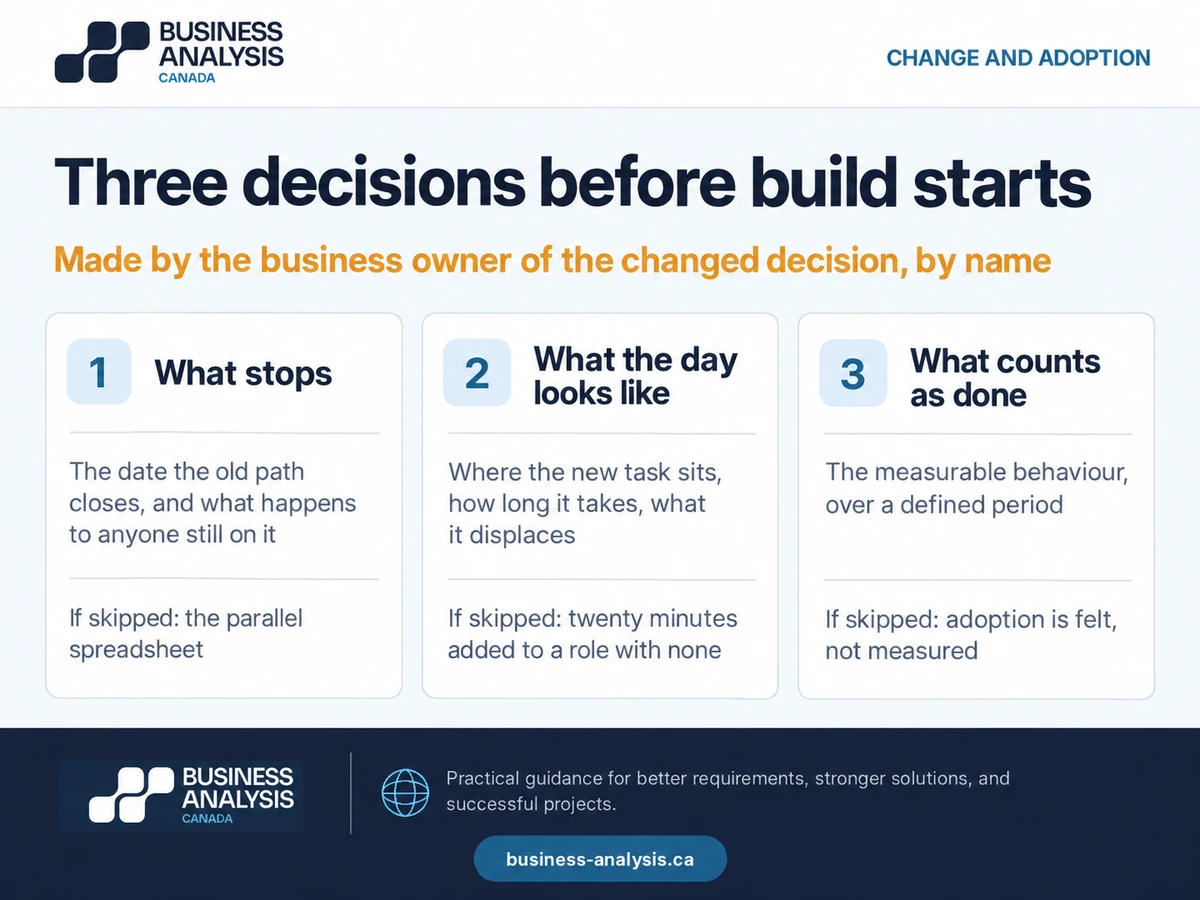
- What stops. The old way of working has to be closed, not left running as a fallback. A parallel path is where adoption goes to die, because the old way is always faster on day one. The owner decides the date the old path closes and what happens to anyone still on it.
- What the day looks like. Where the new task sits in the person's actual working day, how long it takes, and what it displaces. If the honest answer is that it adds twenty minutes to a role that has no twenty minutes, the design is wrong and the requirement fails before it is tested.
- What counts as done. The measurable behaviour, over a defined period, that would satisfy the owner that the change has landed. This is the acceptance criterion, and it has to be stated before build so it can be tested before cutover.
Notice that all three are decisions, not activities. Training, communication, and support are activities that follow from the decisions. When the decisions are missing, the activities are executed well and change nothing, which is the pattern in the introduction.
Key Takeaway: Three decisions from the business owner before build: what stops, what the day looks like, what counts as done. Activities follow decisions, never the other way round.
How do you test adoption before cutover?
The same way you test anything else: run it and measure against the criteria, in conditions close enough to real that a pass means something.
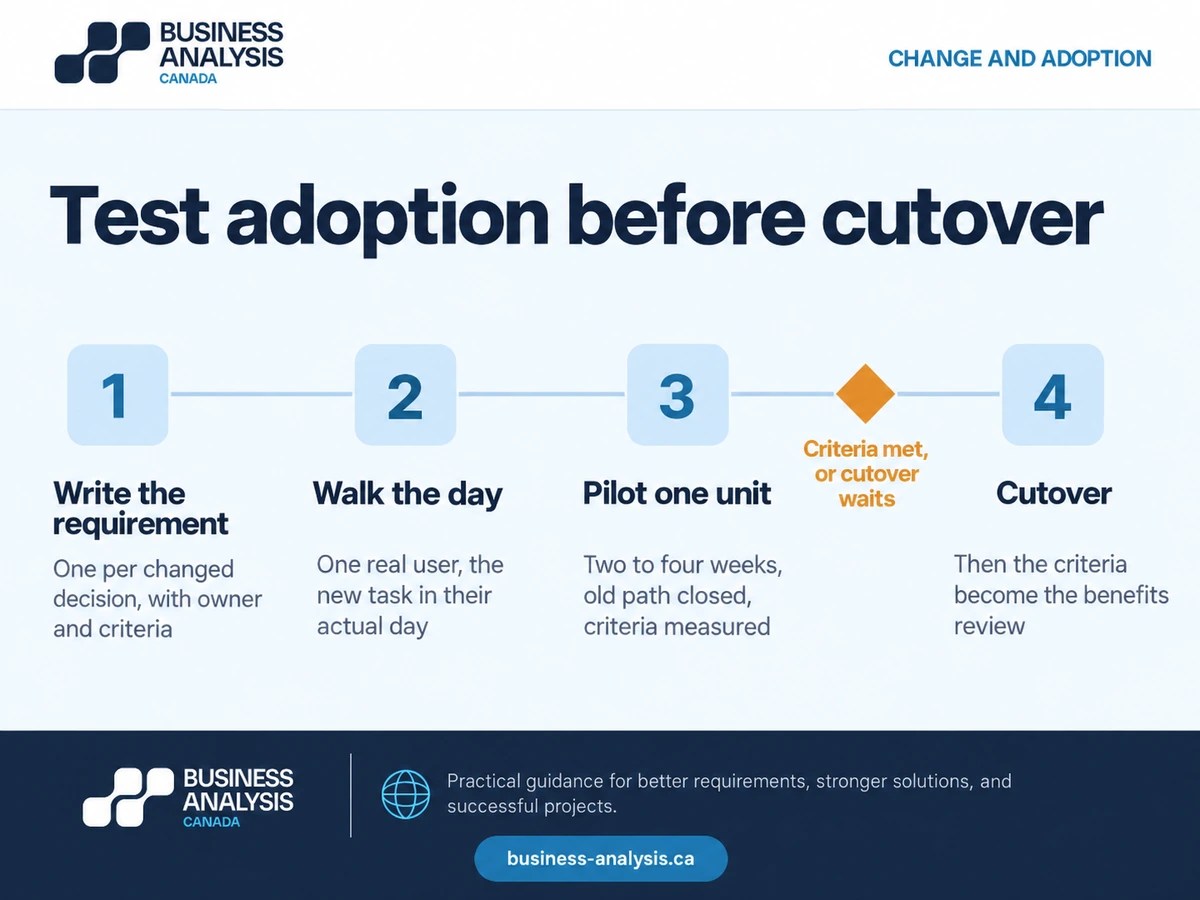
Three steps that fit inside a normal delivery schedule:
- Walk the day with a real user before build. Take the adoption requirement to one person who will live it, and step through their actual day with the new task in it. This finds the twenty-minute problem while it can still change the design.
- Pilot in one unit before cutover. One region, one team, or one product line, on the real system, for two to four weeks, with the old path closed for that unit. Measure the acceptance criteria. This is the adoption equivalent of UAT and it is the step most transformations skip, because the schedule shows cutover as a single date.
- Gate cutover on the result. If the pilot did not meet the criteria, cutover waits and the design changes. If that sounds expensive, compare it with the cost of the parallel spreadsheet in month six.
Digital transformation best practices are usually presented as a list of activities to perform. The practices that matter are requirements to satisfy: an owner named, the old path closed, the day walked, the pilot measured, the cutover gated. Each one is either done or not.
Key Takeaway: Walk the day, pilot one unit with the old path closed, gate cutover on the criteria. A transformation with no adoption test is a launch with a hope attached.
What happens after cutover?
The adoption requirements become the benefits review.
Each requirement has a measurable criterion, so the question six weeks after go-live is simply whether each one is being met. Where it is, the benefit attached to that decision can be claimed. Where it is not, the gap is specific: this role, this decision, this criterion, this shortfall. That is a fixable problem. "Adoption is lower than expected" is not.
The review belongs to the same business owners who wrote the requirements, and it should happen on a fixed date agreed before cutover rather than when someone notices the benefits have not arrived. Most programmes close at go-live and never look. The ones that do look, on a date, with criteria, are the ones whose business cases survive contact with the year-end review.
Key Takeaway: The adoption requirements are the benefits review. Fix the date before cutover, and review against the criteria, not against a feeling.
Frequently Asked Questions
What is the difference between change management and adoption?Adoption is the outcome: people making the new decisions in the new way on the new information, measurably, after go-live. Change management is the set of activities intended to produce that outcome. The distinction matters because change management can be fully executed without adoption occurring, and it usually is when the activities were designed for a solution that never specified what people would do differently. Adoption is the requirement; change management is one of the means.
How do we start building adoption into a transformation that is already in design?List every decision the transformation changes, name the business owner for each, and write one adoption requirement per decision with its acceptance criterion and operating model dependencies, then put those requirements through the same review as the functional ones. ID Business Analysis Canada does this as a fixed-scope piece of work inside a running program, with a business analyst producing the adoption requirements set and a Benefits Audit template that maps each requirement to the benefit it protects, so the post-cutover review is written before cutover happens. On most programs it takes two to three weeks and changes the design in at least one place.
Should change management be a separate workstream on a digital transformation?Separate for the activities, integrated for the requirements. Communications, training, and support need their own plan and people. The adoption requirements belong in the main requirements set, reviewed and approved alongside the functional ones, so that design decisions are made with the operating model dependencies visible. A change workstream that receives the design as a finished input is managing consequences, not shaping them.
How do you measure whether a digital transformation has been adopted?Against the acceptance criteria written into the adoption requirements before build: a measurable behaviour, for a named role, over a defined period. Login counts and training completion rates measure access and exposure, not adoption. The measure that counts is whether the changed decision is being made by the new person on the new information, at the rate the requirement specified, with the old path closed. If the criteria were never written, the honest answer is that adoption cannot be measured, only felt.
Conclusion
Training was delivered. Communications went out. The spreadsheet is still running, because the decision that would have retired it was never written down as a requirement with an owner and a test.
If your transformation has a launch plan and no adoption requirements, ID Business Analysis Canada's Change & Adoption practice writes them in the requirements phase, one per changed decision, with the owner, the criteria, and the operating model dependencies, and hands the change team a specification instead of a date. Book a free consultation and bring the benefits case.