AI Travel Solutions: One Analysis Method Across Many Travel Booking, Support and AI Projects
How Business Analysis Canada ran one requirements method across many travel booking, support, ERP and AI projects for a UK travel software company.
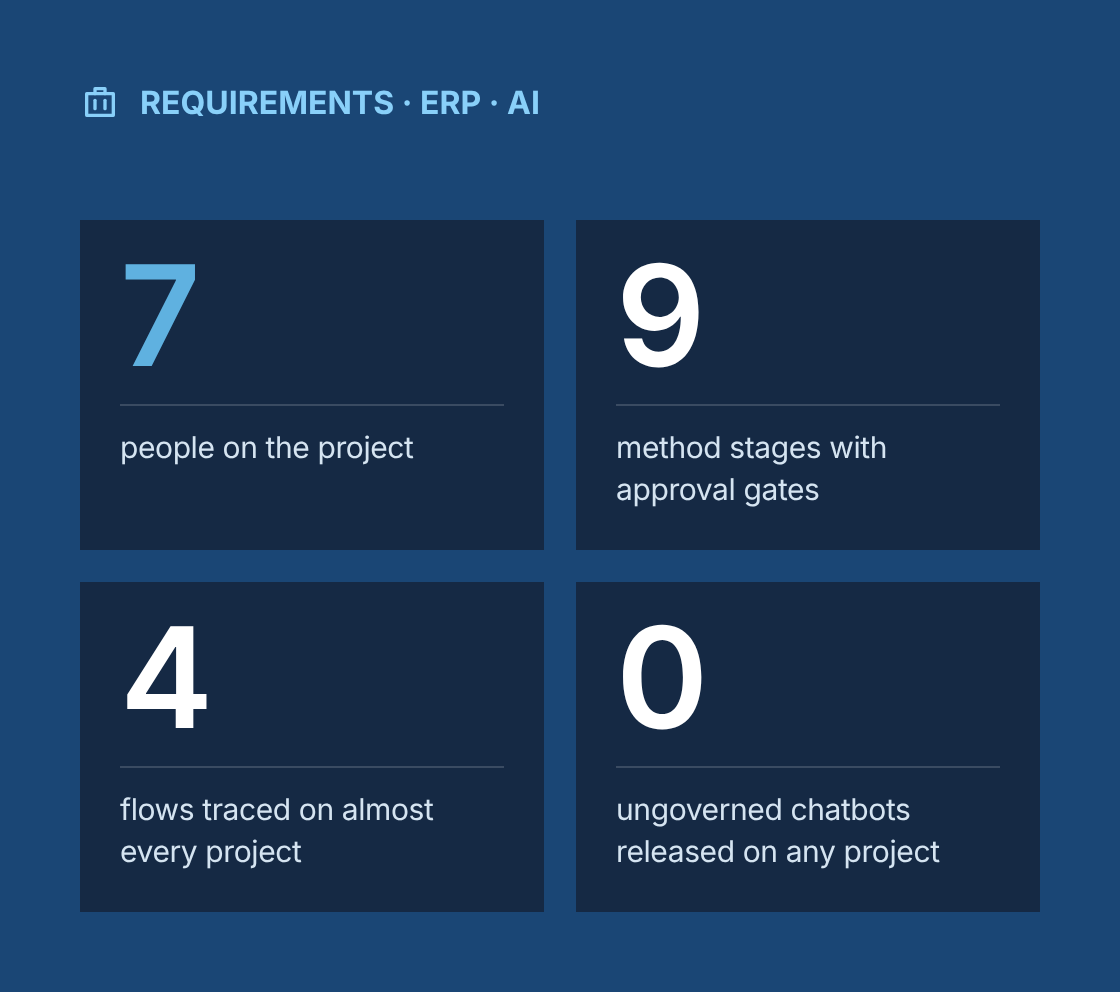
- 7 people on the project
- 9 method stages, each with an approval gate
- 4 flows traced on almost every project
- 0 ungoverned chatbots released on any project
Project at a glance
- Client
AI Travel Solutions, a UK travel software company working with tour operators, travel management companies and online travel agencies, from large operators to independent agencies - Engagement
A long-running series of projects rather than one program, covering bookings, support, operations, back-office and ERP work, and the applications AI Travel Solutions' clients needed. This was requirements and software work. We did not run campaigns. - Project shape
Projects ran in parallel and back to back, each lasting from a few weeks to several months, and each with a separate baseline - Our role
Analysis on every project: elicitation, current-state documentation, business requirements, process models and acceptance criteria. Then application, ERP and AI requirements, and implementation support on the projects that went to build. - Team
Staff augmentation with a team of seven business analysts, embedded in AI Travel Solutions' delivery teams and assigned across the projects running in parallel - Delivery
Remote from Canada, with working hours overlapping UK business hours - Confidentiality
Client names, scopes and commercial terms stay under NDA.
The challenge
What problem was the client trying to solve?
Why did every project need a separate analysis?
Travel software looks similar from the outside, but every operator and agency sells, changes and supports trips differently. The method could be reused from project to project. The content could not.
- Different rule sets
A tour operator selling flight-inclusive packages works under different rules from a travel management company booking business trips under a corporate travel policy. - Different sales models
An online travel agency depends on supplier connections and self-service changes, while an independent agency depends on consultants who know their customers personally. - Cost after the booking
Most of the cost and risk sits after the booking: amendments, supplier schedule changes, cancellations, refunds and support during travel. - Existing systems
Booking, inventory and support systems were already in place on most projects, so new applications had to fit around them. - Brand variation
Multi-brand operators needed brand differences without maintaining separate systems for each brand. - AI with real stakes
AI was on every client's agenda, but each one needed something different from it, and in travel a wrong answer can leave someone stranded.
Analyst team
How was the BA team organized across projects?
Because projects ran in parallel and back to back, AI Travel Solutions used a standing team of seven business analysts instead of hiring for each project.
1 person
Lead business analyst
Focus
AI Travel Solutions' point of contact; maintaining the repeatable method and its templates; allocation and quality review
2 people
Booking and supplier business analysts
Focus
Booking flows, inventory, supplier connections and payments
2 people
Operations and support business analysts
Focus
Changes, cancellations, refunds, support desks and out-of-hours processes
1 person
Finance and ERP business analyst
Focus
Back-office processes, posting rules, supplier settlement and ERP requirements
1 person
AI and data business analyst
Focus
AI use cases, data readiness, approval points and escalation rules
- Analysts usually moved between projects at stage gates, so no project lost its analyst midway through a stage.
- The lead BA kept the method's templates current and added lessons from each project to them.
- A second analyst reviewed every baseline before it went to AI Travel Solutions.
- The lead BA and AI Travel Solutions' delivery lead agreed assignments each week, working from a shared view of upcoming projects.
Our business analysis approach
How did we approach the engagement?
What was the repeatable method?
Every project went through the same stages, with a clear output and a sign-off gate between each one. This let AI Travel Solutions start a new project quickly without copying the previous project's requirements.
- Elicitation
Interview and workshop notes from commercial leads, operations, and the staff who would use the system
Gate Stakeholders confirm the problem statement and scope boundaries - Current state
Process models showing how an enquiry, booking, change or support case moved, and where a person still carried the process
Gate Operations leads confirm the models match reality - Business requirements
Objectives, scope, business rules, assumptions, constraints and success criteria
Gate The client signs off the business requirements - Future state
Process models showing what the application takes over and what stays with staff
Gate Operations and commercial leads agree the future process - Application requirements
Roles, journeys, data, integrations, non-functional requirements and a scoped backlog
Gate The development team can estimate the backlog - ERP and back-office requirements
Finance processes, posting rules, data migration readiness and selection criteria
Gate The client's finance lead signs off before ERP selection or build starts - AI requirements
Use cases, data readiness, model visibility, approval points, decision boundaries and escalation rules
Gate Approved before any assistant or agent reaches staff or customers - Acceptance criteria
Operation-based criteria for every requirement
Gate The client agrees how the application will be judged - Build and implementation
Traceability from requirements to tests and releases, change control and implementation support
Gate Each release is accepted against its criteria
Four flows
Which flows did the current-state work cover?
On almost every project we traced four flows. The systems, rules and failure points were different each time, so the table shows the typical patterns rather than any single client.
Flow
Systems it usually touched
Typical failure point
What the requirements fixed
An enquiry
Website forms, email, phone, CRM
Enquiries sat in personal inboxes, and quotes were rebuilt from scratch when a consultant was away
Shared enquiry queues, quote records linked to the customer, and follow-up rules
A booking
Booking engine, inventory, supplier connections, payments
Bookings were re-keyed between systems, and supplier confirmations were checked by hand
Clear booking states, automatic supplier confirmation checks and exception queues
A change
Booking engine, supplier systems, payments, customer communication
Price differences, supplier fees and updated documents were worked out manually for each change
Change rules, repricing steps, document reissue and an approval point for fees and refunds
A support case
Helpdesk, booking records, phone, out-of-hours lines
Agents searched several systems to understand a booking before they could help
Support cases linked to the full booking, with priority rules for travellers already in destination
Application preparation
What did application preparation cover?
Preparation defined what the software had to do before any screen was drawn. Some projects were a new booking flow, and others were a change to an existing desk. Each one had a separate baseline, built from these components.
User roles
Multi-brand operator
- Group head office with reporting across brands
- Brand managers controlling content, pricing rules and terms for their brand
- Product and contracting teams managing inventory and supplier agreements
- Reservations and customer service agents, scoped to their brands
- Finance teams handling payments, refunds and supplier settlement
- In-destination and out-of-hours support teams
Single agency
- Agency manager
- Travel consultants handling enquiries, bookings and changes
- Administrator covering payments, documents and supplier queries
Journeys
Traveller
Search or enquire, receive a quote, book, pay a deposit and balance, receive documents, request a change, get help during travel, and raise a complaint afterwards
Staff
Take an enquiry, build a quote, confirm a booking with suppliers, process a change, handle a supplier schedule change, issue a refund or credit, and manage a support case
Corporate traveller
On travel management projects: book within policy, get approval where policy requires it, and change a trip
Data to collect, and data to keep out
Needed
- Lead traveller contact details and booking preferences
- Names exactly as they appear on travel documents, at the point of booking
- Booking, payment and supplier references
- Assistance requests, such as wheelchair support, recorded in structured fields
- Marketing consent, recorded separately from booking consent
Not collected, or collected only when required
- Passport details at the enquiry stage. These are collected only when a flight booking requires them, and kept no longer than needed
- Card security codes, or card data outside the payment provider's systems
- Health information beyond specific assistance needs the traveller chooses to share for their trip
- Sensitive details in free-text notes, which agents were guided not to use for this purpose
- Children's details beyond what the booking and supplier require
Integrations
- Booking and reservation systems, with an agreed system of record for each booking element
- Inventory and contracting systems for hotels, transfers and excursions
- Supplier connections such as airline content, bed banks and ground handlers
- Payment providers, including deposits, balance due dates, refunds and multiple currencies
- Helpdesk and customer communication tools
- Accounting and supplier settlement
Non-functional requirements
Access
Role-based access by brand and desk, with support access to booking data limited to the cases an agent is working on
Payments
Card data handled only by the payment provider, with strong customer authentication for online payments
Privacy
UK GDPR requirements for consent, retention and traveller rights, with assistance needs treated as sensitive data
Availability
Support tools available outside office hours, since travellers need help in every time zone
Scoped backlog
Epics and user stories with acceptance criteria, prioritized and split into releases the development team could estimate
Back office and ERP
How did we prepare for back-office and ERP development?
Every booking creates financial events: deposits, balances, supplier costs, commissions, refunds and currency differences. On projects that touched finance, we prepared the back-office and ERP work inside the same baseline, so booking and finance systems agreed on every booking.
Booking to cash
Deposits, balance payments, refunds and credit notes, and the financial posting each booking event creates
Supplier settlement
Supplier costs, due dates, payment runs and reconciliation against supplier statements
Revenue and cost timing
When revenue and costs are recognized, such as at booking or at departure, as agreed with the client's finance team
Multi-currency
Selling and buying currencies, exchange rates, and how currency gains and losses are recorded
VAT and regulatory data
Where the Tour Operators' Margin Scheme or ATOL reporting applied, the booking data needed for margin calculations and returns, confirmed with the client's tax advisers
Brand and entity structure
How brands and legal entities map to companies, cost centres and the chart of accounts
Commission and agent accounting
Commission rates, commission payable and receivable, and net or gross billing for agents
Corporate invoicing
For travel management projects, consolidated invoices by corporate client, cost centre and traveller, with card payment reconciliation
Data migration readiness
Open bookings, supplier balances, customer accounts and history, with quality checks before migration
Selection support
A requirements catalogue, demo scripts built on real booking and change scenarios, and a scoring model for comparing ERP and travel back-office options
Independent agencies rarely needed a full ERP. For them, we specified how the booking tool should feed an accounting package, including supplier payments and commission tracking.
Travel rules
Which travel rules shaped the requirements?
Travel has rules that generic requirements templates miss. Where they applied to a project, they were written into the baseline as business rules and confirmed by the client's compliance lead.
Package travel
On flight-inclusive package projects, requirements reflected the UK Package Travel Regulations and ATOL protection, including the information travellers must receive, how significant changes are handled, and refund timelines when the organiser cancels.
Supplier schedule changes
Airline and supplier changes outside the traveller's control were modelled separately from changes the traveller requested, because the fees, options and communication are different.
Deposits and balances
Payment schedules, reminders and what happens when a balance is missed were defined as rules by brand and product.
Corporate travel policy
On travel management projects, policy checks, approval workflows and out-of-policy reasons were captured as configurable rules for each corporate client.
Duty of care
Support requirements treated travellers already in destination as the highest priority, with clear routes to out-of-hours teams.
Acceptance criteria
How did we write acceptance criteria for travel operations?
Acceptance criteria described what the operation needed to achieve, so the application was judged against the desk, not a feature list.
Supplier schedule change
- Given an airline changes a flight time on a confirmed package booking
- When the change is received from the supplier connection
- Then the booking is flagged for review with the old and new times shown
- And the agent can see whether the change counts as significant under the brand's rules
- And the traveller is not contacted until an agent has approved the message
Organiser cancellation refund
- Given the operator cancels a package booking
- When the cancellation is confirmed
- Then a refund task is created with the due date set by the applicable rules
- And the task is escalated to finance if it is not completed before that date
Support case priority
- Given a traveller contacts support while they are in destination
- When the case is created
- Then it is marked as in-destination and placed at the top of the queue
- And it is routed to the out-of-hours team if the office is closed
AI use cases
How did AI work differ from project to project?
AI sat inside each project's baseline, and the use case was never the same twice. Across the projects we defined four main use cases, each with different data, approval points and limits. On every project the requirement was a controlled aid for the team. Nothing was released as an ungoverned chatbot.
Answering routine traveller questions
Typical project
An online travel agency or tour operator with high volumes of repeat questions
What the AI could see
The traveller's booking details after secure sign-in, and approved content on baggage, transfers, documents and brand terms
Approval point
Content leads approve the knowledge base for each brand before launch and on a regular review cycle
Limits
No visa, passport or health entry advice beyond linking to official government travel advice, and no changes to bookings
Drafting a first response
Typical project
An independent agency or a customer service desk handling enquiries and complaints
What the AI could see
The incoming message, the linked booking and approved templates
Approval point
An agent edits and sends every response, and nothing goes out automatically
Limits
No offers of compensation, refunds or goodwill without agent approval
Routing an enquiry
Typical project
A multi-brand operator with separate desks for sales, changes, groups and support
What the AI could see
Message content, brand, booking status and travel dates
Approval point
Agents can reassign any case, and routing rules are reviewed against misrouted cases
Limits
Messages from travellers in destination, safety concerns and complaints mentioning legal action always go to a person immediately
Summarizing a booking change
Typical project
A desk processing a high volume of amendments and supplier changes
What the AI could see
The booking before and after the change, supplier messages and the price difference
Approval point
The agent reviews the internal summary and the traveller-facing summary before either is saved or sent
Limits
No final price or fee stated unless it matches the booking system
Before any assistant or agent was put in front of staff or customers, each project documented data readiness, covering booking data quality, consistent supplier content and up-to-date brand terms. It also documented what the model could see, the decision boundaries and the escalation rules. Travellers were told when they were dealing with an AI assistant, and each use case was tested with realistic questions, including ones it had to decline or hand over.
Development
How did projects move from requirements to build?
Software development followed the requirements on the projects that went to build.
Traceability
Each requirement was linked to user stories, test cases and releases, so the client could confirm every agreed outcome was delivered.
Testing with real scenarios
Acceptance testing used realistic bookings, changes and support cases, including supplier failures and out-of-hours contacts.
Implementation support
We supported data migration, cutover planning around peak booking periods, and short role-based training for agents.
Change control
When scope moved, each change was assessed against that project's baseline and decided by the client through AI Travel Solutions.
Projects that did not go to build
For these, the baseline and backlog were handed over so the client could take them forward later or use them to choose a supplier.
Multi-brand and independent
How did multi-brand operators and independent agencies differ?
Larger operators needed a shared model with local and brand variation. Independent agencies needed a smaller scope that fit how their desk worked. Both came up often, and each was specified separately. An independent agency never received a trimmed-down copy of an operator's design.
Area
Multi-brand operator
Independent agency
Brands
Shared booking model, with brand content, terms, pricing rules and templates held as configuration
One brand, with the agency's terms and tone
Desks
Separate sales, changes, groups and support desks with routing between them
Consultants handling the whole trip for their customers
Rules
Brand and product-level rules for deposits, changes and cancellations
A small set of rules the agency can maintain
Integrations
Booking engine, inventory, multiple supplier connections, helpdesk and finance systems
Booking tool, payment provider and email
Reporting
Comparable measures across brands and desks
A short view of enquiries, bookings and open changes
ERP and back office
An ERP with brand and entity structure, supplier settlement and multi-currency
A booking tool feeding an accounting package, with simple supplier payment and commission tracking
AI scope
Routing and change summaries at volume, with governance across brands
First-response drafting and routine questions
Governance
How did we work under AI Travel Solutions' relationship and NDA?
- Communication with operators and agencies went through AI Travel Solutions or took place with them present.
- Client names, scopes and commercial terms stay under NDA, including in this case study.
- Analysts signed NDAs covering AI Travel Solutions and its clients, and followed each client's security requirements.
- Traveller data seen during analysis was handled under each client's UK GDPR policies and never stored on Business Analysis Canada systems.
Which BA techniques and tools did we use?
Techniques
- Stakeholder interviews and workshops
- BPMN process modelling
- Current and future state analysis
- Key-person dependency analysis
- Business requirements
- Journey mapping
- Role and permission modelling
- Data minimization analysis
- Integration and system-of-record analysis
- Business rules analysis
- Non-functional requirements
- AI use case definition
- Human-in-the-loop design
- Given/When/Then acceptance criteria
- Requirements traceability
- UAT planning
- Change control
- Posting rules definition
- Chart of accounts and entity mapping
- Fit-gap preparation
- ERP demo scripts
- Vendor scoring
- Data migration readiness assessment
- Peer review
Tools
- Jira
- Confluence
- Miro
- Lucidchart
- Figma
- Microsoft Excel
- Postman
Results
What were the results?
- 7 people on the project
- 9 method stages, each with an approval gate
- 4 flows traced on almost every project
- 0 ungoverned chatbots released on any project
A repeatable analysis method that let new projects start quickly without reusing another client's requirements.
Every application measured against how the desk actually works, through operation-based acceptance criteria.
- Changes, supplier schedule changes and refunds handled through defined rules and approval points instead of manual work.
- Support cases linked to full booking context, with travellers in destination given priority.
- AI use cases matched to each client's needs, with approval points and limits agreed before launch.
- Estimable backlogs for every project, including those that did not go straight to build.
- Back-office and ERP requirements that kept booking and finance systems in agreement on every booking.
- A standing team of seven business analysts across the projects running in parallel.
“
Lessons learned
What can other travel businesses learn from this work?
- Reuse the method, not the baseline. Two travel desks that look alike usually work differently underneath.
- Model the change, not just the booking. Most of the cost and complaints come from amendments, supplier changes and refunds.
- Collect passport and health details only when the trip needs them, and keep sensitive details out of free-text notes.
- Hold brand differences as configuration and content, not as separate systems.
- Make AI hand over to a person quickly when a traveller is in trouble. In travel, a slow escalation costs more than a slow answer.
- Design the booking and the finance posting together. Every booking change is also an accounting event.
Are changes and refunds still worked out by hand?
Talk to a senior business analyst about a repeatable requirements method for your travel booking, support, ERP and AI projects, before any screen is designed.
AI Travel Solutions: One Analysis Method Across Many Travel Booking, Support and AI Projects