Rehaboteket: Accessible E-Commerce for Rehabilitation Products
How our business analysts shaped an accessible e-commerce platform for rehabilitation products in Sweden, from requirements to usability and load testing.
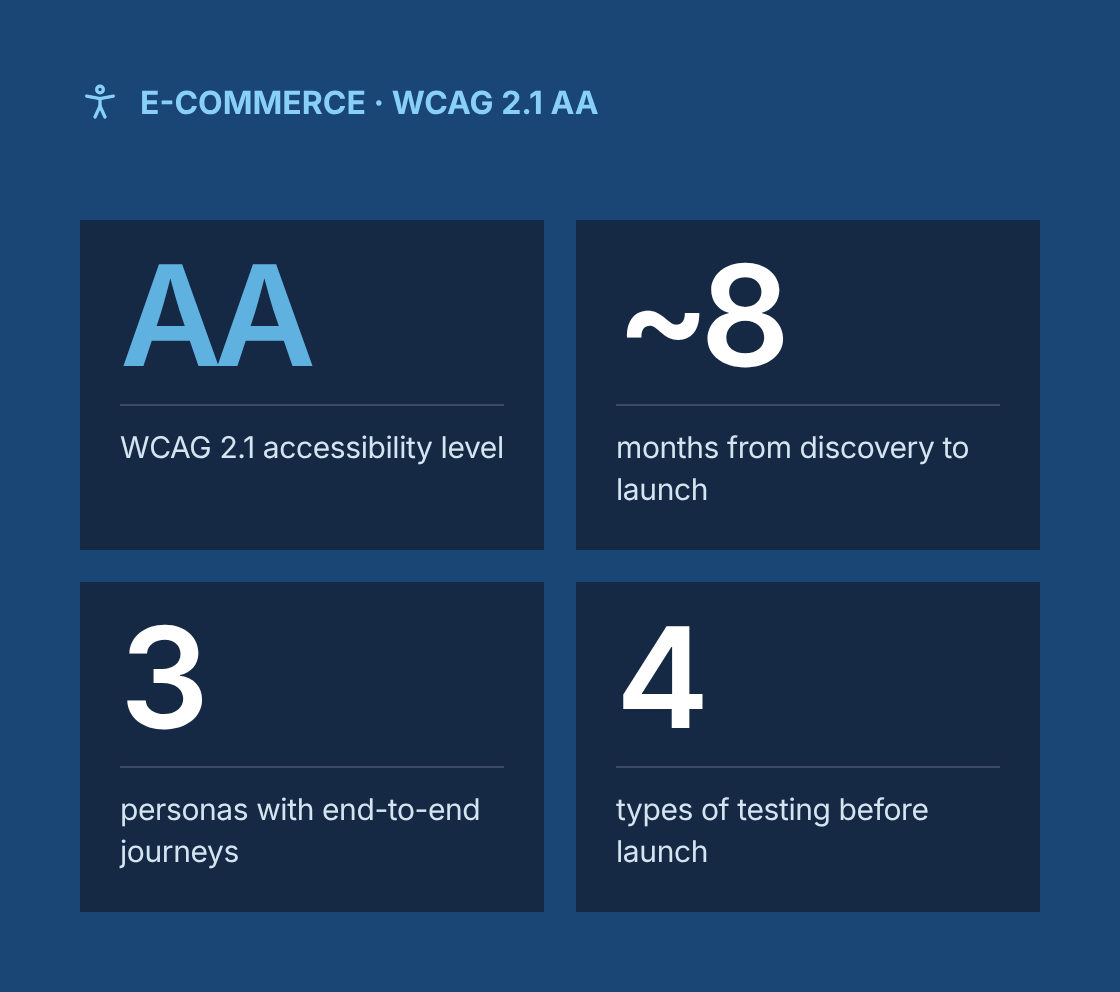
- AA WCAG 2.1 accessibility level, aligned with EN 301 549
- ~8 months from discovery to launch
- 3 personas with end-to-end journeys, from first search to returns
- 4 types of testing, from accessibility to load
Project at a glance
- Client
Rehaboteket, a Swedish supplier of rehabilitation and mobility products serving private customers, caregivers and healthcare providers - Solution
An accessible, responsive e-commerce platform that combines product sales with educational guides and support content - Engagement
Business analysis, functional design support and test leadership, delivered remotely from Canada - Duration
About 8 months, from discovery to launch, followed by a post-launch optimization period - Our role
Lead business analyst, working with the client's management and customer service team, a UX designer, front-end and back-end developers, and QA - Scope
Requirements, e-commerce workflows, functional specifications for custom features, content modelling, accessibility and usability testing, and performance testing
The challenge
What problem was the client trying to solve?
The client's customers often have limited mobility, vision or dexterity, and a standard online shop did not work for them.
- Shopping with assistive technology
Many users relied on screen readers, keyboard navigation, magnification or a caregiver to complete a purchase. - Products hard to choose online
Choosing the right product, such as a walker, wheelchair cushion or bathroom aid, depended on measurements and use cases that standard product pages did not explain. - Routine questions by phone
Customers phoned customer service for advice that could have been answered online, so staff spent much of their time on routine questions. - Manual orders for care providers
Healthcare providers and care organizations needed to order for several end users and pay by invoice, which the existing setup handled manually. - Bulky items and installation
Bulky items needed special delivery options, and some products required assembly or installation. - Accessibility became law
The European Accessibility Act made accessibility a legal requirement for e-commerce services in the EU from June 2025, not just good practice.
Our business analysis approach
How did we approach the engagement?
We designed the platform around the people who find shopping hardest, on the basis that if it works for them, it works for everyone.
- Stakeholder and user research
We interviewed management, customer service and warehouse staff, and spoke with end users, caregivers and occupational therapists. We reviewed customer service call logs to find the most common questions and drop-off points. - Personas and user journeys
We defined personas for private buyers with mobility limitations, caregivers buying on someone's behalf, and healthcare professionals ordering for clients. We mapped end-to-end journeys for each, from first search to delivery and returns. - Business requirements
We documented business requirements and prioritized them with the client using MoSCoW, separating launch-critical features from later releases. - E-commerce workflow design
We mapped sector-specific workflows in BPMN. These covered guided product selection, ordering for another person, B2B accounts with invoice payment, delivery of bulky goods with time slots, assembly and installation booking, and returns of hygiene-sensitive products. - Functional specifications
We wrote user stories with acceptance criteria and functional specs for custom features. These included a product selection guide, measurement-based filters, product comparison, and a request-advice form linked to customer service. - Accessibility requirements
We set WCAG 2.1 Level AA as the minimum standard, aligned with EN 301 549. Accessibility criteria were written into the acceptance criteria of every user story, not left as a separate checklist at the end. - Content modelling
We designed structured content models for product information, buying guides, how-to articles, FAQs and downloadable documents such as user manuals and CE declarations. Each content type had defined fields, relationships to products and plain-language writing rules. - Feedback loops
We ran fortnightly demos with the client and gathered feedback on working software, which was logged, prioritized and fed back into the backlog. - Testing and launch
We led usability, accessibility and performance testing, coordinated UAT with customer service staff, and supported launch and the first weeks of live operation.
Solution
What did we deliver?
Area
Problem
What was delivered
Accessible interface
Standard shop unusable with assistive technology
Requirements and acceptance criteria for keyboard navigation, screen reader support, sufficient contrast, scalable text and large touch targets across all pages
Guided product selection
Customers unsure which product fits their needs
A step-by-step selection guide that asks about user needs, environment and measurements, then narrows the product range
Product discovery
Hard to find the right size or model
Filters by measurements, weight capacity and use case, plus side-by-side product comparison
Educational content
Advice available only by phone
Structured buying guides, how-to articles and FAQs linked directly from related product pages
Ordering for others
Caregivers and providers could not order on someone's behalf
Separate delivery recipient details and saved addresses for people who order for several end users
B2B accounts
Manual handling of institutional orders
Business accounts with invoice payment, order references and reorder from history
Delivery and services
No options for bulky items or installation
Delivery options by product type, with optional assembly and installation booking
Product documentation
Manuals and compliance documents hard to find
Downloadable user manuals and CE documentation attached to each relevant product
Customer support
Routine questions handled by phone
An advice request form routed to customer service with the product context attached
Testing
How did we test the platform?
Testing covered three questions: can everyone use it, does it work correctly, and does it stay fast under load.
- Accessibility testing
Automated checks ran on every page template, followed by manual testing with screen readers, keyboard-only navigation and browser zoom. Each issue was logged against the relevant WCAG success criterion. - Usability testing
We ran moderated sessions with representative users, including older adults, people with limited mobility and caregivers. Each session covered realistic tasks such as finding a suitable walker or completing checkout. Findings were rated by severity and fed into the backlog before launch. - Functional testing and UAT
Test scenarios were written from acceptance criteria. Customer service staff ran UAT on order, return and B2B flows they would support after launch. - Performance testing
We defined performance requirements for page load and checkout response times. Load tests simulated campaign-level traffic, and we tracked Core Web Vitals on key templates on mobile connections.
Governance
How did we manage requirements and compliance?
Every requirement could be traced from a user need to a tested feature, including accessibility and regulatory obligations.
- A requirements traceability matrix linked business requirements to user stories, WCAG criteria, test cases and releases.
- Accessibility, GDPR consent and data handling, and product documentation obligations for medical devices were captured as explicit requirements with named owners.
- Changes to scope went through a lightweight change request with impact on schedule and dependent features assessed before approval.
- A content governance guide set out who writes, reviews and updates each content type, so guides and product information stay accurate after launch.
Which BA techniques and tools did we use?
Techniques
- Stakeholder interviews
- User research
- Personas
- User journey mapping
- BPMN process modelling
- MoSCoW prioritization
- User stories with acceptance criteria
- Functional specifications
- Content modelling
- Accessibility requirements (WCAG 2.1 AA)
- Usability testing
- Performance requirements
- Requirements traceability
- UAT planning
Tools
- Jira
- Confluence
- Figma
- Miro
- axe DevTools
- NVDA and VoiceOver screen readers
- Lighthouse
- JMeter
Results
What were the results?
- AA WCAG 2.1 accessibility level, aligned with EN 301 549
- ~8 months from discovery to launch
- 3 personas with end-to-end journeys, from first search to returns
- 4 types of testing, from accessibility to load
A platform customers with mobility, vision and dexterity limitations can use independently or with a caregiver.
- Simpler product discovery through guided selection, measurement filters and comparison.
- Higher user engagement, with educational content linked directly to the products it explains.
- Fewer routine advice calls to customer service, as common questions are answered on the site.
- Streamlined ordering for healthcare providers and caregivers through business accounts and ordering for others.
- High performance and reliability at launch, backed by structured usability, accessibility and performance testing.
- A documented content model and governance guide the client can use to grow the platform.
“
Lessons learned
What can other e-commerce teams learn from this project?
- Write accessibility into every user story's acceptance criteria. Bolting it on before launch costs more and misses more.
- Test with the people who find your site hardest to use. Their problems are usually everyone's problems, just more visible.
- In specialist retail, product content is part of the product. Guided selection and plain-language guides reduce returns and support calls.
- Map the buyer and the end user separately. In healthcare-adjacent sectors they are often different people.
- Plan content governance before launch. Otherwise educational content goes stale within months.
Can every customer complete a purchase on your site?
Talk to a senior business analyst about making your online store accessible, easier to shop and ready for the European Accessibility Act.
Rehaboteket: Accessible E-Commerce for Rehabilitation Products
Project Description
This project involved the creation of a specialized online platform dedicated to rehabilitation products and services. Designed for individuals with mobility challenges, caregivers, and healthcare providers, the platform combined a streamlined shopping experience with helpful educational content. The development team focused on building an accessible and responsive interface while tailoring functionality to meet the unique demands of the rehabilitation sector. As a result, the platform improved user engagement, simplified product discovery, and maintained high performance and reliability through thorough testing and validation.
Delivered Value
- Collected and documented detailed business requirements to guide development
- Outlined key e-commerce workflows specific to the rehabilitation sector
- Facilitated ongoing feedback loops to ensure the platform met client expectations
- Created functional specs for custom tools and features tailored to user needs
- Led usability testing to validate accessibility and ease of use
- Planned and implemented performance testing to ensure speed and reliability
- Developed structured content models for educational and support resources
- Collaborated with technical teams to ensure domain-specific compliance