River Consultancy Group: Embedded Business Analyst Capacity for a SaaS Growth Consultancy
How Business Analysis Canada placed business analysts on River Consultancy Group's live SaaS growth, due diligence and enablement projects.
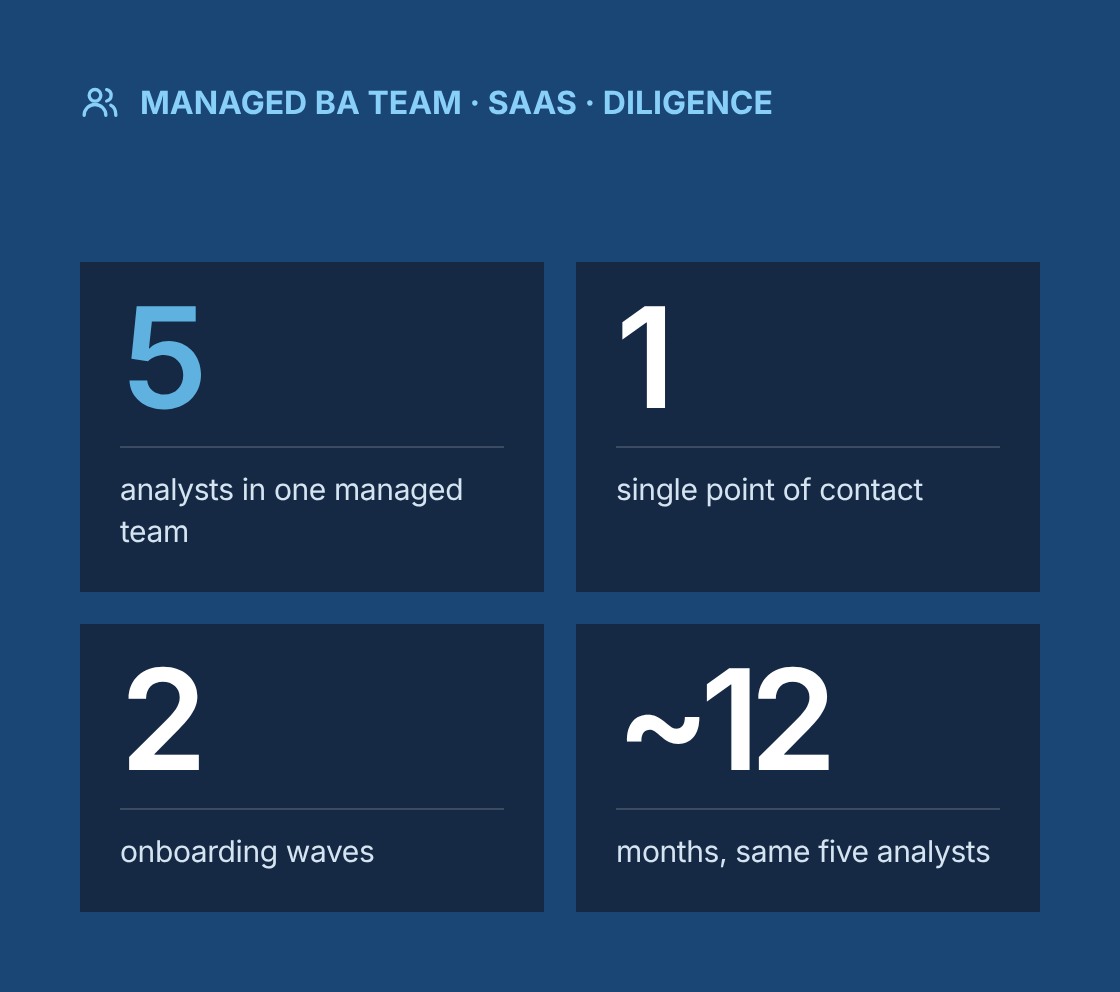
- 5 business analysts in one dedicated, managed team
- 1 lead BA as River's single point of contact
- 2 onboarding waves over the first six weeks
- ~12 months, with the same five analysts throughout
Project at a glance
- Client
River Consultancy Group, a UK consultancy that builds revenue programs, runs due diligence audits and delivers enablement for scale-up and PE-backed SaaS companies - Engagement model
Staff augmentation. A dedicated team of five business analysts was embedded in River's delivery teams and worked on River's live client projects under River's direction. - Team
One lead business analyst, two revenue operations business analysts, one diligence analyst and one process and enablement analyst - Delivery
Remote from Canada, with working hours overlapping UK business hours for client workshops and team calls - Duration
About 12 months. The team was onboarded in two waves over the first six weeks. - Our role
Business Analysis Canada recruited, onboarded and managed the team. River's engagement leads directed day-to-day work. Our lead BA was River's single point of contact for staffing, allocation and quality. - Scope
Requirements elicitation, current-state process mapping, gap analysis, specifications, data and KPI definitions, diligence support and enablement documentation
The challenge
What problem was the client trying to solve?
River's model depends on experienced operators advising clients directly. When client work grew faster than River's analyst capacity, operators ended up doing the analysis themselves.
- Too few analysts
River had more active engagements than its analysts could support, especially when diligence work overlapped with growth programs. - Operators as analysts
Senior operators were writing up interview notes, drawing process maps and drafting requirements instead of working on commercial strategy. - Spiky demand
Demand was uneven. Diligence projects arrive at short notice with fixed deal deadlines, so permanent hires for peak load would sit idle between deals. - Revolving contractors
Individual contractors had come and gone. Each new one needed weeks to learn River's methods and SaaS revenue concepts such as ARR, net revenue retention, pipeline coverage and lead-to-cash, and the knowledge left when they did. - On River's terms
Any extra capacity had to fit River's delivery model: River's methods, templates and quality bar.
Managed team
Why a managed team rather than individual contractors?
River needed stable capacity that could cover several engagements at once. A managed team gave River things that individual contractors could not.
Continuity
The same five analysts stayed with River throughout, so knowledge of River's methods, clients and templates built up instead of walking out the door.
Cover
Team members briefed each other on their engagements, so holidays, sickness or a sudden diligence deadline did not leave a project without an analyst.
Flexibility within a fixed team
When a diligence project landed, the team rebalanced its work internally rather than River having to find and onboard someone new.
Peer review
Analysts reviewed each other's work before the lead BA's quality check, which caught gaps early.
One point of contact
River dealt with one lead BA for staffing, allocation and performance, rather than managing five separate contractors.
Team structure
How was the team structured?
1 person
Lead business analyst
Focus
Team lead and River's point of contact; quality review, allocation and onboarding; hands-on analysis on complex engagements
Where they worked
Across all engagements, with direct work on the most complex growth programs
2 people
Revenue operations business analyst
Focus
Lead-to-cash, CRM, CPQ, billing and reporting requirements
Where they worked
Growth and revenue programs, and systems assessment during diligence
1 person
Diligence analyst
Focus
Data request lists, data room review, process and systems assessment, findings and risk logs
Where they worked
Due diligence and strategic audits
1 person
Process and enablement analyst
Focus
SOPs, RACI matrices, training needs analysis and CRM process guides
Where they worked
Revenue training and enablement, and handover after growth programs
Our business analysis approach
How did we approach the engagement?
We set up the team as a managed service with defined roles, onboarding to River's methods, and quality checks before any work reached River.
- Understanding River's delivery model
With River's leadership we reviewed their engagement types, frameworks, deliverable templates and quality expectations. We also identified which analysis tasks were taking up operator time. - Team design
We sized the team from River's engagement mix and pipeline, and defined a role profile for each position. Each profile listed the required skills, tools, seniority and client-facing expectations. - Matching and approval
We proposed analysts with SaaS go-to-market, CRM and private equity experience. River interviewed and approved all five before they joined any project. - Onboarding in two waves
The lead BA, one revenue operations BA and the diligence analyst started first. The second revenue operations BA and the process and enablement analyst joined a few weeks later, once the first wave had set up the team's working practices with River. Every analyst learned River's frameworks, templates, tools and client conduct, and shadowed River's operators in their first sessions. - Team playbook
The lead BA kept a shared playbook with River-approved templates, worked examples, naming conventions and checklists, so all five analysts produced work in the same format. - Embedded delivery
Analysts joined River's project teams and attended client workshops and interviews alongside River's operators. They elicited requirements, mapped current-state processes and drafted specifications, which River's operators used as evidence for recommendations and as input to delivery. - Quality review
Each deliverable was peer-reviewed by another analyst, then checked by the lead BA against an agreed checklist before it went to River. The checklist covered completeness, consistency, traceability to interview evidence and correct use of River's templates. - Allocation planning
Each week the lead BA and River's delivery lead reviewed which analyst was on which engagement and rebalanced work around new projects and deadlines. Every two weeks they looked further ahead at River's pipeline. - Handover
At the end of each engagement, analysts filed all working documents in River's repository and briefed the River lead, so knowledge stayed with River.
Team flex
How did the team flex across River's engagements?
The team stayed at five, but the work moved between analysts as River's engagements changed.
Steady state
Each analyst covered one or two River engagements, matched to their role.
Diligence spike
The diligence analyst led the analysis work. A revenue operations BA joined for the CRM and systems assessment, and the lead BA picked up that BA's growth program tasks for the duration.
Growth program moving into enablement
The process and enablement analyst took over from the revenue operations BA using a documented handover, so the client did not have to repeat itself.
Holidays and absence
A team member who had already been briefed on the engagement stepped in, with handover notes kept current every week.
A new engagement type
The lead BA added templates and examples to the playbook before work began, so every analyst could use them.
Ways of working
How did the team work with River day to day?
Weekly team stand-up
The five analysts reviewed progress, blockers and upcoming deadlines internally.
Weekly allocation review
The lead BA and River's delivery lead agreed assignments for the coming week.
Monthly performance review
River's leadership and our lead BA reviewed quality, feedback from River's operators and upcoming demand.
Replacement process
If an analyst was not the right fit, a replacement would be proposed within an agreed notice period, with an overlap for handover.
Engagement types
What did our analysts do on each type of engagement?
Growth and revenue programs
What River's client needed
A scale-up SaaS company needed to fix what was slowing revenue growth
What our analysts did
- Interviewed sales, marketing, customer success and finance teams
- Mapped lead-to-cash, renewal and expansion processes
- Documented pipeline stages and handoffs
- Specified CRM and reporting changes
Typical outputs
- Current-state and future-state process maps
- Gap analysis
- CRM requirements
- Pipeline stage definitions
- User stories
Due diligence and strategic audits
What River's client needed
A private equity investor needed an evidence-based view of a target's growth engine before a deal
What our analysts did
- Built data request lists
- Reviewed data room material
- Joined management interviews
- Mapped go-to-market processes and systems
- Assessed revenue durability, CRM effectiveness and operational scalability
- Logged findings and risks
Typical outputs
- Systems landscape
- Process maturity assessment
- Findings and risk log
- Inputs to River's diligence report and 100-day plan
Revenue training and enablement
What River's client needed
Teams needed consistent ways of working after process or CRM changes
What our analysts did
- Documented agreed processes and roles
- Identified training needs by role
- Specified CRM guidance and playbook content
Typical outputs
- SOPs
- RACI matrices
- Training needs analysis
- CRM process guides
Deliverables
What did River's operators get from the team?
Artifact
What it captured
How River used it
Interview and workshop syntheses
Facts, pain points and evidence by stakeholder group
Basis for findings and recommendations
Current-state process maps
Lead-to-cash, renewal, onboarding and handoffs, with pain points marked
Showing clients where revenue leaks and time is lost
Gap analysis
Differences between current practice and the target operating model
Prioritized improvement roadmaps
Requirements specifications
What CRM, CPQ, billing and reporting systems must do
Briefs for implementation partners and client teams
Data and KPI definitions
Agreed definitions for ARR, net revenue retention, churn and pipeline stages
Consistent reporting and board metrics
Findings and risk logs
Diligence findings rated by severity, with supporting evidence
Structuring diligence reports for investors
User stories with acceptance criteria
Implementation-ready changes to processes and systems
Backlogs for client RevOps teams
Governance
How did we protect River's client relationships?
We agreed the rules in writing before the team started.
- Analysts worked as members of River's project teams, under the direction of River's engagement leads, using River's templates, tools and communication channels.
- Analysts never contracted with, quoted or sold to River's clients, and a non-solicitation clause covered the engagement.
- Analysts signed NDAs with River and, where required, with River's clients. Access to data rooms and client systems went only through River-controlled accounts.
- Client data was never stored on Business Analysis Canada systems, and data handling followed UK GDPR and River's information security policies.
- Day-to-day questions went to River's engagement leads. Staffing, allocation and performance went to our lead BA.
Which BA techniques and tools did we use?
Techniques
- Stakeholder interviews and workshops
- Requirements elicitation
- BPMN and swimlane process mapping
- Current and future state analysis
- Gap analysis
- Requirements specification
- User stories with acceptance criteria
- Data and KPI definition
- Process maturity assessment
- Findings and risk logs
- RACI
- Training needs analysis
- Peer review
Tools
- Salesforce
- HubSpot
- Miro
- Lucidchart
- Notion
- Google Workspace
- Microsoft Excel
- Jira
Results
What were the results?
- 5 business analysts in one dedicated, managed team
- 1 lead BA as River's single point of contact
- 2 onboarding waves over the first six weeks
- ~12 months, with the same five analysts throughout
A stable five-person BA team covering River's growth, diligence and enablement work.
River could staff more concurrent engagements without adding permanent headcount.
- Senior operators kept their time for commercial strategy, client advice and recommendations.
- Diligence spikes absorbed by rebalancing work within the team, without onboarding new contractors at short notice.
- Continuity through holidays and absences, because team members were already briefed on each other's engagements.
- Consistent, peer-reviewed artifacts across projects, in River's format.
“
Lessons learned
What can other consulting firms learn from this engagement?
- Augment with a team, not a string of contractors. Shared methods, peer review and cover for absences come with a team.
- Define the role before choosing the person. A clear role profile cuts matching and ramp-up time.
- Onboard in waves. A first wave that sets up working practices makes the second wave faster.
- Onboard analysts to the partner's methods, not yours. The end client should see one consistent team.
- Review quality before work reaches the partner. A consultancy buying capacity should not have to check every deliverable itself.
Are your senior consultants doing analyst work?
Talk to a senior business analyst about adding a managed BA team to your client projects, working under your direction and to your standards.
River Consultancy Group: Embedded Business Analyst Capacity for a SaaS Growth Consultancy