
Capacity Without Headcount: Business Analyst Staff Augmentation, Outstaffing, and Consulting Compared



Share the page:
Three different arrangements get called "bringing in a contractor," and they behave differently in month six. Business analyst staff augmentation puts an analyst on your team under your direction, billed by time. Outstaffing, the term offshore and nearshore vendors use, means the vendor employs the analyst and assigns them to you full time. Consulting buys a deliverable, a BRD or a discovery report, with the vendor managing the work. They differ on who directs the day, who owns the output, who is the employer, how knowledge survives roll-off, and how the invoice is built. Pick by the shape of the work and write the statement of work for the ending. For PMO and IT leaders with a funded initiative and no analyst to run it.
Introduction
The request usually arrives as one sentence: "Can we get a BA for the ERP program?" Procurement hears a contractor. Finance hears a day rate. The vendor hears whichever model it sells, and quotes that. Three months later the sponsor discovers that the analyst cannot be redirected to the second workstream because the contract bought a document, or that the analyst can be redirected anywhere but nobody owns the requirements they produce.
You may have arrived here from a vendor's page offering "dedicated business analysts," or from a staffing firm's rate card, or from a search for when to bring in a business analysis consultant. All three are selling the same hour of analyst time under three different contracts. This guide separates them, so you can choose the contract before a vendor chooses it for you, and so the person who signs the statement of work knows what to put in it.
Why do organizations borrow business analyst capacity instead of hiring?
Because the work has a shape that a permanent role does not fit, and in most cases the shape is one of three. The initiative has an end date, so the capacity is needed for nine months and then not at all. The skill is specific and scarce, an analyst who has mapped a Dynamics 365 finance migration or written interface specifications for a payments integration, and the local hiring market will not produce one inside the project window. Or headcount is frozen while project budgets are not, which is the most common reason of all and the one nobody writes in the business case.
The mistake is treating the three answers to that problem as one thing. "Contractor" covers an independent analyst invoicing you directly, a staffing firm's employee sitting on your floor, an offshore vendor's employee on your Teams channel, and a consulting firm delivering a document from its own office. The hour of analysis looks the same on the calendar. The obligations, the risk, and what you keep at the end are different in each case, and those differences are what the rest of this article is about.
The earlier comparison of IT staff augmentation and in-house teams covers the hire-or-borrow decision. This one starts after it: you have decided to borrow, and the question is under which contract.
Key Takeaway: Borrow when the work has an end date, needs a scarce skill, or sits in a project budget rather than a headcount line. Then decide the model on purpose; a vendor will otherwise decide it for you.
What is the difference between business analyst staff augmentation, outstaffing, and consulting?
They differ on five lines: who directs the work day to day, who owns the deliverable, who employs the analyst, how knowledge is retained when the engagement ends, and how cost is structured. Everything else, including what the vendor calls it, follows from those five.
Business analyst staff augmentation places an analyst inside your team. You assign the work, run the stand-up, and own what comes out. The analyst is employed by a staffing firm or operates through their own corporation, and you pay for time. It is the right shape when you have a delivery lead who can direct an analyst and a backlog that changes weekly.
Outstaffing is the model that nearshore and offshore vendors sell, and the word rarely appears in Canadian procurement, which is why buyers misread it. The vendor employs the analyst, usually in another country, and assigns them to you full time for a fixed monthly fee. You direct the work as in augmentation. The vendor handles payroll, benefits, equipment, and replacement. In North American terms it is closest to a dedicated resource through an employer of record. The trade is a lower rate against distance, time zones, data residency questions, and a thinner line of sight into who you are getting.
Consulting buys an outcome. You describe a problem; the vendor scopes a deliverable, a discovery report, a BRD, a process baseline, staffs it with its own people, manages them, and delivers. You do not direct the analysts; you accept or reject the work. A fractional business analyst is a variant: a senior analyst on a part-time retainer, usually a consulting arrangement priced per month rather than per hour.
The failure we see most often sits in the fourth row. An augmented analyst spends eleven months on a program, holds every decision about why a field maps the way it does, and rolls off on a Friday with a two-page handover note, because the statement of work bought hours and said nothing about artifacts. ID Business Analysis Canada places analysts through its IT staff augmentation service with the BRD, the traceability matrix, and the decision log named in the statement of work as contracted deliverables, reviewed monthly, so that roll-off is a file transfer rather than a knowledge loss.
Key Takeaway: Decide the five lines before you read a rate card. Two vendors quoting the same hourly figure can be selling different models, and the difference shows up at roll-off, not at signing.
Which model fits which situation?
Match the model to three facts about the work: whether it has a defined output or an open backlog, whether you have someone who can direct an analyst every day, and how long the need will last. The decision runs in that order, and the visual below walks through it.
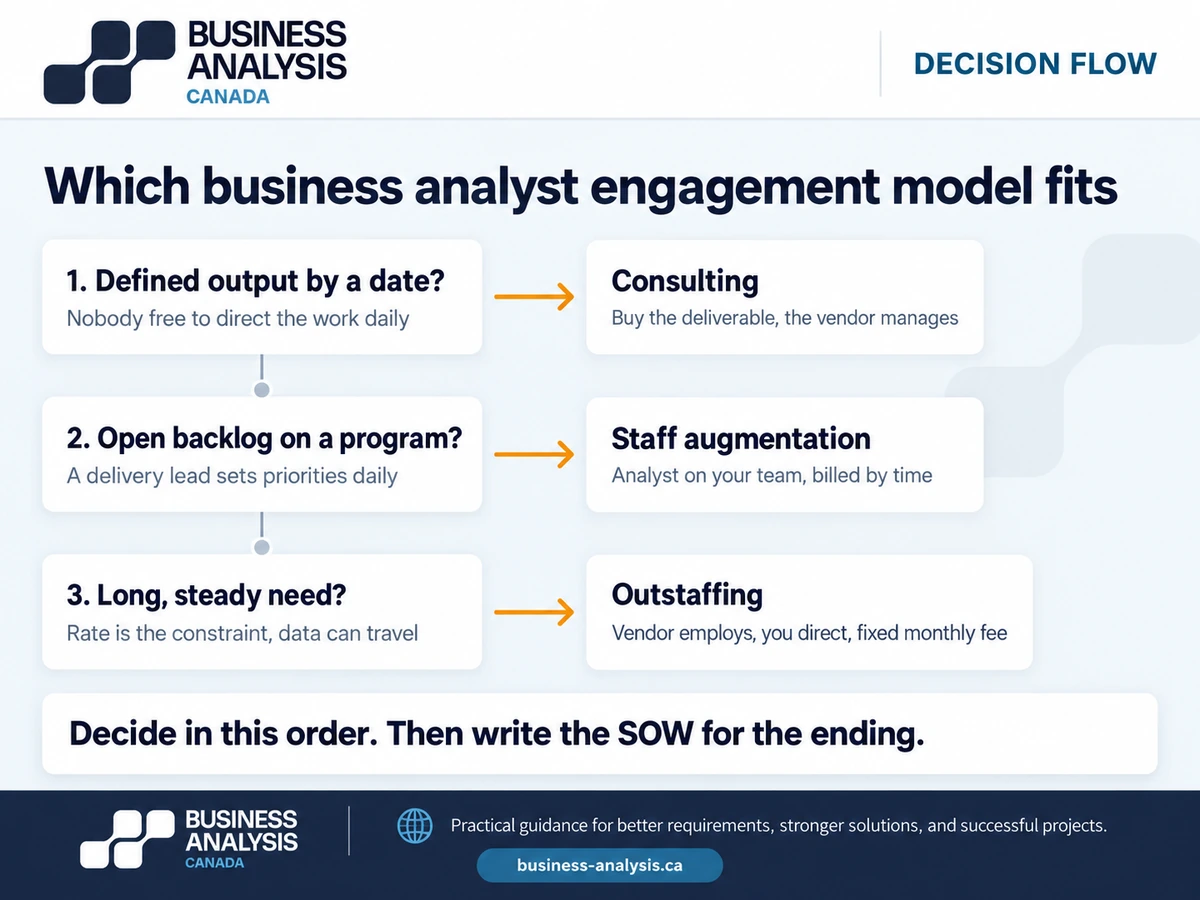
If the work is a defined output by a date, a BRD for an RFP, a current-state process baseline, a discovery report that a steering committee will decide on, and nobody on your side has time to direct an analyst daily, buy the deliverable. Consulting costs more per hour and less per outcome, because the vendor carries the management and the risk of producing something you will not accept. The pattern we see is a department head who needs requirements for a system replacement in six weeks and has a full-time job already; an augmented analyst in that situation produces whatever the loudest stakeholder asks for, because nobody is setting priorities.
If the work is an open backlog on a program with a delivery lead, a scrum master, or a PMO that can direct the analyst, augment. A nine-month ERP program with a change-control board and a weekly steering is the textbook case. The analyst joins the team, the program manager sets the priorities, and the hours flex with the phase.
If the need is steady and long, eighteen months of product analysis on a platform team under a headcount freeze, and the rate is the deciding factor, outstaffing is the model that fits, on two conditions. The data the analyst touches has to be allowed to leave the country, or the vendor has to have Canadian staff, and you need a lead on your side who will run the relationship across the time difference. Without the second, a dedicated analyst becomes an expensive ticket queue.
Key Takeaway: Defined output and no one to direct it: consulting. Open backlog with a delivery lead: augmentation. Long steady need with the rate as the constraint: outstaffing, if the data can travel.
Who carries the employment and legal risk in each model?
A different party in each one, and in Canada two rules shape the answer. The first is tax. If an analyst invoices you through their own corporation and would reasonably be regarded as your employee but for that corporation, the Canada Revenue Agency can treat the corporation as a personal services business: no small business deduction, a 33% federal rate, and deductions limited to the salary paid to the analyst. That consequence lands on the contractor, not on you, but the facts that create it, your control over the work, exclusivity, and integration into your team, are the same facts that matter in the second rule.
The second is employment law. In McKee v. Reid's Heritage Homes, the Ontario Court of Appeal confirmed that a worker paid through a corporation can still be an employee, and that an exclusive, long-term contractor who is not an employee can be a dependent contractor owed reasonable notice. A business analyst who has worked only for you for three years under your daily direction is in that territory whoever issues the invoice, and a 30-day termination clause may not be worth what it says. Confirm the specifics with your own counsel; the pattern is what the engagement decision needs.
The models distribute this differently. Through a staffing firm, the firm is the employer of record, runs payroll, and carries the first layer of the risk, though a long exclusive placement under your direction still looks like employment to a court. In outstaffing, the vendor employs the analyst under the laws of its own country; your exposure moves to data: PIPEDA, Quebec's Law 25 if Quebec residents' data is involved, and for federal work the contract security requirements that an offshore analyst cannot usually meet. In consulting, the firm carries employment and delivery risk together, which is part of what the higher rate pays for.
Key Takeaway: Augmentation moves employment risk to the staffing firm but not entirely; outstaffing moves it offshore and brings data residency in; consulting prices it into the fee. Ask who is the employer before you ask the rate.
What belongs in the statement of work regardless of model?
Six clauses, and the model changes their content but not whether they exist. The visual below is the checklist; the detail follows.
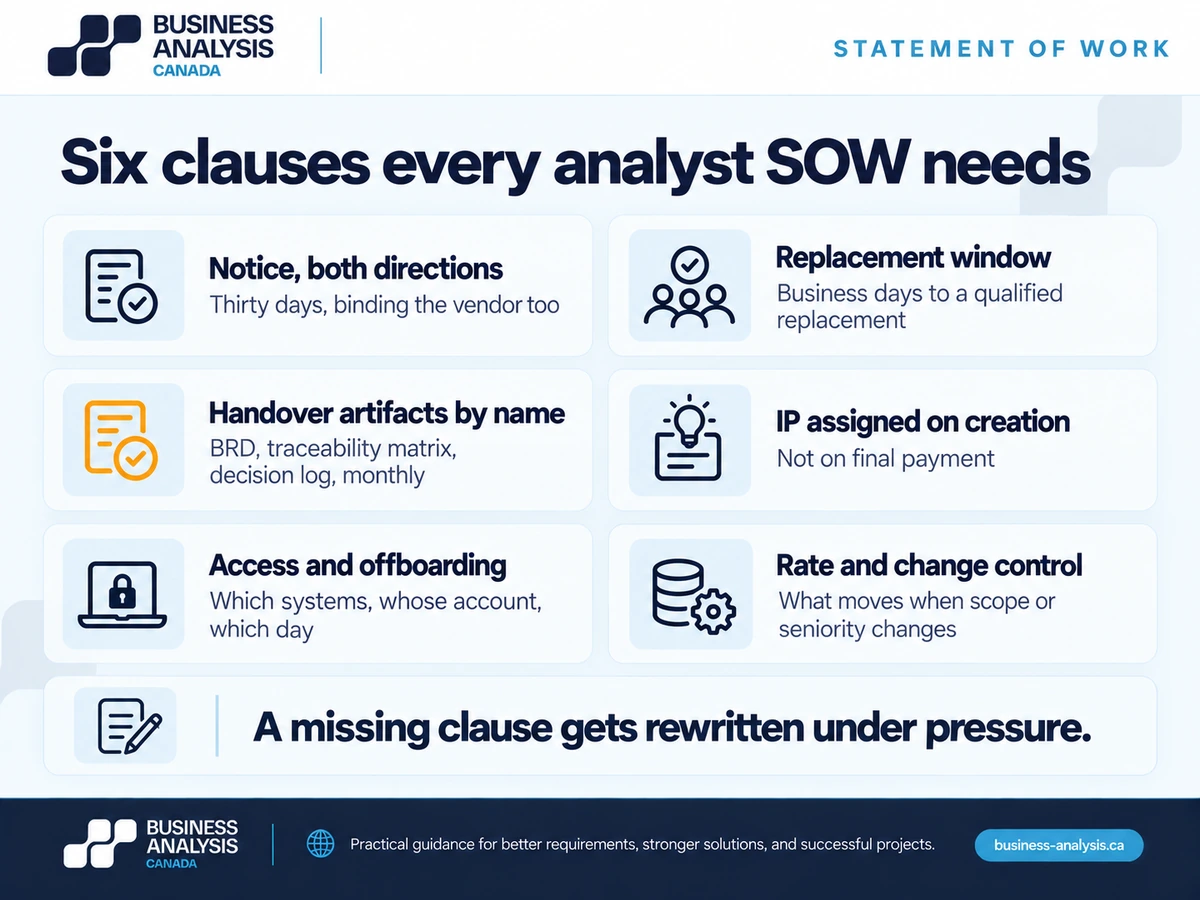
Notice, in both directions. Thirty days is normal for augmentation and outstaffing; make sure it binds the vendor as well as you, because the analyst you depend on can otherwise be reassigned to a better-paying client with a week's warning. Replacement, with a window. If the analyst leaves or the fit is wrong, how many business days until a qualified replacement starts, and who pays for the overlap. Handover artifacts, by name. For a business analyst that means the requirements document in its current state, the traceability matrix, the decision log, open issues, and the stakeholder map, all in your repository, all current at month end, so the roll-off week has nothing to reconstruct. Intellectual property and work product assigned to you on creation, not on final payment, so a dispute over an invoice does not become a dispute over who owns the requirements. Access and offboarding: which systems, which data, under whose account, and the day access ends, which matters most when the analyst sits outside Canada. Rate structure and change control: what happens to the rate when the scope, the hours, or the seniority changes, so the second workstream does not become a renegotiation.
The five questions for any staffing supplier in the earlier article still apply, and the first of them, whether you can interview the named analyst before signing, is the one vendors most often decline. If you are hiring the analyst yourself rather than borrowing one, how to hire a business analyst covers the evaluation.
Key Takeaway: Notice, replacement, handover artifacts, IP, offboarding, change control. A statement of work missing any of the six will be rewritten under pressure, at the worst moment, by the party with less to lose.
Frequently Asked Questions
What is business analyst outstaffing?Outstaffing is an engagement model in which a vendor employs a business analyst and assigns them to your organization full time, usually from another country, for a fixed monthly fee. You direct the analyst's work day to day as if they were on your team; the vendor handles employment, payroll, equipment, and replacement. The term is common among Eastern European and South Asian vendors and rare in Canadian procurement, where the same arrangement is usually called a dedicated resource or an employer-of-record placement.
When should we bring in a business analysis consultant instead of a contractor?When you need a defined deliverable by a date and nobody on your side can direct an analyst daily. A consultant is managed by their firm and accountable for the output: a BRD, a discovery report, a process baseline. A contractor under augmentation is managed by you and accountable for hours. If your sponsor needs requirements for a system replacement in six weeks and already has a full-time job, the consulting model produces the document; the augmentation model produces whatever the loudest stakeholder asked for that week.
Is a fractional business analyst the same as staff augmentation?No. A fractional business analyst is a senior analyst on a part-time retainer, typically one or two days a week for a fixed monthly fee, working across several clients. It is a consulting arrangement: the analyst sets the method and you set the priorities. Staff augmentation places an analyst under your daily direction for the hours you buy, usually full time. Fractional fits a small organization that needs senior judgment on a standing basis; augmentation fits a program that needs capacity.
How do we start a business analyst staff augmentation engagement?Write a one-page role brief first: the program, the systems involved, the deliverables expected in the first 90 days, and who the analyst reports to daily. ID Business Analysis Canada runs the engagement from that brief as an IT staff augmentation placement: a named business analyst or systems analyst you interview before signing, and a statement of work that fixes notice, replacement, handover artifacts, and IP before the first day. A typical start from brief to first day is two to three weeks when the named analyst is available.
Conclusion
"Can we get a BA for the program?" is three questions wearing one sentence: who will direct the work, what we will own at the end, and who is the employer. Answer them before procurement does, because the contract that arrives first will answer them for you.
If you have a funded program and no analyst to run it, ID Business Analysis Canada's Business Analysis Roles placement service puts a named business analyst or systems analyst under your direction, with the BRD, traceability matrix, and decision log written into the statement of work as deliverables. Book a free consultation and bring the role as you would describe it to a vendor; the first thing we will do is work out which of the three models you are asking for.
Sources
- TaxTips.ca, Personal Services Business, summary of Income Tax Act s. 125(7), s. 123.4(1), and s. 18(1)(p): loss of the small business deduction and general rate reduction, 33% federal rate since 2016, and restricted deductions.
- Nelligan Law, Ontario Court of Appeal affirms existence of dependent contractors, on McKee v. Reid's Heritage Homes Ltd., 2009 ONCA 916.
- Business Analysis Canada, Overcoming Gaps: IT Staff Augmentation vs In-House Teams, business-analysis.ca blog, August 2026.
- Business Analysis Canada, Hiring the Bridge: How to Hire a Business Analyst Who Can Deliver, business-analysis.ca blog, September 2026.
- Business Analysis Canada, The Standard Behind the Role: The BABOK Guide for People Who Hire Business Analysts, business-analysis.ca blog, September 2026.