
Hiring the Bridge: How to Hire a Business Analyst Who Can Deliver



Share the раgе:
Most business analyst hires are screened on the wrong evidence. Résumés list methodologies, tools, and years, and interviews test whether the candidate can talk about them. What predicts delivery is whether the person has produced the specific artifact your project is missing, and whether someone they worked with would say a decision changed because of it. Statistics Canada reported that 28% of job vacancies in the first quarter of 2026 had been open for 90 days or more, which is the cost of screening slowly for the wrong things. This guide gives a five-step screening sequence built on artifacts, a work sample, and a reference about a decision, with what to add when the role is an ERP or a business intelligence analyst.
Introduction
The shortlist had four candidates. All four had agile, waterfall, and hybrid on the résumé. All four had Jira, Confluence, and Visio. All four described themselves as strong communicators with excellent stakeholder management skills. The interviews went well. The hire lasted five months.
Nothing on the résumé was false. It was also not evidence of anything the project needed, which was a person who could take a contradictory set of business rules from three departments and turn them into a specification the build team could implement without a meeting.
Nobody asked to see one.
Why do business analyst hires go wrong?
Because the screen tests for vocabulary, and vocabulary is evenly distributed across good and bad analysts.
Every candidate who has held the title for three years can describe elicitation techniques, name a prioritization method, and talk through how they handle a difficult stakeholder. The interview format rewards the description. It does not reveal whether the candidate has produced a document that a developer built from, a tester tested against, and a sponsor made a decision on.
The cost of the slow, wrong screen is measurable. Statistics Canada reported that in the first quarter of 2026, 28.0% of job vacancies had been open for 90 days or more, with recruitment ongoing.<sup>[1]</sup> That figure is across all occupations. On a funded delivery programme, 90 days without the analyst is a quarter of the project spent without the person who was supposed to write the requirements, followed by a hire chosen because the position had to close.
The pattern we see is a hiring manager who knows the project is missing a specific piece of work, screens for general competence instead, and discovers the gap when the new analyst produces a document that looks like the last one that did not work.
Key Takeaway: Screen for the artifact the project is missing, not for fluency in the vocabulary of the profession.
Filling a BA seat on a live programme and not sure the screen is testing the right thing? Our BA Roles placements are screened on work samples before a candidate is proposed. Book a free consultation.
What evidence predicts whether a business analyst can deliver?
Artifacts and references, traced to decisions. The table maps what a résumé offers to what you should ask for instead.
The third column is not harder to obtain than the first. Candidates who have done the work have the artifacts, redacted, and can produce them in a day. Candidates who have not will send a template, a slide, or an explanation of why the documents were confidential, which is itself information.
The reference row is the one most hiring managers skip because references are assumed to be uniformly positive. They are, if the question is whether the candidate was good to work with. They are not, if the question is "tell me about a decision that went differently because of a document this person wrote." Most references cannot answer that about most analysts. The ones who can are telling you something a résumé cannot.
Most hiring managers write the posting from the previous one and screen against it, which is how four interchangeable candidates end up on a shortlist for a role that needed one specific thing. ID Business Analysis Canada screens every BA Roles candidate against a work-sample pack built from the client's own project: a redacted requirement with a known contradiction in it, forty-five minutes, and a request for the questions the candidate would ask and the acceptance criteria they would write, scored by a business analyst against the role profile before any interview is scheduled.
Key Takeaway: Artifacts, a work sample, and a reference who can name a decision. All three are obtainable inside a week, and together they predict delivery better than any interview.
What does the screening sequence look like?
Five steps, in order, each one removing candidates before the next one costs anyone's time.
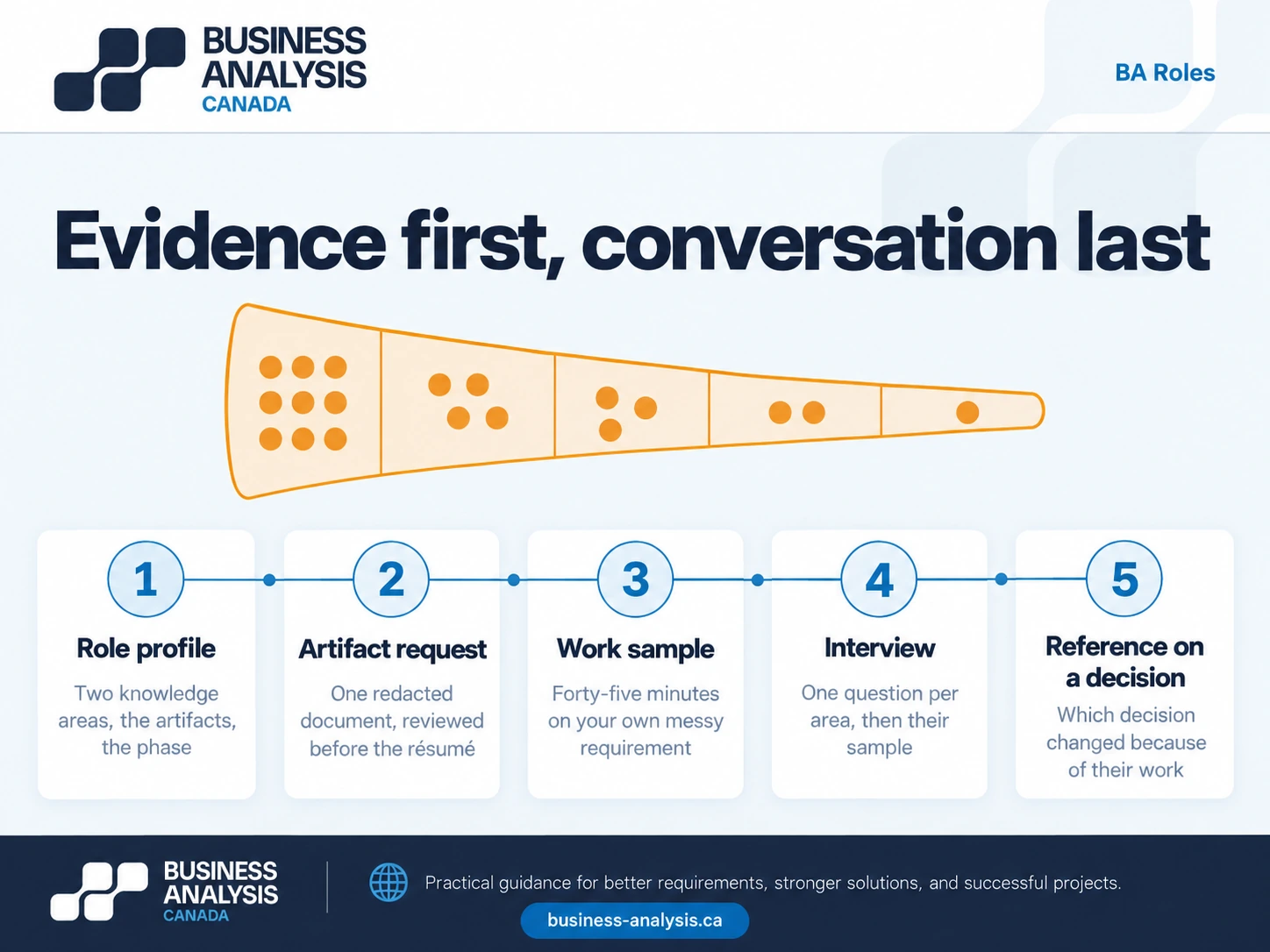
- Role profile before posting. Rank the six BABOK knowledge areas for the project, name the top two, list the artifacts the role will own, and state the phase the project is in. Our BABOK post covers how. This takes a day and shapes everything after it.
- Artifact request at application. Ask every applicant for one redacted example of the artifact the role will own. Not a portfolio, one document. Review it before reading the résumé. Half the field usually removes itself here.
- Work sample before interview. A short, timeboxed exercise on a problem drawn from your project. Details in the next section. Score it against criteria written in advance.
- Interview on the sample and the artifact. One question per ranked knowledge area, each asking for a document and a decision. Spend the rest of the time on the candidate's own sample: why they asked those questions, what they would ask next, what they would refuse to specify without an answer.
- Reference on a decision. One call, one question: which decision changed because of this person's work. Ask for the specific document and the specific outcome. If the reference cannot name one, ask for a second reference who can.
The sequence front-loads the evidence and back-loads the conversation. Most hiring processes do the opposite and then wonder why the interviews were so persuasive.
Key Takeaway: Evidence first, conversation last. Each step removes candidates before the next one costs time.
How do you run the work sample?
Give the candidate a real problem at reduced scale, a fixed time, and a task that produces a document rather than a discussion.
The shape that works:
- Input. One page of requirements from your actual project, redacted, with at least one contradiction, one ambiguity, and one missing exception path left in. Do not clean it up. The mess is the test.
- Task. Forty-five minutes. Produce the questions you would need answered before you could specify this, and write acceptance criteria for the one requirement you consider clearest.
- Scoring. Did they find the contradiction? Did they find the missing exception path? Are the questions addressed to a named role rather than "the business"? Can a tester execute the acceptance criteria without asking what was meant?
A strong candidate finds the contradiction in the first ten minutes, writes six to ten questions that are each directed at a specific person, and produces acceptance criteria with a measurable pass condition. A weak candidate rewrites the requirement in better prose, asks no questions, and produces criteria that restate the requirement.
The sample also tells you how the person works under mild pressure with incomplete information, which is the entire job.
Key Takeaway: Real problem, forty-five minutes, a document as the output. The contradiction you left in is the test.
How is hiring an ERP or a business intelligence analyst different?
The sequence is the same. The artifact, the work sample, and the technical probe change.
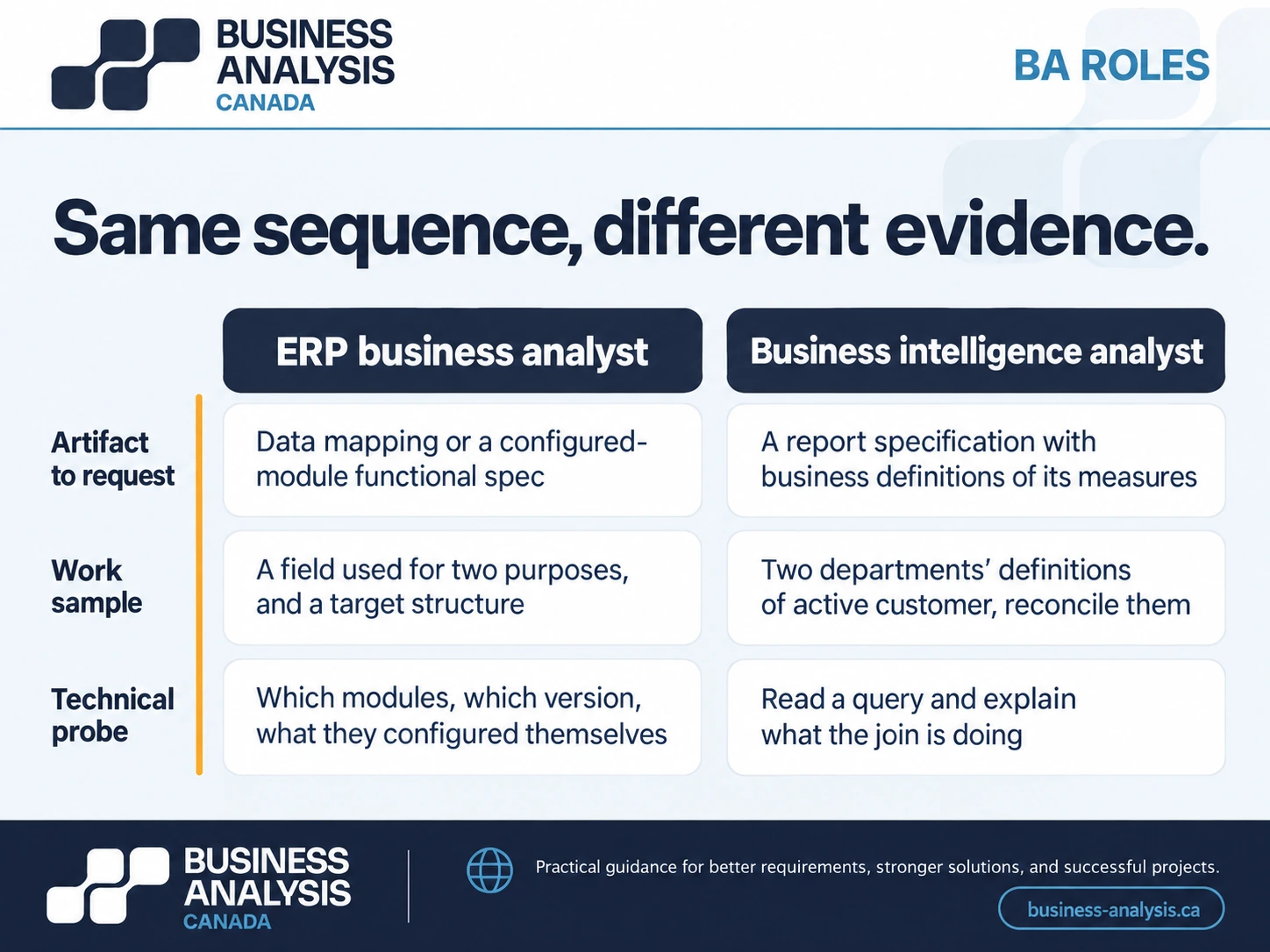
ERP business analyst. The artifact to request is a data mapping or a functional specification for a configured module, because the job is translating business rules into the way a specific platform enforces them. The work sample should include a data question: here is a field being used for two purposes, here is the target structure, what do you ask and what do you recommend. The technical probe is platform depth: which modules, which version, which parts they configured themselves versus specified for someone else. A candidate who has only gathered requirements for an ERP and never sat with the configuration is a generalist with ERP on the résumé, and the difference shows up in month three of a migration.
Business intelligence analyst. The artifact to request is a report specification with the business definitions of its measures, because the job is making two people who ask the same question get the same number. The work sample should be a definitional problem: here are two departments' definitions of "active customer," here is what the dashboard needs to show, reconcile them or explain why you cannot. The technical probe is data modelling and SQL, read rather than written: can they explain what a query returns and whether the join is doing what the business thinks it is. A candidate who can build a dashboard but cannot defend a definition will produce beautiful reports that finance disputes.
For both, the reference question changes slightly: which number, or which configuration, would be wrong today if this person had not been on the project.
Key Takeaway: Same sequence, different artifact and probe. ERP analysts are tested on configuration depth, BI analysts on definitions.
Frequently Asked Questions
Should we hire a business analyst permanently or on contract?Match the employment model to the shape of the work. If the analysis load is tied to a funded initiative with an end date, a contract analyst fits and avoids carrying the trough after the requirements peak. If the role is continuous, supporting operations and a stream of small changes, a permanent hire builds the institutional knowledge the contract model loses at handover. The staff augmentation post on this site covers the full comparison. The screening sequence is identical for both.
How do we start hiring a business analyst when we have never hired one before?Write the role profile first: which project phase you are in, which two knowledge areas the role leads on, and which artifacts it will own. Then build the work sample from your own project material and score it before the first interview. ID Business Analysis Canada produces both as a hiring pack for organizations filling a BA seat directly, with a business analyst writing the role profile, the work-sample exercise with its scoring criteria, and the interview questions, and it can run the screen and propose a candidate through BA Roles if the internal recruiter would rather not. The pack takes two to three days and is reusable for the next hire in the same role family.
How long should hiring a business analyst take?With the artifact request at application and the work sample before interview, three to four weeks from posting to offer is realistic, because most of the field removes itself at the artifact step and the interviews are short. The delay in most BA hires comes from a long shortlist of interchangeable candidates and multiple interview rounds trying to tell them apart. Front-loading the evidence removes both.
What if we cannot find a business analyst with the right depth?Split the role. Most "cannot find" cases are postings asking for deep strategy analysis and deep technical specification in one person, at one salary band, in one market. Decide which of the two the project needs now, hire or contract for that, and cover the other with a shorter engagement or an internal transfer. A generalist who is strong at neither is the usual outcome of insisting on both, and that is the five-month hire from the introduction.
Conclusion
Four candidates with the same résumé is not a shortlist. It is a sign that the screen was measuring something all four had, which was the vocabulary. The project needed one specific artifact, produced under mild pressure, from messy input, and only a work sample would have shown who could do it.
If you are hiring a business analyst and the current process is a posting, a shortlist, and three rounds of conversation, ID Business Analysis Canada's BA Roles practice provides the role profile, the work-sample pack scored against it, and the reference question, and will propose a screened candidate or hand the pack to your recruiter. Book a free consultation and bring the posting.
Sources
- Statistics Canada, The Daily: Job vacancies, first quarter 2026, June 16, 2026.
- Business Analysis Canada, The Standard Behind the Role: The BABOK Guide for People Who Hire Business Analysts, business-analysis.ca blog, September 2026.
- Business Analysis Canada, Under the Hood: Why Complex Initiatives Need a Technical Business Analyst, business-analysis.ca blog, August 2026.