
Comparable Bids: How to Write an RFP for Software That Canadian Vendors Can Price



Share the page:
Most software RFPs cannot be priced, so vendors price the risk instead and the bids come back six times apart. An RFP for software is a request for comparable prices against decisions you have already made: the scope boundary, who holds the data, which interfaces are yours, and which rules the system falls under. Write it in nine sections, give every requirement an acceptance criterion, and publish the evaluation weights so vendors answer the parts that score. Public-sector buyers add trade-agreement thresholds, CanadaBuys or provincial posting rules, and official languages. This guide gives the six pre-RFP decisions, the nine sections, a sample evaluation grid, and a template to download. For the IT or procurement lead about to issue one.
Introduction
The pattern we see most often starts with a bid spread. An RFP for a case management system goes out with 212 numbered requirements, each beginning "the system shall." Three bids come back: $340,000, $890,000, and $2.1 million. The procurement lead assumes the highest bidder is padding and the lowest has misread the document. Neither is true. The low bid priced a configured product with the buyer doing its own data migration. The high bid priced custom development, two years of hosting, and the integration with the finance system that the RFP had mentioned in one line. Three vendors answered three different RFPs, because the one RFP had left the differences open.
If you searched for how to write an RFP for software, you are probably about to issue one, or you have one back and the numbers do not line up. The fix is the same in both cases. Vendors do not price your requirements; they price your uncertainty. What follows takes the uncertainty out before the document goes out: the decisions to make first, the nine sections that make bids comparable, the evaluation grid vendors can see, and what changes when the buyer is a Canadian public body.
What is an RFP for software, and when is it the wrong tool?
An RFP for software is a formal request for vendors to propose and price a solution to a defined set of requirements, so that the proposals can be scored against published criteria and compared on the same basis. The word that matters is compared. An RFP that produces three proposals you cannot line up side by side has failed at its only job, however thick it is.
It is the wrong tool more often than buyers admit. If you do not yet know whether you want a product, a platform configuration, or custom development, you want a request for information: a short document that asks the market what exists, what it costs in round numbers, and what a vendor would need to know to price it. If you know exactly what you want and it is a commodity, a request for quotation with a specification and a price form is faster and fairer to everyone. If you want advice rather than a system, you are choosing a consultant, and the guide to choosing a digital transformation consultant covers that selection; an RFP written for a system will not find one.
The RFP earns its place in a narrow band: the need is understood, the major decisions are made, at least three credible vendors exist, and the value is high enough that a structured, defensible comparison is worth four to eight weeks of the vendors' time and yours. Below that band an RFP is theater. Above it, when the system is a multi-year program, the RFP is one stage of a procurement that should have started with a request for information and a business case.
The field test is short. If a vendor could ask ten questions and the answers would move their price by more than a third, the document is a request for information wearing an RFP's clothes. Answer the ten questions first.
Key Takeaway: Use an RFP when the decisions are made and three vendors can price the same thing. If ten vendor questions would move the price by a third, make the decisions or issue a request for information, and write the RFP after.
What decisions must be made before the RFP is written?
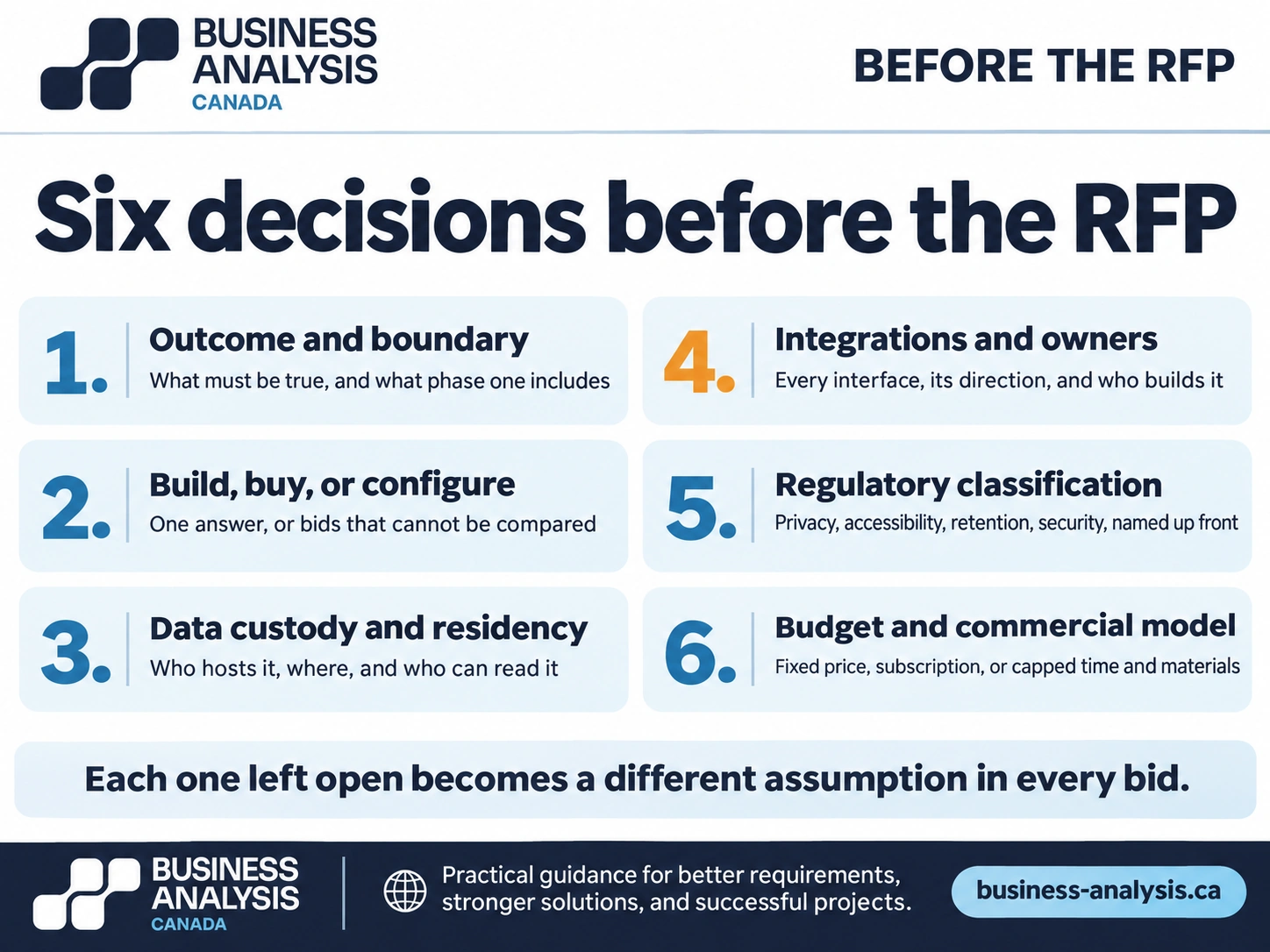
Six, and all of them belong to the buyer, because each one changes what the vendor is pricing. In the case management pattern above, the spread came from exactly these: the RFP had delegated the decisions to the bidders and was then surprised that they decided differently.
- The outcome and the boundary. What the system has to make true, in measurable terms, and which processes, user groups, and sites are inside the first phase. A requirements list without a boundary invites each vendor to draw their own.
- Build, buy, or configure. If you will accept a configured commercial product, say so, and say what you will change in your process to fit it. If you need custom development because the process is the competitive advantage, say that. An RFP open to both receives bids that cannot be compared because they are different things.
- Custody and residency of the data. Who hosts it, in which country, under whose contract, who can read it, and what happens to it when the contract ends. Canadian buyers in health, government, and finance usually have a residency answer already; write it down, because "data stays in Canada" changes the vendor list and the price before a single requirement is read.
- Integrations and who owns each interface. Every system the new one must exchange data with, the direction, the volume, and which side builds and maintains the connector. The one-line "must integrate with our finance system" in the pattern above was worth about $400,000 of the spread on its own.
- Regulatory classification. Which laws and standards apply: PIPEDA or the provincial privacy statute, PHIPA for Ontario health information, Quebec's Law 25, accessibility under the AODA and WCAG, records retention, and the security classification if you are a public body. Name them so vendors price compliance instead of discovering it during contract negotiation.
- The budget envelope and the commercial model. Whether you want a fixed price for implementation and a subscription for the product, time and materials with a cap, or a managed service, and roughly what you can afford. Buyers withhold the budget to keep vendors honest; in practice it produces bids on both sides of the number and nothing you can compare.
In our work these decisions get made in a short discovery before procurement: four to six weeks of current-state mapping, stakeholder interviews, the integration inventory, and the regulatory review, ending in a decision record that the RFP quotes word for word. The requirements elicitation guide covers how the interviews and the observation are run; the point here is that the output is a set of signed decisions, not a longer requirements list.
The failure we see is the RFP assembled by the procurement office from a requirements list the business handed over, with the six decisions still open because nobody owned them. ID Business Analysis Canada runs the pre-RFP work as a Discovery Sprint: a business analyst closes the six decisions with the sponsor, builds the integration inventory, and writes the requirements by business outcome with acceptance criteria, so that procurement receives sections one through six of the RFP already drafted and vendors receive a document they can price.
Key Takeaway: Close six decisions before drafting: boundary, build or buy, data custody, interface ownership, regulatory classification, commercial model. Each one left open becomes a different assumption in each bid.
What sections produce comparable bids?
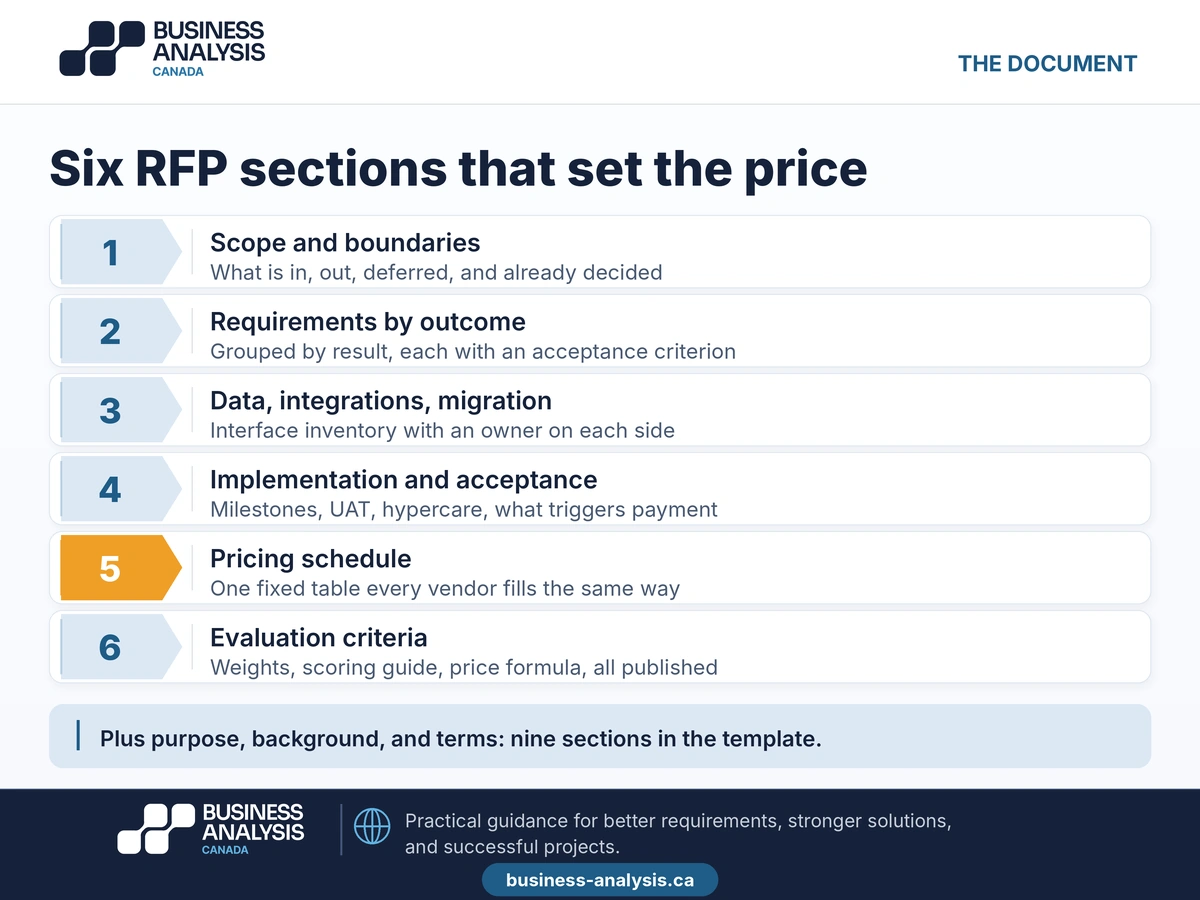
Nine, in a fixed order, with the requirements in the middle and the money and the scoring at the end. The order matters because vendors read an RFP the way students read an exam paper: they find the marks first and work backward. If the evaluation criteria sit on page 40, that is page one for the bid manager.
- Purpose and business outcomes. Two paragraphs on why the system is being bought and the three to five measures that will show it worked. Vendors who understand the outcome propose better than vendors who match features.
- Background and current state. Volumes of users, transactions, records, and sites; the systems in place; the process as it runs today; the known pain. Numbers, not adjectives. "14,000 cases a year, peak of 90 a day in March" lets a vendor size the system; "high volume" does not.
- Scope and boundaries. What is in the first phase, what is explicitly out, what is deferred, and the six decisions, quoted.
- Requirements by business outcome. Functional requirements grouped under the outcome they serve rather than by module or screen, each with an identifier, a priority of mandatory or rated, and an acceptance criterion a tester could run; the acceptance criteria guide gives the form. Then the non-functional requirements with numbers: availability, response time at peak, recovery objectives, retention, accessibility level, languages.
- Data, integrations, and migration. The interface inventory with an owner on each side, the data to be migrated with volumes and known quality problems, and who cleanses what.
- Implementation, transition, and acceptance. The delivery approach you expect, the milestones, training, the user acceptance testing you will run and what passing it means (the UAT guide covers the sign-off), hypercare, and the acceptance step that releases each payment.
- Pricing schedule. One fixed table every vendor completes the same way: subscription or license by year for five years, implementation by milestone, each integration priced on its own line, migration, training, support tiers, hourly rates for change requests, and a mandatory assumptions page. The schedule is what turns three proposals into one spreadsheet.
- Evaluation criteria and process. Mandatory criteria, rated criteria with weights, the price formula, the demonstration script, reference checks, and the timeline from close to award. The next section is about this one.
- Terms, submission instructions, and the question period. The contract terms or the standard agreement attached, service levels, intellectual property, exit and data return, the submission format, the deadline, the single point of contact, and how questions and answers will be shared with every bidder.
Organizing requirements by outcome, in section four, is the single change that most improves the bids. A list of 212 "the system shall" statements sorted by module tells a vendor which screens you expect. Forty requirements under "a caseworker closes a standard case in one sitting without re-keying anything from the intake form," each with an acceptance criterion, tells the vendor what you are buying and lets them propose a better way to get it. It also shortens the document, because the same statement stops appearing under three modules.
The digital wallet post has a wallet-specific version of this structure, organized by transaction state and with the regulatory assignments a payments product needs; the nine sections above are the general form.
Key Takeaway: Nine sections, requirements by outcome with acceptance criteria, and a pricing schedule every vendor fills in the same way. If the three bids cannot be pasted into one spreadsheet, section seven was missing.
How do you write evaluation criteria vendors can see?
Publish them in the RFP, with the weights, the scoring guide, and the price formula, and then score exactly what you published. A vendor who knows the demonstration carries 20 points and the implementation plan carries 15 writes a proposal that answers those sections properly. A vendor guessing at the weights pads every section, and the evaluators drown. Hidden criteria do not produce better bids. They produce longer ones, and a challenge from the vendor who came second.
Two kinds of criteria, kept apart. Mandatory criteria are pass or fail, and a proposal that fails one is out before anyone scores it, so keep the list short and make each item verifiable from the proposal itself: a data residency statement, a WCAG 2.1 AA conformance report, two references for a system of similar size live within the last three years, financial statements. Write them with "must," never "should." The Office of the Procurement Ombud's practice review of Public Services and Procurement Canada files found mandatory criteria written in vague terms, criteria that said "should" where a pass-fail test needed "must," and criteria restrictive enough to appear to favor a supplier, in one case a size and weight requirement that exactly matched the winning product. None of those can be defended at a debrief. Rated criteria carry the weights and separate the compliant bids from each other.
The table shows the grid we start from for a mid-sized business application. The weights move with the project; the structure does not.
Three rules make the grid work. First, the scoring guide for each rated criterion is published with it, so "functional fit" means the four-point code in the table and not a feeling. Second, a minimum technical score before the price envelope is opened, usually 60 to 65 percent of the 70 rated technical points, so a cheap bid that barely clears mandatory cannot win on price alone. Third, price is scored by formula against the lowest compliant bid, taken from the pricing schedule in section seven over the full term, so the vendor with a low year-one subscription and an expensive year three does not score as the cheapest.
Then the hard part: score what you published, and nothing else. Public Services and Procurement Canada's guidance for the assessors who audit its own files says evaluators must follow the scoring guide stated in the solicitation, must not apply criteria that were not in it, and must document a rationale for every score, so that anyone reviewing the award can recreate the selection from the file. Private-sector buyers are not audited that way, and they should evaluate as if they were, because the discipline is what stops a panel from choosing the vendor it liked and backfilling the scores.
Key Takeaway: Publish the criteria, the weights, the scoring guide, and the price formula; set a technical minimum before price is opened; score only what you published. A mandatory criterion uses "must" and is verifiable from the proposal, or it is not mandatory.
What changes for Canadian public-sector RFPs?
Four things: a threshold that decides whether the RFP must be open to all comers, a posting venue and a method fixed by policy, published criteria that stop being good practice and become a rule, and official languages. The structure above does not change. The obligations around it do.
Thresholds first. Federal departments buying services at or above the Canadian Free Trade Agreement threshold, which Treasury Board's Contracting Policy Notice 2025-8 sets at $139,000 for January 2026 through December 2027, are inside the trade agreement rules: open tendering, non-discrimination, and a review route for suppliers who believe the rules were broken. The international agreements, among them the WTO Agreement on Government Procurement and CETA, carry their own higher thresholds, and the notice resets all of them every two years, so quote the current notice rather than a number you remember. Below the thresholds PSPC still competes most purchases; it classes services under $40,000 as low-dollar value, and above that a competitive solicitation applies. Provinces and the broader public sector have their own directives. Ontario's Broader Public Sector Procurement Directive, in the version effective April 13, 2026, requires an open competitive process at $139,000 and above and requires consulting services to be competed at any value.
Posting and method. Federal opportunities are posted on CanadaBuys, which PSPC describes as the official source suppliers should rely on, and bids for opportunities in the electronic procurement system are submitted through SAP Ariba, which means much of section nine is written for you. Provincial and municipal buyers use their own portals or a commercial tendering service, named in the directive or the by-law.
Published criteria as a rule. The Ontario directive requires the procurement documents to set out the mandatory, rated, and other criteria with the weight of each, to disclose the evaluation methodology in full including how ties are resolved, to alter criteria only by addendum once the RFP is out, to keep mandatory criteria to a minimum, and to give the price component the maximum justifiable weight. Federal policy and the trade agreements carry the same substance. Everything in the previous section is therefore compliance in the public sector, and the evaluation file has to show that the panel scored what was published; the Procurement Ombud's reviews turn on exactly that evidence.
Official languages. Treasury Board's 2022 notice on official languages in federal procurement states that the obligations apply to all phases of the procurement process and to contracts of every value, and the guide it introduces covers notices, solicitations, and bid documents. For the RFP writer that means two things. The solicitation goes out in both languages, and the system requirements have to say which languages the product, its documentation, and its support desk must work in, because a bilingual interface is a requirement with a price attached, not a line in the cover letter.
Two smaller things. Public-sector RFPs run a formal question period in which every question and answer goes to all bidders; plan for two rounds and budget the analyst's time to answer them. And accessibility is usually a mandatory criterion rather than a rated one, so the conformance evidence has to be requested in a form a vendor can supply for the version it is proposing. The government industry page describes how we work inside these rules.
Key Takeaway: Check the current threshold notice before choosing the method, post where the policy says, treat published criteria and the evaluation file as compliance, and write the official-languages requirement into the system requirements rather than the cover letter alone.
Frequently Asked Questions
What is the difference between an RFP, an RFI, and an RFQ for software?A request for information asks the market what exists and what it roughly costs, before decisions are made; it is not a competition and produces no binding price. A request for quotation asks for a firm price on a precise specification, usually a commodity, and is decided mostly on price. A request for proposal asks vendors to propose and price a solution to defined requirements, decided on published criteria that weigh fit, approach, team, and price. Software with integration work is an RFP; a license renewal is an RFQ.
How long should a software RFP be?Long enough to carry the nine sections and short enough that a vendor's bid manager reads all of it. For a mid-sized business application that is usually 25 to 40 pages plus the requirements appendix and the pricing schedule. Length comes from requirements written by module and repeated under each one; it falls when requirements are grouped by outcome. Give vendors four to six weeks to respond, more if the question period is formal, and expect the strongest vendors to decline an RFP they cannot price in that time.
How many vendors should you invite to bid on a software RFP?Three to five credible bidders for an invited RFP: enough for a real comparison, few enough that each one believes it can win and invests in the response. Below three the comparison is weak, and above the public-sector thresholds an invited list is usually not allowed at all. Above six, strong vendors decline because the odds are poor, and the evaluation is spent scoring proposals from vendors who should not have been invited. A request for information or a short qualification stage is how the five are chosen.
Who should write the software RFP, and how do we start?The business analyst drafts sections one through six, procurement drafts seven through nine, and the sponsor signs the decision record before anything goes out. Start with the six decisions, not the requirements list. ID Business Analysis Canada runs that start as a Discovery Sprint: four to six weeks that close the decisions with the sponsor, build the integration inventory, and deliver the requirements by business outcome with acceptance criteria and the draft RFP, so procurement issues a document vendors can price on the same basis.
Conclusion
The three bids in the case management pattern were not three opinions about price. They were three answers to the questions the RFP had left open, and the buyer paid for all three: once in the weeks spent reconciling proposals that could not be reconciled, and again in the contract negotiation where the open questions were finally decided, with the vendor holding the pen. The RFP that comes back comparable is the one that was finished before it was sent.
If you are about to issue an RFP for software and the six decisions are still open, ID Business Analysis Canada's Discovery Sprint closes them in four to six weeks and hands procurement the requirements, the acceptance criteria, and the draft document. Book a free consultation and bring the requirements list you have; the first thing we will do is count how many of its lines a vendor could price.
Sources
- Treasury Board of Canada Secretariat, Contracting Policy Notice 2025-8: Trade Agreements: Thresholds Update, December 23, 2025; thresholds for January 1, 2026 to December 31, 2027, updated every two years.
- Government of Ontario, Broader Public Sector Procurement Directive, version effective April 13, 2026; sections 7.2.3, 7.2.9, and 7.2.10 on thresholds, evaluation criteria, and methodology disclosure.
- Public Services and Procurement Canada, Seminar notes: How the government buys what you sell; CanadaBuys as the official source, SAP Ariba submission, low-dollar-value thresholds.
- Global Affairs Canada, Canada's approach to government procurement in international trade; agreements with procurement chapters and the 2026 to 2027 threshold table.
- Office of the Procurement Ombud, Procurement practice review of Public Services and Procurement Canada, 2023; findings on mandatory and rated criteria and on evaluation against the published process.
- Public Services and Procurement Canada, Assessor Guidance Document, 6. Evaluation of proposals; scoring against the stated guide, rationale, and recreating the selection from the file.
- Treasury Board of Canada Secretariat, Contracting Policy Notice 2022-4: Guide to Official Languages in Federal Procurement, December 21, 2022.
- Business Analysis Canada, Before the RFP: Business Analysis for Digital Wallet Projects, business-analysis.ca blog, October 2026.
- Business Analysis Canada, Testable or Not Written: How to Write Acceptance Criteria Developers and Testers Can Use, business-analysis.ca blog, November 2026.
- Business Analysis Canada, UAT Testing Explained: What User Acceptance Testing Is, Who Signs It Off, and What to Check Before Go-Live, business-analysis.ca blog, October 2026.
- Business Analysis Canada, Buying Advice, Not a Pitch: How to Choose a Digital Transformation Consultant, business-analysis.ca blog, October 2026.
- Business Analysis Canada, Ask Better: Requirements Elicitation Techniques and When Each One Earns Its Hour, business-analysis.ca blog, October 2026.