
Buying Advice, Not a Pitch: How to Choose a Digital Transformation Consultant


Share the page:
A digital transformation consultant sells analysis and a plan; a transformation company sells the build; an agency sells the experience layer. Each one's advice bends toward what it sells next, so find that out first. NTT DATA Business Solutions' Transformation Study 2026 found that 39% of transformation leaders struggle most with analyzing the IT they already have, which is the part a pitch skips and an assessment does. Buy the first phase on its own: fixed-price discovery, a dated deliverable list, named people, a do-nothing option in the business case, and an exit gate. This guide covers the three kinds of firm, twelve questions that separate analysis from a pitch, how to structure the engagement so you can stop it, and what a good first four weeks produce.
Introduction
The proposal is forty pages. Pages one to six describe your industry's challenges in language that could apply to any company in it. Pages seven to thirty describe the firm's transformation framework, with a diagram. Page thirty-one is the first mention of your organization by name, and page thirty-eight is the price, which is for twelve months.
You probably arrived here because two or three of those proposals are on your desk and they are hard to compare, since each one describes a different thing: an assessment, a platform, a redesign. They are hard to compare because they are different things, sold by different kinds of firms, and the word "digital transformation consultant" is being used for all three. This guide separates them and gives you the questions to ask before you sign for twelve months of anything.
What does a digital transformation consultant do?
A digital transformation consultant assesses how an organization currently works, its processes, systems, data, and people, decides with you which changes are worth making and in what order, builds the business case for the first of them, and defines it well enough that someone can deliver it. The output is a plan with evidence behind it. What a consultant does not do, in the strict sense of the word, is build the system or run the program; that is delivery, and it is where most of the money and most of the conflict of interest sit.
The analysis is the part buyers undervalue, because it looks like weeks of interviews before anything visible happens. It is also the part transformations most often get wrong. NTT DATA Business Solutions' Transformation Study 2026, drawn from 1,115 executives and transformation leaders across 15 countries, found that 39% struggle most with, in the study's words, "analyzing existing IT landscapes," and that 82% of transformations exceed budget. The two findings describe the same project: nobody fully understood the current state before committing to the future one, and the surprises arrived as invoices.
So the test of a consultant is whether their first phase produces an honest picture of what you have. Not a vision. A current-state assessment with the systems inventoried, the processes observed rather than described, the data quality measured, and the people who do the work interviewed, followed by options with costs and a recommendation you could reject. The two earlier guides on what digital transformation is and which domain to start with cover the content of that assessment; this guide is about buying it.
Key Takeaway: A consultant's product is an evidence-based plan you could act on without them. If the first phase produces a vision deck and a proposal for phase two, you bought a pitch.
Consultant, company, or agency: what are you buying in each case?
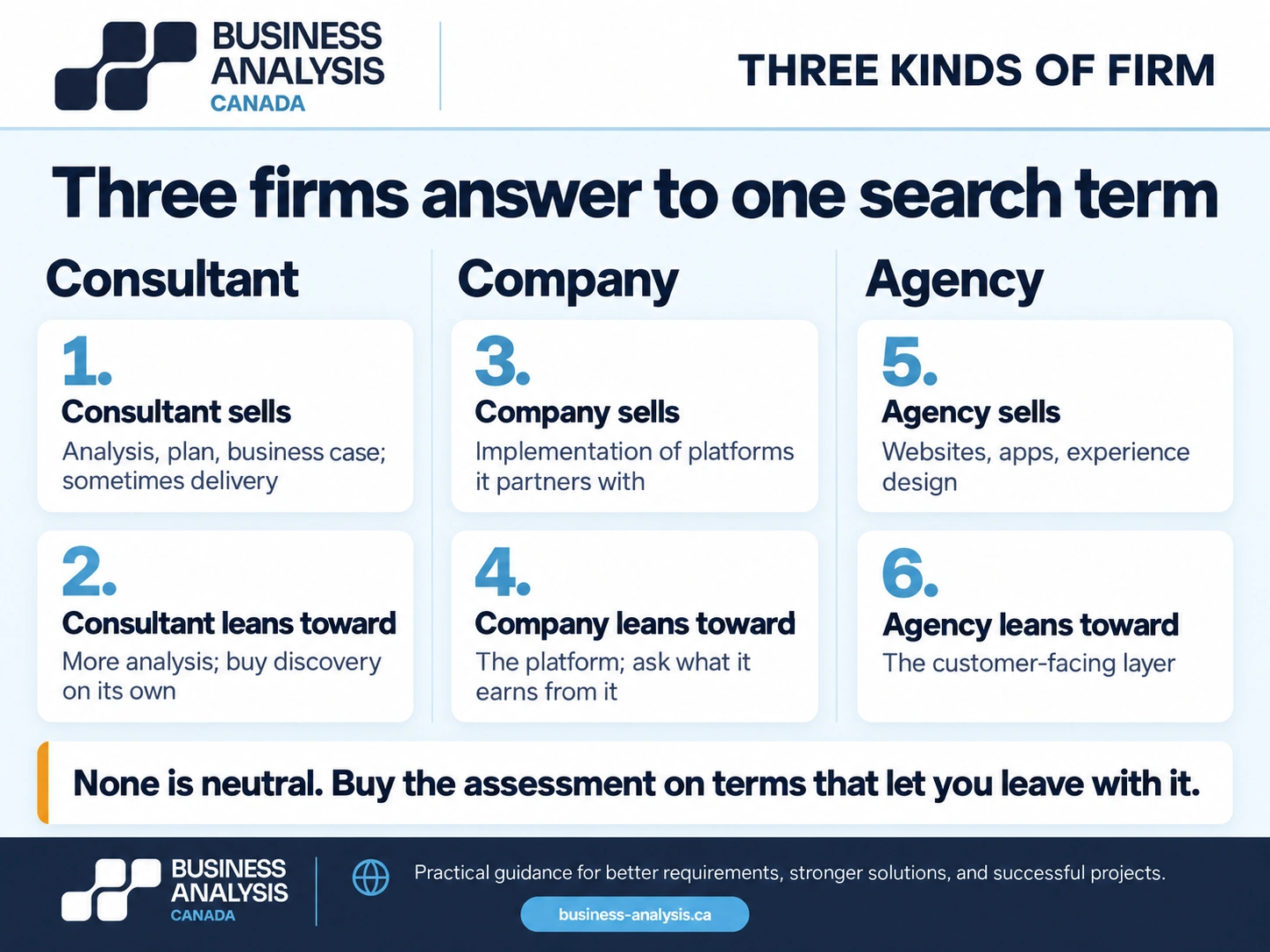
Three kinds of firm answer to the same search, and they differ on what they sell after the assessment, which is the thing that shapes the assessment. A consultant sells analysis and planning, and sometimes the delivery of what it planned. A digital transformation company sells implementation of platforms, often ones it partners with, and the assessment is the path to that sale. A digital transformation agency sells the customer-facing layer, websites, apps, and experience design, and its assessment tends to find that the customer-facing layer is the problem.
None of these is dishonest. Each is a business, and each one's advice bends toward its revenue. The buyer's job is to know which way the bend runs before reading the recommendation. A company that resells an ERP will find your ERP is the problem more often than chance would predict; an agency will find your customer journey; a consultant with a bench of analysts will find you need more analysis. The question is not which firm is neutral, because none is, but which one's bias points in the direction you already needed to go, and whether the contract lets you take the assessment and walk.
The visual below is the chooser we use with clients who have three proposals on the desk.
The honest position for a firm like ours is to say where it sits. ID Business Analysis Canada sells analysis first and delivers some of what it plans, so the conflict exists and is handled by contract: the Discovery Sprint is a separately priced phase with an exit gate, its deliverables are a current-state assessment, a scored option set, a business case with a do-nothing baseline, and a BRD-level scope for the first initiative, and a client who takes those four documents to another firm has received exactly what they paid for. That structure is the thing to demand from whichever kind of firm you choose.
Key Takeaway: Find out what the firm sells after the assessment, and assume the assessment leans that way. Then buy the assessment on terms that let you leave with it.
Which questions separate analysis from a sales pitch?
Twelve, asked in the first meeting, before the proposal is written. The answers matter less than whether the firm has them ready; a firm that has sold analysis before has heard every one of these.
Questions 4 and 10 do the most work, because they are the ones a sales-led firm has not rehearsed. A reseller's margin is not a scandal, but an undisclosed one is a reason to discount every recommendation that lands on that platform. And a firm that cannot recall ever recommending against a partner has either never had the occasion, which is unlikely, or has not noticed, which is worse.
Key Takeaway: Ask what they sell next and when they last recommended against it. The other ten questions are due diligence; those two are the test.
How should you structure the engagement so you can stop it?
Buy the first phase as its own contract, fixed in price, scope, and duration, with the deliverables named, the people named, and a gate at the end where you decide to stop, proceed, or re-scope. Everything after the gate is a separate purchase, priced only once the assessment exists, because a price quoted before the current state is known is a guess dressed as a commitment.
The first phase is discovery, and the discovery phase guide covers how it runs. For a transformation program it is usually four to eight weeks and produces four things: the current-state assessment; a set of options, each with cost, benefit, risk, and the do-nothing baseline they are compared against; a business case for the recommended first initiative; and a scope for that initiative detailed enough to be priced by the same firm or a different one. If the proposal cannot name those four with dates, it is not a discovery proposal.
The gate is where most buyers give away their position. It has to be a real decision point with three outcomes, and "stop" has to be a respectable one: the assessment was worth having even if the answer is to fix two processes and not buy a platform. Write the gate into the contract as the end of the engagement, with any continuation as a new statement of work. Firms that sell analysis as analysis will accept this without discussion; firms that sell what follows will push for a program contract with the discovery folded in as "phase one," and the folding is the point.
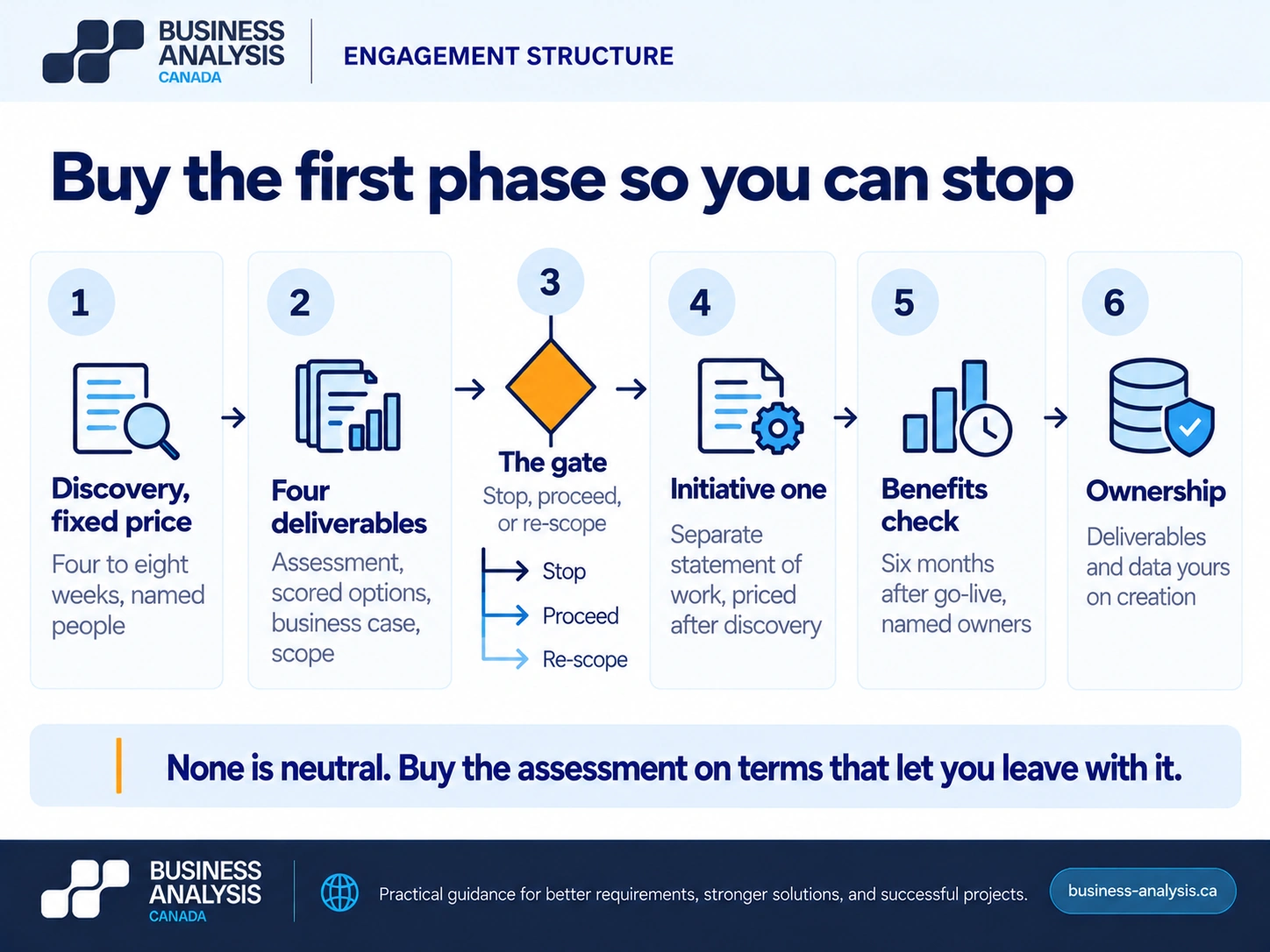
Three clauses complete the structure. Deliverables and data belong to you on creation, so a dispute about an invoice is never a dispute about who owns the assessment. Named people cannot be swapped without your written agreement, because the senior person in the pitch meeting is the thing you bought. And the firm discloses any commercial relationship with a platform it recommends, in the deliverable, next to the recommendation.
Key Takeaway: Discovery as a separate fixed-price contract, four named deliverables, named people, and a three-way gate at the end. Anything that is priced before the assessment exists is a guess.
What does a good first four weeks look like?
Interviews and observation in weeks one and two, a current-state picture you recognize in week three, and options you can argue with in week four. If the firm is presenting a target architecture in week two, it brought the answer with it.
Week one is scope and inventory: the processes in play, the systems that run them, the data each holds, the people who own each one, and the question the sponsor wants answered. Week two is observation and interviews, the analyst sitting with the people who do the work rather than reading the procedure manual, and the first data quality checks, which usually produce the first surprise. Week three is the current-state assessment played back to the people who were interviewed, who correct it; a current state nobody has corrected is a draft. Week four is options: three or four, each costed against the do-nothing baseline, with a recommendation and a reason, and the first version of the business case.
The signals that the firm is doing analysis rather than selling are visible by week two. They are asking for data exports and read-only system access rather than for the executive calendar. Their questions are getting more specific, not more strategic. And the working documents are inventories and process maps, not slides. The pattern we see on the other side is a firm whose week-two deliverable is a "vision workshop" with the leadership team: a pleasant day, and the moment the firm stops gathering evidence and starts gathering sponsorship.
Key Takeaway: By week two they should be asking for data access and sitting with operators. A vision workshop in week two means the recommendation was written before the assessment.
Frequently Asked Questions
What is the difference between a digital transformation consultant and a digital transformation company?A consultant sells analysis and planning: the current-state assessment, the options, the business case, and the scope of the first initiative. A digital transformation company sells implementation, usually of platforms it partners with, and uses an assessment as the path to that sale. An agency is a third kind and sells the customer-facing layer. All three are legitimate purchases; the risk is buying one while believing you bought another. The test is what the firm sells after the assessment and whether its contract lets you take the assessment and stop.
How much does a digital transformation consultant cost in Canada?Ask for two numbers rather than one: a fixed price for the discovery phase, typically four to eight weeks with named people and deliverables, and the pricing model for anything after the gate. Firms that quote a single twelve-month program price before any assessment exists are pricing a guess, usually set by what the budget will bear. The discovery price is the only one that can be compared across proposals, because it is the only phase every firm describes the same way.
Do we need a consultant or a business analyst?If the question is "what should we change and in what order," you need the assessment and the options, which is consulting work done by senior business analysts. If the question is "how do we deliver the change we have chosen," you need analysts on the program: requirements, process design, acceptance criteria, testing. Many organizations need the first for six weeks and the second for a year, and buying both as one contract is how the first gets shaped by the second. See finding a business analysis consultant in Canada.
How do we start with a digital transformation consultant?Write one page first: the problem as the sponsor describes it, the systems involved, the budget envelope, and the decision you need to make by when. Put the twelve questions above to each firm and compare the discovery proposals, not the program proposals. ID Business Analysis Canada starts every transformation engagement with a Discovery Sprint priced as its own contract: a business analyst inventories systems and processes, observes the work, and delivers the assessment, scored options, business case, and first-initiative scope at a gate where stopping is an accepted outcome.
Conclusion
The forty-page proposal described the firm's method, the firm's framework, and a twelve-month price, and mentioned your organization on page thirty-one. That order tells you what you were being sold. A firm selling analysis would have had to ask you questions first, and the proposal would have been shorter and mostly about you.
If you have transformation proposals on your desk and they are hard to compare, ID Business Analysis Canada's Discovery & Strategy practice runs the first phase the way this guide describes: a fixed-price Discovery Sprint, named people, a current-state assessment, scored options with a do-nothing baseline, and a business case and scope you can take to anyone. Book a free consultation and bring the proposals; the first thing we will do is find page thirty-one in each of them.
Sources
- NTT DATA Business Solutions and Natuvion, Transformation Study 2026; 1,115 CEOs, CIOs, IT decision-makers and transformation leaders across 15 countries; 39% struggle most with analyzing existing IT landscapes; 82% exceed budget.
- Business Analysis Canada, Past the Slogan: What Is Digital Transformation in Practice?, business-analysis.ca blog, September 2026.
- Business Analysis Canada, Where to Start: Digital Transformation Domains and the Plan That Sequences Them, business-analysis.ca blog, September 2026.
- Business Analysis Canada, Guarding the Gate: The Value of a Project Discovery Phase in IT Strategy, business-analysis.ca blog, August 2026.
- Business Analysis Canada, Business Analysis Consultant Near Me: Canada, business-analysis.ca blog.