
Robotic Process Automation in Healthcare: Canadian Use Cases and the Privacy Rules That Shape Them


Share the page:
Robotic process automation in healthcare means software bots doing the administrative work around care: referral intake, claims reconciliation, scheduling, supply reorder, credential renewals. It never touches clinical judgment; drawing that line is the first job. The Canadian Federation of Independent Business put physician red tape at 20 million hours a year in January 2026, nearly half of it work that does not need a physician; that is RPA's pool. What US guides miss is the law: a bot that reads a record is an agent of the custodian under PHIPA and its provincial equivalents, so logging, least access, and breach handling are requirements. This guide covers the candidates, the refusals, the obligations a bot inherits, how to specify one that survives a portal change, and where to start.
Introduction
The referral arrives by fax. It is printed, stamped with the date, walked to the clerk who types the demographics into the scheduling system, then to the triage nurse who reads the clinical note, then back to the clerk who calls the patient. Four people have handled a piece of paper, and the only step that needed a clinician was the second one.
That is the shape of most automation candidates in Canadian healthcare: a chain of administrative steps wrapped around one moment of judgment. The guides that rank for RPA in healthcare are written for US revenue cycle teams and talk about prior authorizations and payer denials. Canadian hospitals, clinics, and health authorities have different processes, different payers, and a different legal frame, and a bot designed without that frame is a privacy incident with a schedule.
What is robotic process automation in healthcare?
Robotic process automation in healthcare is software that performs repetitive, rule-based administrative tasks across existing systems the way a clerk would, by logging in, reading fields, copying data, and submitting forms, without changing those systems. The general definition and the boundary of what a bot should ever touch are covered in what robotic process automation is; this post applies that boundary to health settings.
The pool of work is large. The Canadian Federation of Independent Business, in its January 2026 report on physician red tape, estimated that Canadian physicians lose 20 million hours a year to administrative work, more than one full day a week each, and that nearly half of it does not require a physician's expertise. Physicians are one role; the same pattern runs through clinic clerks, health records staff, scheduling offices, and finance teams reconciling provincial payments. RPA works on the half that does not need a professional, and only on the part of that half that follows rules a machine can read.
What it is not: a clinical decision tool, a replacement for the electronic medical record, or a way to move health information somewhere new. A bot that moves a referral from a fax queue into a scheduling system has not created a new record; it has done a clerk's step faster and with a log. That framing matters for the privacy analysis later, and it is also the test that separates good candidates from bad ones.
Key Takeaway: RPA in healthcare automates the administrative chain around a clinical decision, never the decision. If a step needs a professional's judgment, the bot stops and hands it over.
Which healthcare processes are RPA candidates, and which are not?
The candidates are high-volume, rule-based administrative steps on stable systems where the data a bot needs is already in a field; the non-candidates are anything that decides care, interprets a clinical note, grants access to a record, or handles consent. Most Canadian organizations have five to ten of the first kind running on paper, fax, and re-keying today.
The visual below is the same boundary as a map: the administrative ring a bot may work in, the clinical and consent core it may not enter, and the hand-off points between them.
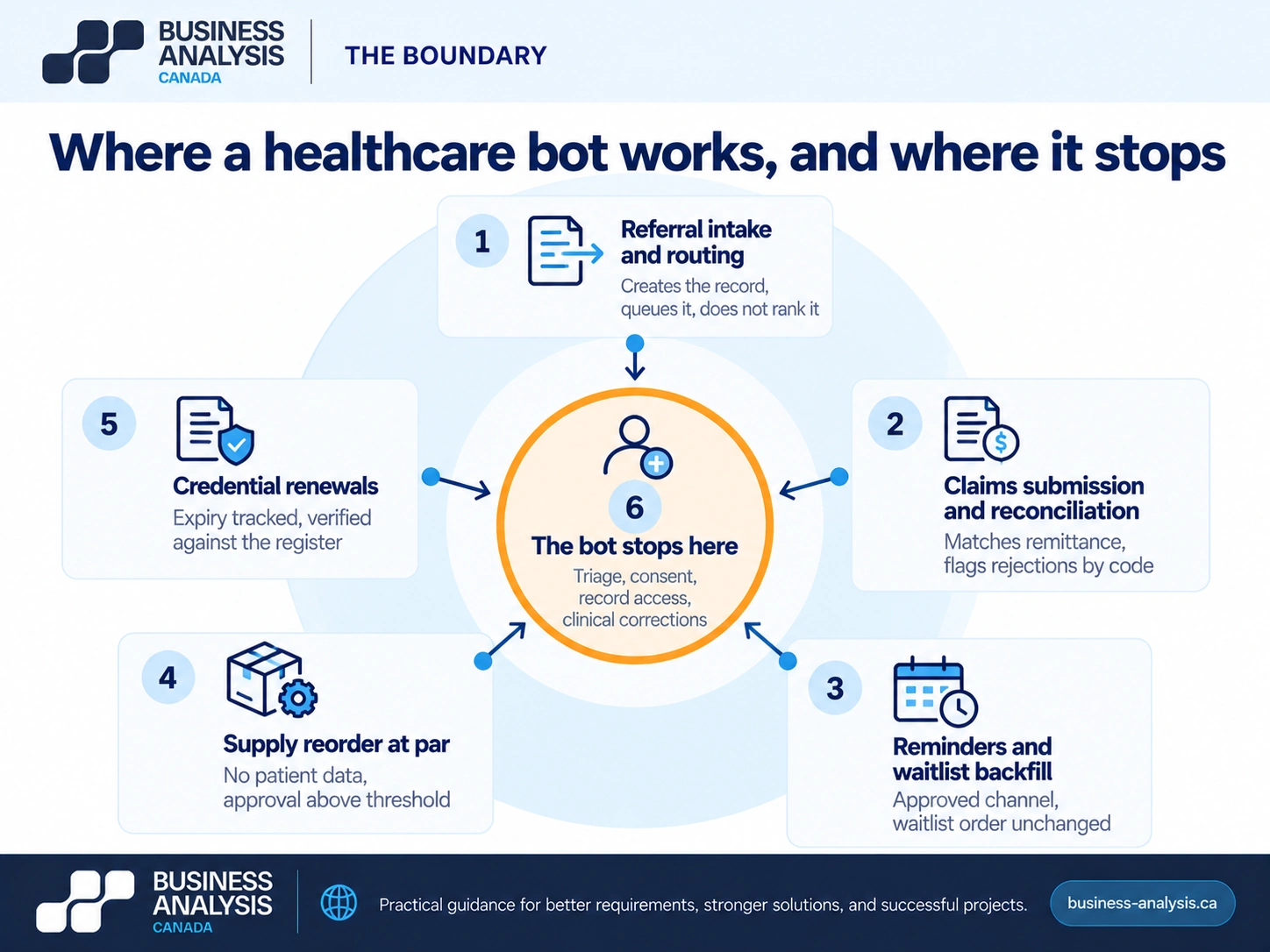
The failure we see most often is a bot scoped by enthusiasm rather than by this table: it starts in referral intake, proves useful, and six months later someone has extended it to "pre-sort by urgency" because the keywords are right there in the note. At that point a piece of software is making a triage decision with no professional accountability and no audit of why. ID Business Analysis Canada scopes bots inside its Low-Code and RPA solution the way the multi-function RPA program in its case studies was run: more than 40 candidate processes scored before any were built, business exceptions routed to a person and kept separate from system exceptions, and each bot specified in a process design document that names the step where it stops.
Key Takeaway: Candidates are administrative, rule-based, and already in a field. Triage, access, consent, and corrections are out before scoring starts, and the stop point is written into the specification.
What do PHIPA, provincial privacy law, and PIPEDA require of a bot?
In Ontario, a bot that collects, uses, or discloses personal health information on behalf of a hospital or clinic is acting as an agent of a health information custodian under the Personal Health Information Protection Act, and the custodian remains responsible for what it does. Every other province has a comparable statute with the same structure: Alberta's Health Information Act, Quebec's health information law alongside Law 25, British Columbia's E-Health Act and public-sector privacy legislation, and the health privacy acts of Manitoba, Saskatchewan, and the Atlantic provinces. PIPEDA applies to private-sector health activity where a provincial law has not been declared substantially similar. The names differ; the obligations a bot inherits are close to identical.
Four of them shape the design. Least access: the bot gets its own service account with the minimum permissions for its task, never a shared login borrowed from a clerk, because the law and the audit both need to know who did what. Logging: PHIPA was amended in 2020 to provide for electronic audit logs recording the viewing, handling, and modification of personal health information, producible to the Information and Privacy Commissioner, and whatever the in-force status of a given provision on the day you deploy, the design requirement is the same: every bot access logged with who, what, when, and whose record, in a form a privacy officer can read. Retention and location: bot logs, screenshots, and temporary files are health information too; they need a retention rule and a storage location that satisfies the custodian's residency position. Breach response: a bot that posts data to the wrong queue has caused a privacy breach, and the response plan must name who is told and how fast, which in most provinces includes the patient and the commissioner above a threshold.

Two practical consequences. The vendor who hosts the bot platform is, in Ontario terms, usually an electronic service provider to the custodian, which means the contract has to say what they may and may not do with the information, and that includes support staff looking at logs. And a privacy impact assessment is not a formality at the end; in a custodian organization it is where the bot's access, logging, and retention get decided, so it belongs in discovery. Confirm the specifics for your province with counsel or your privacy officer; the pattern is what the design needs.
Key Takeaway: Own account, full log, retention rule, breach plan. Write the four into the bot's requirements before build, and do the privacy impact assessment in discovery rather than after.
How do you specify a healthcare bot so it survives a form change?
Specify the exceptions before the happy path, give every exception a human queue, and treat the systems the bot touches as things that will change without telling you. The happy path on a referral bot is nine steps. The exceptions, once written down, are more: an illegible fax, a missing health number, a duplicate patient, a referral to a clinic that no longer accepts the type, a portal that added a mandatory field overnight. Bots that were specified from the happy path are the ones that break in production.
The specification has six parts. The trigger and the volume: what starts a run, how many per day, when the peak falls (Monday mornings in most clinics). The data contract: every field the bot reads or writes, its source, and what the bot does when it is empty or malformed. The business rules, written as "if X then Y" with X readable from a system; a rule that needs a person to interpret is an exception path, not a rule. The exception queue: who receives what, with what information, within what time, and how they clear it. Change detection: the bot checks that the screen or form it expects is the one it sees, and stops rather than guessing when it is not. And the audit record: the log line each step writes, in the format the privacy officer agreed.
The pattern we see is the portal change. A provincial billing portal adds a field; the bot that was reading positions on a screen fills the wrong box for three days before the rejection codes come back. A bot specified with change detection stops on day one and queues the claims; a bot specified from the happy path keeps going. The difference is a requirement, not a tool.
Key Takeaway: Exceptions first, every one with a human queue, and a stop rule when the screen changes. A healthcare bot that keeps going when it is unsure is the one that ends up in a breach report.
Where should a Canadian hospital or clinic start?
With one administrative process that has high volume, stable source systems, no clinical judgment anywhere in it, and a privacy profile the custodian is comfortable with, run as a four-to-six week discovery before anything is built. Claims reconciliation and supply reorder fit that description more often than referral intake, which is the process people want first and the one with the most exceptions.
The discovery does five things. Observes the process as it is done in practice, three real cases end to end, because the procedure manual describes a version nobody follows. Counts: volumes, time per case, error and rework rates, so the benefit is a number rather than an adjective. Scores the candidates against the boundary in this guide and against technical stability. Runs the privacy impact assessment with the privacy officer, which settles the account, logging, and retention decisions. And produces the specification above for the first bot, with its acceptance criteria and a hypercare plan for the first two weeks after it goes live. The discovery phase guide covers the gate at the end of it.
One warning on measuring success. Hours saved is the number vendors quote and the one finance distrusts, because the hours rarely come off a payroll. Measure the things the organization feels: days from referral receipt to first contact, claims rejected on first submission, stock-outs, overtime in the health records office. If those do not move, the bot is running and the process is not better.
Key Takeaway: Start with claims or supply, not referrals. Six weeks of discovery with the privacy officer in the room, and a success measure the organization already tracks.
Frequently Asked Questions
Is RPA in healthcare compliant with PHIPA and provincial privacy law?It can be, and the compliance is in the design rather than the tool. A bot that handles personal health information acts as an agent of the custodian, so it needs its own service account with least access, a complete audit log of every record it touches, a retention rule for its logs and temporary files, and a place in the breach response plan. Those four are written before build, confirmed in a privacy impact assessment, and verified in testing. A bot on a borrowed login is not compliant.
What are the most common RPA use cases in Canadian healthcare?Referral intake and routing, provincial claims submission and remittance reconciliation, appointment reminders and waitlist backfill, supply reorder at par level, staff credential and license renewals, and health records requests that follow a fixed rule. All of them are administrative steps around care. The processes that do not qualify are triage, consent and lockbox handling, record access decisions, and clinical corrections, because each requires a professional's judgment and the accountability that goes with it.
Does an RPA bot read patient records?Often, yes, which is why it is treated as an agent of the custodian. A referral bot reads demographics and the referral reason; a claims bot reads health numbers and service codes. The design response is to give the bot the narrowest access that lets it do the step, log every read and write, and keep it out of free-text clinical notes unless the step cannot be done without them. Supply and credential bots usually read no patient data at all, which is one reason they are good first projects.
How do we start an RPA project in a hospital or clinic?Pick one administrative process with high volume and no clinical judgment in it, and run a discovery before any bot is built. ID Business Analysis Canada runs this as a Low-Code and RPA discovery: a business analyst observes the process, counts volumes and rework, scores candidates against the clinical and consent boundary, works through the privacy impact assessment with your privacy officer, and delivers the process design document and acceptance criteria for the first bot. The custodian signs the specification, including the step where the bot stops, before build starts.
Conclusion
The fax still arrives. What changes is who carries it: a bot that creates the record, enters the demographics, and queues it for the nurse, logs every step under its own name, and stops the moment the form looks different. The nurse still reads the note. That is the whole design, and most of the work is deciding where the bot stops and proving it does.
If your organization has administrative processes running on fax, paper, and re-keying and a privacy officer who is rightly cautious, ID Business Analysis Canada's Low-Code and RPA practice runs the discovery described here: process observation and counts, candidate scoring against the clinical boundary, the privacy impact assessment, and a bot specification with its stop points and audit record defined. Book a free consultation and bring the process everyone complains about; the first thing we will do is find the one step in it that needs a clinician.
Sources
- Canadian Federation of Independent Business, Patients before Paperwork
- McCarthy Tétrault, Amendments to Ontario's health information legislation bring new obligations and penalties, June 2020; electronic audit log provisions (s. 10.1), administrative penalties (s. 61.1), de-identification.
- Ontario, Personal Health Information Protection Act, 2004, consolidated statute.
- Business Analysis Canada, Robotic Process Automation Across Business Functions, case study: more than 40 candidate processes scored, business and system exceptions separated, dedicated service accounts, credentials in vaults, two-week hypercare per bot.
- Business Analysis Canada, First Principles: What Is Robotic Process Automation, and What Should It Touch?, business-analysis.ca blog, September 2026.
- Business Analysis Canada, Why RPA Bots Break in Production, business-analysis.ca blog.
- Business Analysis Canada, Guarding the Gate: The Value of a Project Discovery Phase in IT Strategy, business-analysis.ca blog, August 2026.