
Under the Hood: Why Complex Initiatives Need a Technical Business Analyst



Share the page:
Most enterprise builds touch a dozen systems before they touch a single user. The average organization now runs 957 applications and has only 27% of them connected, so the hard part of a project sits in the gaps between systems rather than inside any one of them. A generalist business analyst writes down what the business wants. A solution architect decides how the platform holds together. The work in between, field-level data contracts, error and exception behaviour, and acceptance criteria a tester can run without asking a developer what was meant, belongs to a technical business analyst. This guide covers what the role owns, how it differs from a business systems analyst, and when to bring one on.
Introduction
You probably found this page after a status meeting that went sideways. Development said the requirement was ambiguous. The business said it was obvious. Both were telling the truth, because the requirement described an outcome and the build needed a contract.
That gap is where complex initiatives quietly lose their schedule. Not in the coding, and not in the workshops. In the space between a signed-off business requirement and the thing a developer has to type.
What does a technical business analyst do on a project?
A technical business analyst translates business intent into specifications a build team can implement without guessing, covering data structures, system behaviour, integration contracts, and testable acceptance criteria.
The generalist version of the role stops at the boundary of the business process. A technical business analyst keeps going. When the business says "the customer record should sync to the billing system," the technical analyst is the person who asks which fields, in which direction, on what trigger, at what frequency, and what should happen when the billing system rejects the payload at 2 a.m. on a Saturday.
Those questions look pedantic in a requirements workshop. They are the entire project in month seven.
The pattern we see most often on integration-heavy builds is a requirements document that reads beautifully and specifies nothing enforceable. Every sentence is true. None of them can be tested. An integration requirement written without a field-level contract is a wish with a ticket number attached.
Key Takeaway: If a requirement cannot be turned into a test case by someone who was not in the room, it is not finished.
Need this discipline on a live build? Our Analysis & Design practice covers exactly this layer. Book a free consultation.
Why do complex initiatives break in the gaps between systems?
Because the number of systems has grown far faster than the number of connections between them. MuleSoft's 2026 Connectivity Benchmark Report, based on interviews with 1,050 IT leaders, found that the average organization manages 957 applications and has only 27% of them connected.<sup>[1]</sup>
Read that as a workload rather than a headline. Every disconnected pair is a manual process, a spreadsheet, or a nightly file someone maintains by hand. When a new initiative arrives, it inherits all of it. The project scope says "add a customer portal." The real scope is the portal plus whatever undocumented behaviour is currently holding the seams together.
A generalist analyst maps the business process and moves on. A technical analyst goes and reads the file, finds the four fields nobody documented, and discovers that the finance team has been correcting one of them manually since 2019. That discovery is worth more than a month of workshops, and it only happens if somebody's job is to look.
Common places we find the unwritten rules:
- Reconciliation spreadsheets maintained outside the system of record
- Email approvals that gate a process step with no system equivalent
- Legacy field values reused for a second meaning after a merger
- Batch jobs whose failure handling is a person checking a folder each morning
Key Takeaway: Budget discovery time for the connections, not the applications. The applications are documented. The connections rarely are.
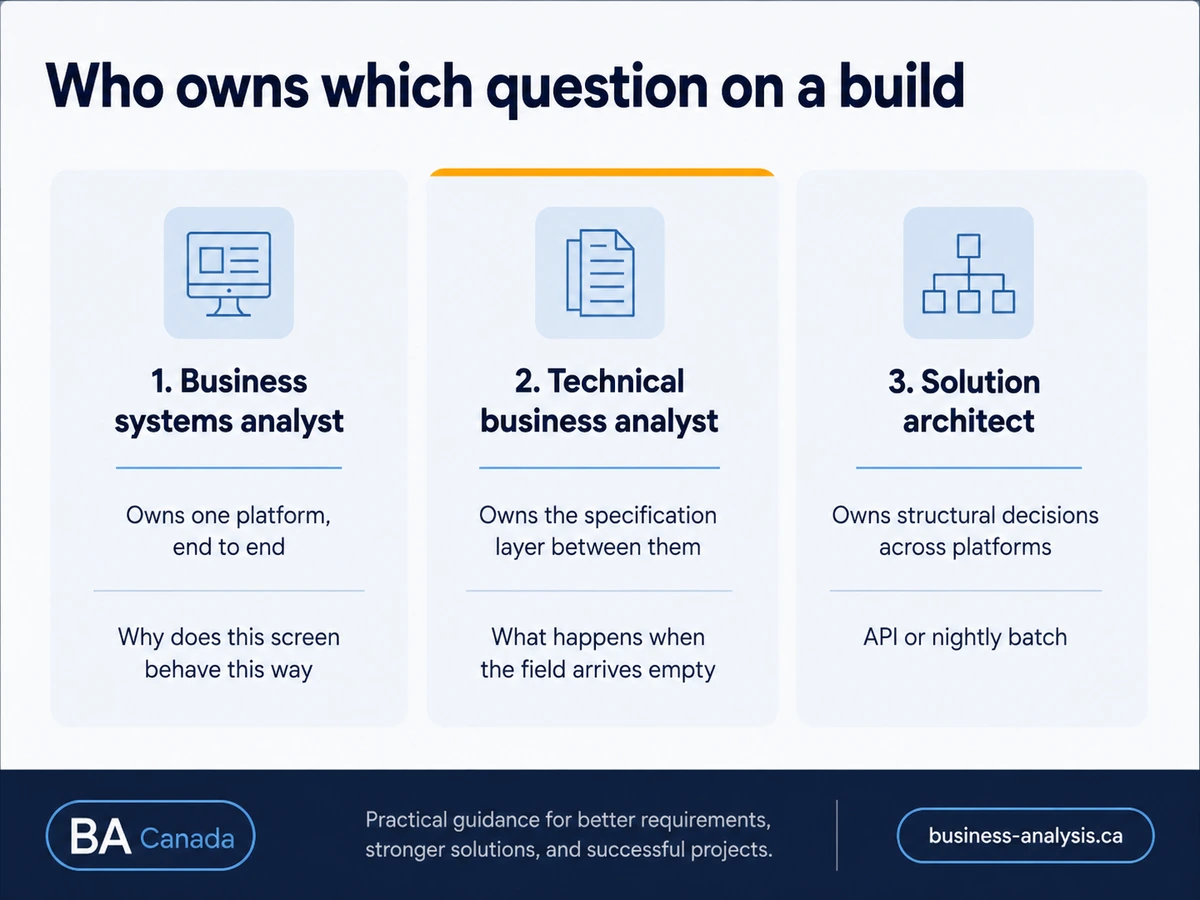
How is a technical business analyst different from a business systems analyst or an architect?
The three roles overlap in title and separate in deliverable. A business systems analyst usually sits closer to one platform and owns its configuration and behaviour. A solution architect owns structural decisions across platforms. A technical business analyst owns the specification layer between them.
In practice the split is easiest to see by asking who gets called when something is wrong. If the question is "should this be an API or a nightly batch," that is architecture. If the question is "why does this ERP screen behave that way for the operations team," that is systems analysis. If the question is "what exactly is supposed to happen when field X arrives empty," that is the technical business analyst, and on most projects nobody has been assigned to answer it.
Titles are unreliable across organizations, so hire against the deliverable rather than the label. Ask a candidate to show a functional specification they wrote and read the exception handling section. That single section tells you more than an hour of competency questions.
Key Takeaway: Match the role to the artifact you are missing, not to the job title you are used to posting.
What is the difference between a BRD and a functional requirements document?
A business requirements document states what the organization needs and why. A functional requirements document states what the system must do in response, in enough detail to build and test against. The comparison below is the one buyers ask about most, and getting it wrong is a reliable way to start a build on a document that cannot support it.
The failure we see repeatedly is a BRD promoted to build document because the schedule was tight. It holds until the first integration defect, then the team spends three weeks reconstructing intent from meeting notes.
A use case document template helps, though the template is not the value. The value is the alternate flows, the part most teams delete to save time. If your template has a section called "exceptions" and it is empty on every page, the template is doing nothing for you.
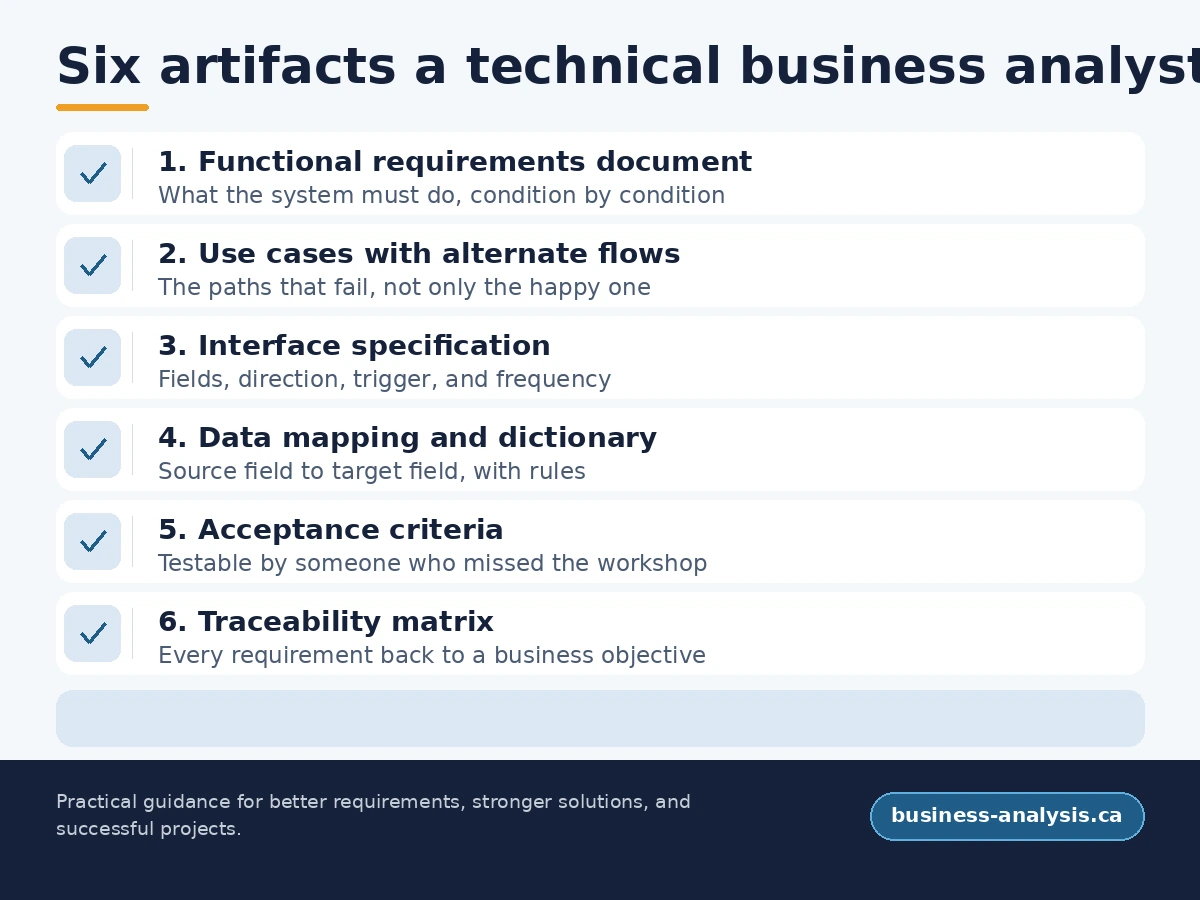
Checklist of six specification artifacts a technical business analyst produces on a complex build
Key Takeaway: No build starts against a BRD alone. Either the FRD exists, or the developers are writing it themselves in code, undocumented.
When should you bring a technical business analyst onto the project?
Bring one in before the solution is selected, not after the contract is signed. Vendor selection made without a field-level view of the data usually produces a platform that fits the demo and fights the business.
Four signals that you need the role now:
- The initiative touches three or more systems that must stay in sync
- A vendor or system integrator is asking for specifications you do not have
- Your last release generated defects that were re-argued as requirements disputes
- Data has to be migrated, reconciled, or corrected as part of the work
If none of those apply, a generalist analyst is likely enough, and I would rather tell you that than sell you a heavier engagement. Most process improvement work does not need this depth. Integration work always does.
For teams without the capability in-house, an embedded analyst is usually faster than a hire. Our BA Roles placements exist for this shape of gap.
Key Takeaway: The cheapest moment to add the role is before the vendor contract. The most expensive is after user acceptance testing has started.
Frequently Asked Questions
Is a technical business analyst the same as a business systems analyst?They overlap but are not identical. A business systems analyst usually specializes in one platform and owns its configuration, behaviour, and support. A technical business analyst works across systems and owns the specification layer between business intent and build, including interface contracts and testable acceptance criteria. On small teams one person does both jobs. On multi-system programmes they are separate seats.
Does a technical business analyst need to write code?No, though the role has to read it and question it. What matters is fluency in data models, APIs, and integration patterns, plus the ability to hold a design conversation with developers without deferring on every point. Reading SQL and interpreting an API response are reasonable expectations. Shipping production code is not part of the job.
What documents does a technical business analyst produce?A functional requirements document, use case or user story sets with acceptance criteria, interface and data mapping specifications, business rules, and a traceability matrix linking each requirement back to a business objective. On data-heavy work, add a data dictionary and reconciliation rules.
When is a generalist business analyst enough?When the work stays inside one system and the change is procedural rather than structural. Process redesign, policy changes, reporting improvements, and training-led adoption work rarely need field-level specification. Once the change crosses a system boundary or moves data that finance depends on, the deeper role earns its cost.
Conclusion
Complex initiatives do not fail because the technology was wrong. They fail because nobody was accountable for the specification layer, so the developers filled it in with assumptions and the business found out at UAT.
Give that layer an owner. If you are scoping an initiative that spans several systems and you are not sure whether your current analysis will hold up against a build team, book a free consultation and we will tell you honestly what is missing.
Sources
- MuleSoft, 2026 Connectivity Benchmark Report insights, February 2026. https://blogs.mulesoft.com/agentic-perspectives/connectivity-benchmark-report/