
AI Readiness Assessment: A Checklist for Canadian Organizations Before the First Pilot



Share the page:
An AI readiness assessment scores an organization on six areas before its first pilot, with evidence rather than self-ratings: data, process, people, governance, technology, and value. Statistics Canada reported in May 2026 that 19.2 percent of businesses used AI to produce goods or deliver services, up from 12.2 percent a year earlier, so most pilots now starting are first pilots. The checklist on this page scores each area 0 to 3, names the evidence that earns the score, and names the finding that stops the pilot. Federal institutions add the Algorithmic Impact Assessment; private-sector organizations work under PIPEDA, Quebec's Law 25, and, for financial institutions, OSFI's model risk guideline. Canada has no federal AI statute in force. A Copilot section covers permissions and oversharing.
Introduction
The version we see most often is the pilot that ran before the question. A claims team pilots a generative AI assistant for drafting customer letters. Three weeks in, the assistant cites a policy clause that was superseded two years ago, because the document library it was pointed at holds four versions of every policy and nobody had said which one was current. The pilot is paused, written up as a failure of the tool, and the budget moves to something else. The tool did what it was told. The organization had not checked whether its documents, its permissions, or its rules were in a state to be told anything.
If you searched for an AI readiness assessment, you are probably somewhere between a vendor demo and a first pilot, and you want to know what to check before money and reputation go into it. The assessment below is written for that moment. It scores six areas with evidence, it says which findings stop a pilot, and it covers the two regulatory tracks a Canadian organization is on, federal or private, plus the Copilot pilot that most mid-size organizations are about to run. What follows covers what the assessment is, the six areas, how each is measured, what changes for federal institutions and regulated industries, and how to check Copilot readiness.
What is an AI readiness assessment?
An AI readiness assessment is a structured, evidence-based review of whether an organization can run an AI initiative safely and get value from it, completed before the first pilot and repeated before each expansion. It scores a fixed set of areas, states the evidence behind each score, identifies the findings that would stop a pilot, and ends in a recommendation: which use case to pilot first, under which conditions, or what to fix before piloting anything.
It is not a maturity model. An AI maturity assessment places an organization on a ladder from "exploring" to "transforming" and is useful for a board slide; a readiness assessment answers a narrower question, whether this organization can run this pilot now, and it is useful for the person who has to sign the pilot off. It is also not a vendor's readiness check, which measures readiness for the vendor's product and tends to find that the organization is ready for exactly that. And it is not the AI strategy; the enterprise AI strategy post covers how pilots are chosen and taken to production, and names the readiness assessment as the step that precedes the choice.
The timing matters because first pilots are now the common case. Statistics Canada's Canadian Survey on Business Conditions for the second quarter of 2026, released in May, reported that 19.2 percent of businesses had used artificial intelligence to produce goods or deliver services in the previous twelve months, up from 12.2 percent in the same quarter of 2025. The adoption curve is steep, which means a large share of the organizations piloting this year have never run one, and the failure in the opening pattern is the one they are about to have.
Readiness is specific to the initiative. An organization can be ready for a Copilot pilot in the finance team and not ready for a model that scores customer applications, because the second one touches personal information and a decision about a person, which pulls in the regulatory track in the fourth section. The assessment is therefore scored twice: once for the organization as a whole, and once for the candidate pilot, with the pilot score the one that decides.
Key Takeaway: An AI readiness assessment scores six areas with evidence before the first pilot and ends in a recommendation, which pilot under which conditions, or what to fix first. It is not a maturity ladder and not a vendor's product check.
Which areas does an AI readiness assessment score?
Six, and the order matters, because the first two decide whether the last four are worth scoring. Each area has three or four questions, a 0 to 3 score, and a named piece of evidence; the next section shows how the scoring works.
- Data. Does the data the initiative needs exist, is it accurate, is it current, is one version authoritative, is it classified, does the organization know where it is stored and who can read it, and is any of it personal information? The claims team's four versions of every policy is a data finding. So is the customer table with three address fields. The legacy system assessment post describes the data profile that produces this evidence; the BI adoption gap post describes what happens when it is skipped.
- Process. Is the process the AI will join documented and measured, and is the decision point where a model would contribute named? A model that drafts letters joins a process with a reviewer; a model that scores applications joins a process with an approver. If nobody can draw the process, nobody can say where the AI goes or who checks its output.
- People. Who will use the output, who will check it, who will own the model, and do they have the time and the skills? Readiness here is not enthusiasm; it is a named reviewer with hours in the week and a named owner who will answer when the output is wrong.
- Governance. Is there an AI use policy that says what may be pasted into a tool, generated, and sent out; an inventory of AI already in use; a privacy assessment process; a named accountable executive; and a way to log and explain what a system did? The regulatory track in the fourth section is scored here.
- Technology. Identity and permissions, integration paths to the systems that hold the data, separate environments for pilot and production, logging, and the hosting region. Most of this exists in a mid-size organization; the question is whether it is in a state the pilot can rely on, and permissions are where it usually is not.
- Value. One candidate use case with a measurable outcome, a baseline measured today, and a manager who owns the result. "Improve productivity" is not a use case. "Reduce the time to first draft of a standard letter from forty minutes to ten, measured over four weeks in the claims team, owned by the claims manager" is.
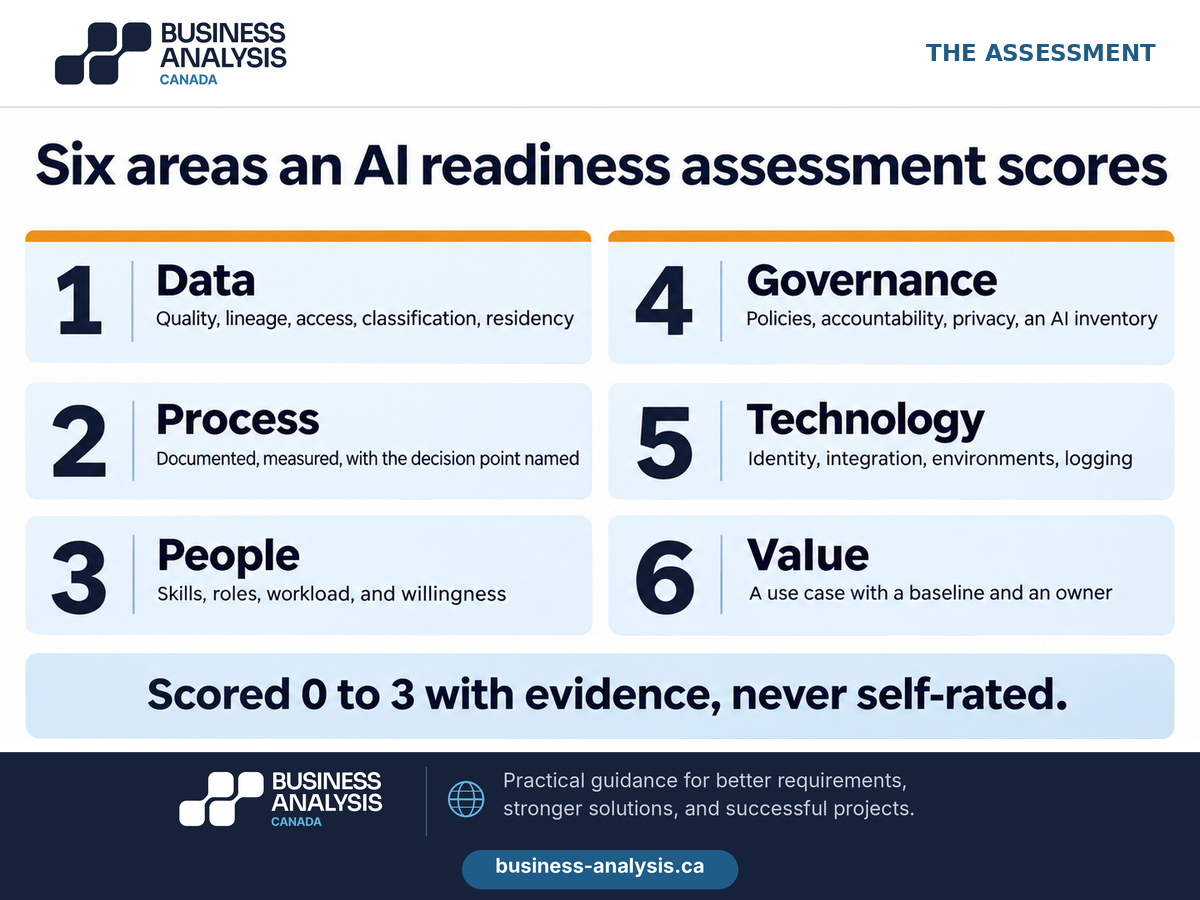
Two areas are gates. A low data score or a low governance score stops any pilot that touches personal information or a decision about a person, whatever the other four say, because those two are where the regulatory and reputational damage lives. The other four lower the ambition of the pilot rather than block it: a weak people score means a smaller pilot with more review; a weak technology score means a pilot inside one system rather than across three.
The failure we see is the assessment done as a survey, with managers rating their own areas three out of three and the pilot approved on the average. ID Business Analysis Canada runs the readiness assessment as a Discovery Sprint ahead of the first pilot: a business analyst scores the six areas from evidence, the data profile, the process map, the permissions review, and the policy inventory, rather than from interviews alone, identifies the regulatory track the candidate pilot is on, and delivers the scored checklist with the findings that must be fixed before the pilot and a recommendation of which pilot the scores allow.
Key Takeaway: Six areas: data, process, people, governance, technology, value. Data and governance are gates for any pilot touching personal information or a decision about a person; the other four set the size of the pilot rather than stop it.
How do you measure AI readiness?
With evidence, not opinion, on a 0 to 3 scale per question, where 0 means absent, 1 means exists but unreliable, 2 means reliable for the pilot, and 3 means reliable for production. The score is only as good as the evidence column, so the table lists what has to be produced to earn it and the finding that stops the pilot. An assessment that cannot show the artifact has scored a hope.
Read the scores as a profile, not a total. A total hides the gate. An organization scoring 2 on everything except data, where it scores 0, is not "ready at 83 percent"; it is not ready, and the fix is a data clean-up measured in weeks, after which the same pilot may be scored 2 and run. The written output of the assessment is therefore three lists: findings that must be fixed before the pilot, findings that shape the pilot (smaller scope, more review, one system), and findings that can wait until production.
Four measurement habits separate a usable assessment from a survey. Sample the data rather than asking about it: pull two hundred records and count. Walk the process rather than describing it: the elicitation guide covers observation, and for readiness it is the technique that finds the undocumented spreadsheet the model would never see. Run the permissions report rather than assuming the permissions: the Copilot section below explains why. And write the value line as a requirement with an acceptance criterion, in the form the acceptance criteria guide describes, so the pilot has a pass condition before it starts.
The assessment also settles what kind of system is being piloted. A tool that drafts for a human reviewer and a system that acts on its own are different contracts with different readiness bars, and the agentic versus generative post sets out the difference; a first pilot should almost always be the first kind.
Key Takeaway: Score each question 0 to 3 against named evidence: a data profile, a process map, a role list, a policy inventory, a permissions report, a pilot charter. Read the result as a profile with gates, and write three lists: fix before, shape the pilot, defer to production.
What changes for federal institutions and regulated industries in Canada?
The governance area gets a defined checklist instead of a judgment, and which checklist depends on who you are. Canada has no federal statute regulating artificial intelligence in force: the Artificial Intelligence and Data Act was part of Bill C-27, and the bill died when Parliament was prorogued in January 2025. What applies instead is a directive for federal institutions, privacy law for everyone, a provincial statute with specific rules on automated decisions, and a prudential guideline for financial institutions. The assessment identifies the track and scores governance against it.
Federal institutions. The Treasury Board's Directive on Automated Decision-Making applies to systems that make or inform administrative decisions, and its instrument is the Algorithmic Impact Assessment, which the Treasury Board describes as a mandatory risk assessment tool supporting the directive. The assessment is a questionnaire of 65 risk questions and 41 mitigation questions that places a system in one of four impact levels, from little impact at level I to very high impact at level IV. It is completed at the start of design, again before the system goes into production, and on a schedule or when the system's scope changes, and the final results are published. Higher levels bring more demanding peer review and more human involvement in the decision; baseline requirements at every level include consulting legal services before development, testing and monitoring outcomes, and providing recourse. For a federal readiness assessment, the governance score is largely whether the impact level has been established and the obligations for that level are planned; a pilot that would inform a decision about a person without an impact assessment is a gate failure.
Private-sector organizations. The federal privacy law for the private sector, PIPEDA, applies as it always has: personal information is collected and used for purposes a reasonable person would consider appropriate, with consent, and the organization is accountable for it. The guidance that translates that into AI terms is the December 2023 statement of principles from Canada's federal, provincial, and territorial privacy commissioners, which asks organizations to know and document their legal authority for every use of personal information in a generative AI system, to keep consent as specific as possible, to tell affected people whether a generative AI tool is part of a decision about them, to keep accountability for decisions with the organization rather than the system, and to give people an effective challenge mechanism including human review for significant decisions. The readiness question is whether the organization can show the legal basis for the personal information in the pilot's scope, and whether it is keeping personal information out of tools whose vendors may use inputs for training.
Organizations with Quebec customers or staff. Law 25 adds rules for decisions based exclusively on automated processing of personal information, in force since September 2023: the person must be informed at the time the decision is made, must on request be told what personal information was used and the reasons and principal factors that led to the decision, has the right to have that information corrected, and must be able to submit observations to someone who can review the decision. A pilot that would let a model decide anything about a Quebec resident on its own, with no person in the loop, has to be designed around those rules before it starts; confirm the current obligations with counsel.
Federally regulated financial institutions. OSFI's Guideline E-23 on model risk management, effective May 1, 2027, applies to banks, insurers, and trust and loan companies, and its definition of a model includes AI and machine learning methods. It expects an enterprise inventory of models with non-negligible risk, an inherent risk rating for each, independent validation, defined monitoring with thresholds, and a formal decommissioning process, and it states that extensive use of advanced AI techniques should have correspondingly mature governance, with explainability set by the model's purpose, autonomy, and customer impact. For an institution in scope, a pilot is the first entry in that inventory, and readiness includes being able to rate, validate, and monitor it from day one.
Two notes for everyone. Provincial rules are moving: Ontario has legislated disclosure of AI use in hiring, and other provinces are consulting; the assessment records the jurisdiction's rules on the day and names a date to recheck them. And the healthcare rules are their own track, which the RPA in healthcare post covers for provincial health privacy statutes.
Key Takeaway: No federal AI statute is in force. Federal institutions complete the Algorithmic Impact Assessment and plan for its level; private-sector organizations show legal authority under PIPEDA and the commissioners' principles; Quebec's Law 25 governs exclusively automated decisions; OSFI's E-23 puts financial institutions' AI models in a managed inventory from May 2027.
How do you check Microsoft 365 Copilot readiness?
By checking permissions before you check prompts, because Microsoft's own description of the product is the readiness test: Copilot grounds its responses in the data users already have permission to access. It does not grant access. It makes existing access visible, instantly, in a chat window. A SharePoint site that was set to everyone in the organization in 2019 for convenience, holding a salary review or a draft restructuring, has been accessible to everyone since 2019; the difference after Copilot is that someone can ask for it in plain English. Oversharing is the Copilot readiness problem, and it is a technology and governance finding, not a model finding.
Microsoft's deployment blueprint for Copilot organizes the work under three headings, remediating oversharing, setting up guardrails, and meeting regulations, and recommends that administrators identify high-risk sites and files, apply interim access restrictions where needed, fix the access issues, and keep enforcing the guardrails afterward. The tooling for the first part is SharePoint Advanced Management, which Microsoft states is included with the Copilot license, with reports that show which sites are broadly shared and controls that can keep overshared sites out of Copilot's reach while they are fixed. Microsoft Purview carries the second part: sensitivity labels on the documents that matter, and data loss prevention rules that apply to Copilot at runtime as well as to the data it reads.
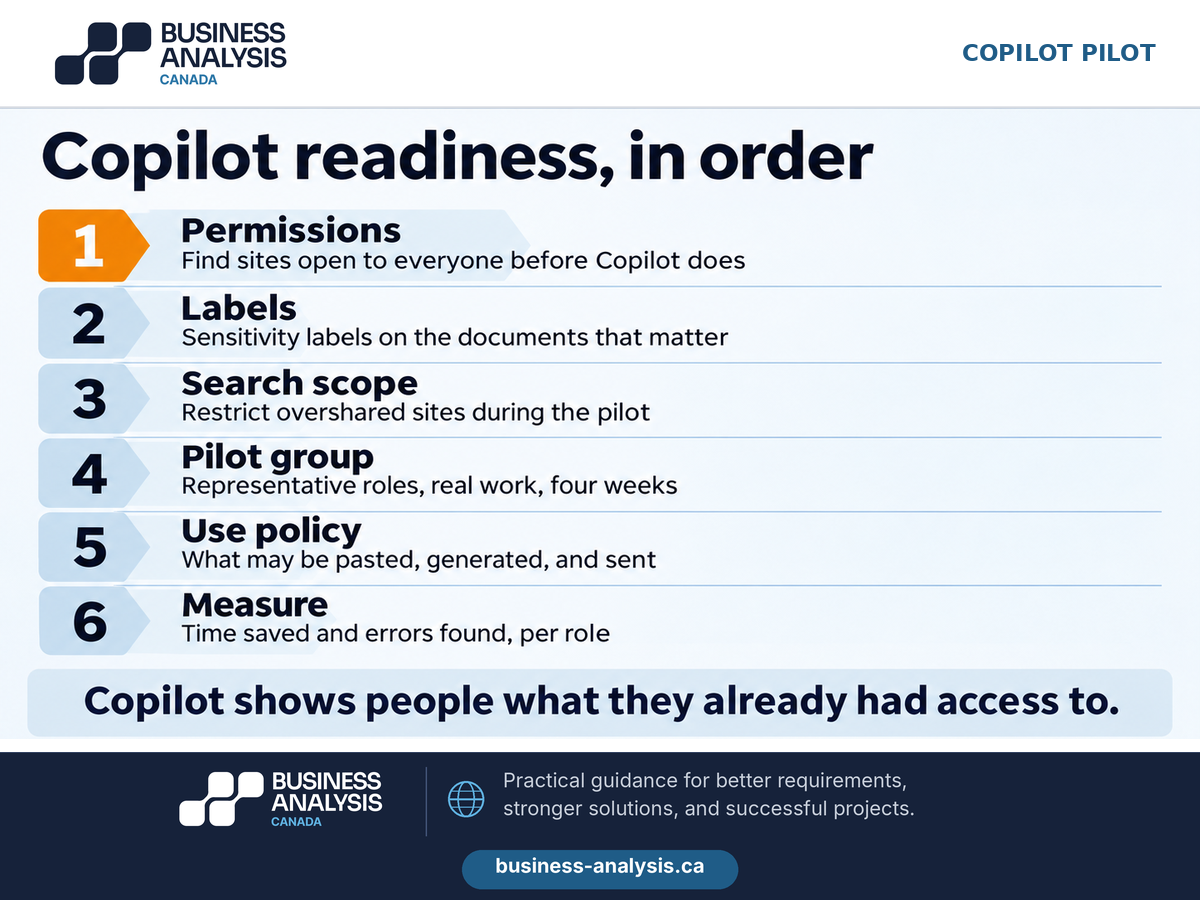
The Copilot readiness assessment is the six-area checklist with the technology and governance rows made specific. Permissions: run the oversharing reports on every site the pilot group can reach and fix or restrict the broadly shared ones before a single license is assigned. Labels: label the documents that would be damaging if summarized to the wrong person, and test that Copilot respects the label. Pilot group: choose representative roles, twenty to fifty people, doing real work for four weeks, with the baseline measured first. Use policy: a one-page note on what may be pasted in, what may be sent out without review, and what must never be entered, read and acknowledged before access. Measure: time saved and errors found, by role, against the baseline, with a stop rule. Region: confirm in writing, against Microsoft's current documentation, where your tenant's data and Copilot's processing sit relative to any residency commitment you have made.
The outcome is usually a shorter pilot than the one that was planned and a longer clean-up before it. That is the assessment working. The organization that pilots Copilot on top of unreviewed permissions learns about its oversharing from the pilot, which is the most expensive way to learn it. The AI workflow automation post covers the analysis that follows a successful pilot, when the question changes from whether the tool works to which process it should join.
Key Takeaway: Copilot shows people what they already have access to, so readiness is permissions first: run the oversharing reports, fix or restrict broadly shared sites, label what matters, set the use policy, pilot with a measured baseline, and confirm the processing region in writing.
Frequently Asked Questions
What is the difference between an AI readiness assessment and an AI maturity assessment?A maturity assessment places an organization on a scale from exploring to transforming and is useful for direction-setting over years. A readiness assessment answers whether this organization can run this pilot now, scoring six areas with evidence and naming the findings that stop the pilot. An organization can be low on maturity and ready for a narrow pilot, or high on maturity and not ready for a pilot that touches personal information. The readiness assessment is the one a sponsor signs before money is spent.
How long does an AI readiness assessment take?Three to five weeks for a mid-size organization and one candidate pilot, with the data profile and the permissions review taking the longest. Interviews alone take a week and produce a survey; the extra time goes to sampling the data, walking the process, and running the reports, which is what makes the scores evidence. A second candidate pilot adds about a week, because the organization-level scores are reused and only the pilot-level scoring repeats.
Does Canada have an AI law we have to comply with?No federal AI statute is in force; the Artificial Intelligence and Data Act died with Bill C-27 in January 2025. What applies is the Treasury Board's Directive on Automated Decision-Making for federal institutions, PIPEDA and the privacy commissioners' generative AI principles for private-sector organizations, Quebec's Law 25 for decisions based exclusively on automated processing, and OSFI's Guideline E-23 for federally regulated financial institutions from May 2027. Provincial rules are changing; recheck them at each expansion.
How do we start an AI readiness assessment?Name the candidate pilot, the process it joins, the data it would use, and the people who would use and review its output; those four answers decide the regulatory track and the evidence to collect. ID Business Analysis Canada runs the assessment as a Discovery Sprint of three to five weeks that scores the six areas from the data profile, the process map, the permissions review, and the policy inventory, and delivers the scored checklist, the findings to fix before the pilot, and the pilot the scores allow.
Conclusion
The claims team's pilot in the opening pattern did not fail. It reported, accurately and in three weeks, that the document library held four versions of every policy, that nobody owned the current one, and that the reviewer role had never been assigned. A readiness assessment would have reported the same three findings in the first week, at no cost to the team's confidence in the tool, and the pilot that followed the clean-up would have been the one the organization remembers as a success.
If you have a first pilot in front of you, ID Business Analysis Canada's AI Implementation practice runs the readiness assessment before it starts and hands you the scored checklist, the regulatory track, and the pilot the scores allow. Book a free consultation and bring the name of the document library the pilot would read from; the first thing we will do is count the versions.
Sources
- Statistics Canada, Canadian Survey on Business Conditions, second quarter 2026, The Daily, May 27, 2026; 19.2% of businesses used AI to produce goods or deliver services, up from 12.2% in the second quarter of 2025.
- Treasury Board of Canada Secretariat, Algorithmic Impact Assessment tool, modified September 15, 2026; 65 risk and 41 mitigation questions, four impact levels, completion at design and before production.
- Treasury Board of Canada Secretariat, Directive on Automated Decision-Making; cited by name (page not fetched on the day).
- Office of the Privacy Commissioner of Canada and provincial and territorial counterparts, Principles for responsible, trustworthy and privacy-protective generative AI technologies, December 7, 2023.
- Torys LLP, Looking ahead: the Canadian privacy and AI landscape without Bill C-27, January 16, 2025; Bill C-27 died on prorogation.
- Torys LLP, Automated decision-making: what Quebec's Bill 64 reforms mean for business, Torys Quarterly, Spring 2022; notice, information on request, and review obligations in force September 2023.
- Office of the Superintendent of Financial Institutions, Guideline E-23: Model Risk Management (2027), effective May 1, 2027.
- Microsoft Learn, Microsoft 365 Copilot blueprint for oversharing; Copilot grounds responses in data users already have permission to access; remediate, guardrails, regulations; SharePoint Advanced Management included with the Copilot license.