
Before the Rewrite: Legacy System Assessment for Modernization Decisions



Share the page:
TL;DR
A legacy system assessment is the work of finding out what an old system does before deciding what to do about it. It produces four things a replacement cannot proceed without: an interface inventory, a catalog of business rules recovered from the code and from the people who work around it, a data profile, and a baseline of the process as it runs today. Those four decide among rehost, replatform, rebuild, and retire on evidence instead of preference. Treasury Board reported that 38 percent of Government of Canada business applications were assessed as healthy in 2024 to 2025, so most of the estate is a candidate. The assessment costs weeks against the rewrite's years. For the IT director with a system out of support.
Introduction
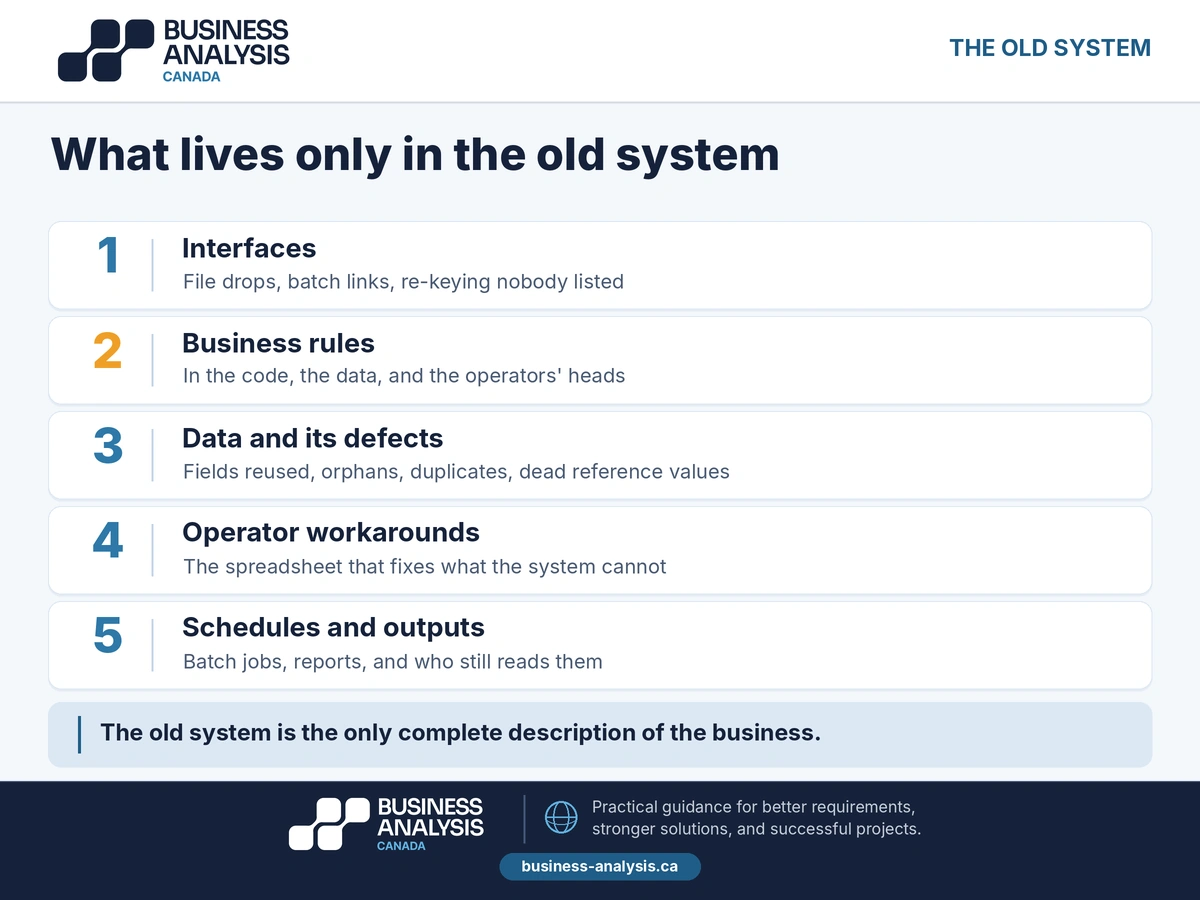
The version we see most often is a billing system at a utility, written in the 1990s, that is being replaced for the third time. The first two projects were canceled at the same point: a few months in, when the vendor asked for the business rules and the answer was the system itself. Nobody had a list of the interfaces either. The one person who knew why the meter-reading job rejected certain accounts on the fifth of the month was retiring in fourteen months. The third project started the way the first two had, with a request for proposal and a budget, until somebody asked what the earlier projects had found out, and the honest answer was nothing that had been written down.
If you searched for legacy system assessment, you probably have a system out of support, a vendor or an internal team ready to rewrite it, and a feeling that the estimate is a guess. It is a guess. The old system is the only complete description of what the business does, and the assessment is how you read it before it is gone. What follows covers what the assessment documents, how it recovers rules nobody wrote down, how it decides among rehost, replatform, rebuild, and retire, and what it costs against the rewrite.
What is a legacy system assessment?
A legacy system assessment is a time-boxed study of a system still in use, usually four to eight weeks, that documents what the system does, what depends on it, what data it holds and in what condition, and what it would take to change or replace it. Its purpose is a modernization decision that rests on evidence rather than on the age of the code or the enthusiasm of the vendor who wants to rewrite it.
Legacy does not mean old. It means a system the organization can no longer describe, change, or support with confidence: the vendor has ended support, the two people who understood it have left or are about to, the documentation describes a version from 2009, and yet the system runs the business every day without complaint. That last part is why the assessment is needed. A system that works and cannot be described is more dangerous to replace than one that is visibly broken, because its replacement will be measured against behavior nobody wrote down.
The scale of the problem is on the record. Treasury Board's 2026 to 2027 Departmental Plan reports that 38 percent of Government of Canada business applications were assessed as healthy in 2024 to 2025, with a target of 39 percent by March 2027. Read the target as well as the result: the government's own plan for the next fiscal year moves the number by a single point. A departmental audit at Agriculture and Agri-Food Canada, published in May 2026, shows what that looks like from inside one organization: application portfolio management described as reactive and ad hoc, no regular department-wide review, end-of-life retirement plans not completed, and decisions driven by the branches that control the funding rather than by anyone with a view of the whole portfolio. None of that is unique to government. Replace "branch" with "business unit" and the audit describes most mid-sized companies we have worked with.
An assessment is not three other things it is often confused with. It is not a code audit, which tells you about the code and nothing about the business. It is not a vendor's application modernization assessment, which is a sales process that ends in the vendor's platform; the guide to choosing a digital transformation consultant explains how to tell the two apart. And it is not the project plan for the rewrite, although the plan cannot be written without it.
Key Takeaway: A legacy system assessment documents what an old system does, what depends on it, and what its data looks like, in four to eight weeks, so that the modernization decision rests on evidence. Legacy means undescribable, not old.
What has to be documented before a legacy system can be replaced?
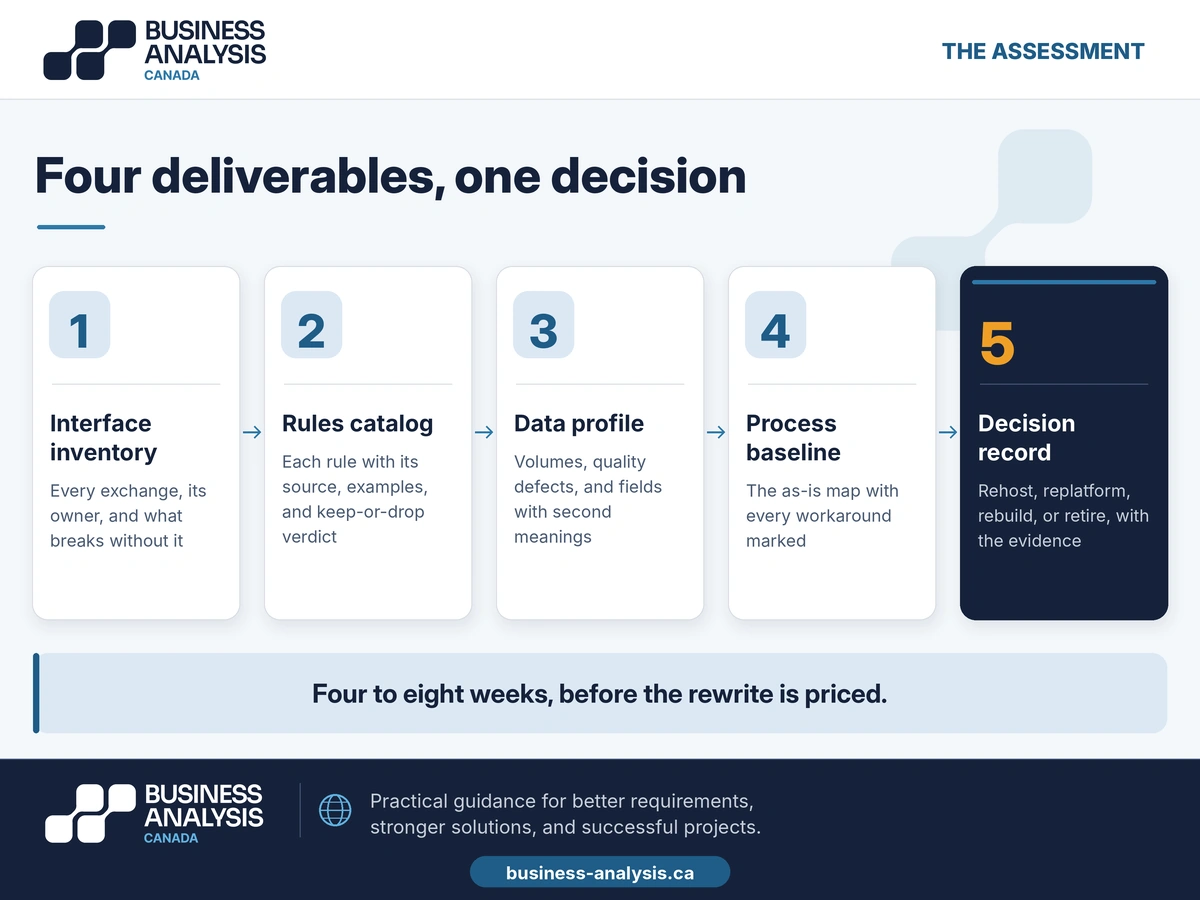
Four things, and the order matters because each one feeds the next. They are the deliverables of the assessment, and the test of each is whether a vendor could price the rewrite from it.
- The interface inventory. Every exchange of data in and out of the system: nightly batch files, database links, the file drop the bank picks up, the report a regulator receives, the screen a clerk re-keys into another system by hand. For each: direction, format, frequency, the system or person on the other end, who owns it, and what stops if it stops. The human interfaces matter as much as the technical ones. The accounts clerk who exports to a spreadsheet every Friday and emails it to finance is an interface, and the rewrite that forgets her breaks month-end. The count is always higher than anyone's first guess, which is why the inventory comes first: it sets the size of everything after it.
- The rules catalog. The business rules the system enforces, recovered from the code and from the people who operate it (the next section covers how). Each rule gets a plain statement, its source (a code location, a person, a policy document), two or three example records that show it firing, an owner, and a verdict: keep, change, or drop. The verdict is what turns the catalog into requirements.
- The data profile. What the system holds today: row counts by table, which tables and fields are used and which are dead, fields reused for a second meaning after a reorganization, orphan records, duplicates, reference values that no longer correspond to anything, and the date range of live history. The ERP data migration checklist covers what happens to the data afterward; the profile is the evidence the migration plan is built on.
- The process baseline. The process as it runs today, with every workaround marked: the spreadsheet beside the system, the override code the supervisor types in, the step that exists only because the system cannot do something. The process mapping guide covers which notation fits; a swimlane with the workarounds in a distinct color is usually enough. Where the system supports an operation with shifts, queues, and exceptions, a short ConOps does the same job from the operator's side.
Three smaller items ride along: the batch schedule and what each job depends on, the list of reports and who still reads them, and the security model, because a system that has been patched for twenty years usually has roles nobody can explain.
The deliverables are produced by two people working together, not in sequence: a business analyst who owns the rules, the process, and the interviews, and a developer who can read the code and query the database. Neither can do the other's half. The technical business analyst post describes the seat that sits between them on larger programs. The operators are the third party, and their time is the scarcest input: budget it, because a rules catalog nobody has confirmed is a list of guesses.
The failure we see is the assessment done by the rewrite team on the rewrite's budget, which produces the documentation the rewrite needs to justify its estimate and nothing that would argue against it. ID Business Analysis Canada runs the assessment as a Discovery Sprint ahead of the modernization decision: a business analyst and a developer produce the interface inventory, the rules catalog, the data profile, and the process baseline in four to eight weeks, with each rule signed by the operator who uses it and each interface confirmed by the owner of the system on the other end, so the decision record that closes the sprint can be handed to any vendor or kept in-house.
Key Takeaway: Four deliverables before any rewrite: interface inventory, rules catalog, data profile, process baseline. Each is confirmed by the people who depend on it, and together they are what a vendor prices.
How do you recover business rules nobody wrote down?
From four sources, cross-checked against each other, because each one lies in a different way. The code tells you what the system does but not why. The data tells you what has happened but not what was intended. The operators tell you what matters but remember the exceptions better than the rule. The old documents tell you what was decided in 2004 and nothing since.
Start with the code, with the developer driving. Every conditional, validation, calculation, and status transition is a candidate rule. Static analysis tools will list the branches, and the list is useful as an index, but business rules extraction is the act of attaching meaning to each branch, and no tool does that. A condition that rejects accounts with a particular flag on the fifth of the month is a line of code until someone explains that the flag marks accounts on a payment plan and the fifth is when the plan installment posts. The developer finds the branch; the analyst finds the meaning; the catalog records both, with the record samples that prove it.
Then the data, because the data shows which rules still fire. A validation that has not rejected a record in six years is a dead rule, and the catalog should say so rather than carry it into the new system. A field with three distinct patterns of values usually hides three rules, one of them added after a merger and never documented anywhere. Profiling the data before the interviews gives the analyst specific questions to ask instead of general ones.
Then the operators, interviewed about exceptions rather than about the process. "Walk me through a normal day" produces the training manual. "What do you do when it rejects the account?" produces the rules. The requirements elicitation guide covers observation and interviews in detail; for legacy work, observation is the technique that earns its hour, because the workaround the operator performs without thinking is the rule she will not mention. Every rule recovered from an operator goes back to her for sign-off, in her words, with the example that made her remember it.
Then the documents: change tickets, old policy memos, the training deck from the last upgrade, the regulator's guidance the rule was written to satisfy. They rarely describe the current system, but they explain the origin of rules that otherwise look arbitrary, and origin is what decides the verdict. A rule that exists because of a policy is kept or changed with the policy owner. A rule that exists because the 1990s database could not hold a longer field is dropped. A rule that exists because of a workaround is fixed in the process, not rebuilt in the software.
The extreme case is the public sector, where the rules are legislation accumulated over decades. Employment and Social Development Canada moved Old Age Security off a system it describes as sixty years old in March 2025 and began moving Employment Insurance benefits onto the new platform later that year, with the Canada Pension Plan to follow. The rules inside a system of that age are not documentation problems; they are the law as applied, and recovering them is the program. Smaller organizations face the same problem at smaller scale: a billing rule that encodes a 2011 rate decision is a regulatory obligation, whether or not anyone remembers the decision.
Key Takeaway: Recover rules from four sources and cross-check them: the code for what the system does, the data for which rules still fire, the operators for the exceptions, the documents for the origin. Every rule gets a source, an example, an owner, and a keep, change, or drop verdict.
Rehost, replatform, rebuild, or retire: how does the assessment decide?
Four options, and the assessment decides among them with evidence it has already produced. Vendors publish longer lists; Gartner's glossary entry for application modernization services runs through re-hosting, re-platforming, recoding, rearchitecting, re-engineering, interoperability, replacement, and retirement. The four below are the decisions a sponsor funds, and the longer lists are variants of them.
Rehost moves the system as it is onto new infrastructure. Replatform changes the runtime or the database with minimal change to the code. Rebuild replaces the system, either with new code or with a commercial product, against requirements written from the rules catalog. Retire switches it off and absorbs whatever it still does into another system. The right answer depends on where the problem lives, and the four deliverables are what show that.
Two patterns recur. The first is that the option changes during the assessment. Rewrites that start as rebuilds become replatforms once the rules catalog shows that the business logic is right and only the platform is dead, and the budget drops with the scope. The reverse happens too, when a planned rehost turns out to be moving a system whose rules the business no longer wants, and the sponsor would have paid to preserve them. The second pattern is that retire is under-chosen. The Agriculture and Agri-Food Canada audit found decommissioning delayed because nobody owned the portfolio decision, and the same holds in companies: a system with three users and one report survives for years because switching it off is nobody's project.
Once the option is rebuild or replace, the decision record becomes the first section of the procurement. The RFP guide starts from the build, buy, or configure decision, and that decision is the assessment's output, not the RFP's; the interface inventory becomes the integration section, the rules catalog becomes the requirements by outcome, and the data profile becomes the migration section.
Key Takeaway: Rehost when the rules are right and the hardware is the problem, replatform when the data model is worth keeping, rebuild when the rules must change, retire when little unique function is left. The assessment supplies the evidence for each, and the option often changes once it is in hand.
What does the assessment cost compared with the rewrite?
Weeks against years, and two people against a program. A single-system assessment is four to eight weeks of a business analyst and a developer, plus operator hours that the business should treat as the real cost, because the people who know the system are the people who run it. Multi-system assessments scale by interface count more than by code size: a small system with forty interfaces takes longer to assess than a large one with four.
Set that against what the rewrite spends when the assessment is skipped. The spend arrives as change orders when rules are discovered during build, as a parallel run extended because reconciliation keeps finding differences nobody can explain, as a second data migration rehearsal, and as the restarted project the utility in the opening pattern was on for the third time. The discovery phase post makes the general argument for paying early; for legacy work the argument is sharper, because the knowledge being recovered has an expiry date in the form of a retirement.
There is a second cost the assessment exposes, which is the cost of continuing. Employment and Social Development Canada's own briefing to its minister in early 2026 described a decade of spending on maintaining legacy platforms that produced, in its words, no measurable return. The maintenance line for an old system looks small in any single year and is rarely compared with the cost of replacement over the same horizon. The assessment's decision record puts the two side by side.
The assessment pays even when the answer is rehost, because every deliverable is reused. The interface inventory becomes the integration plan and the cutover checklist. The rules catalog becomes the requirements, the acceptance criteria, and the regression test set for whatever is built or bought. The data profile becomes the migration plan and the reconciliation rules. The process baseline becomes the change management plan and the training material. Nothing in the assessment is thrown away; what the rewrite would have produced late and under pressure, the assessment produces early and signed.
Key Takeaway: The assessment is weeks of two people against a rewrite measured in years, and every deliverable is reused in the rewrite. The expensive version is the one discovered during build, after the person who knew the answer has retired.
Frequently Asked Questions
How long does a legacy system assessment take?Four to eight weeks for one system, with the interface count as the main driver: a system with forty interfaces takes longer than a large system with four. The code size matters less than whether a developer who can read it is available, and the operators' availability matters most, because every recovered rule goes back to an operator for sign-off. A portfolio of systems is assessed in a sequence, one at a time, starting with the one whose knowledge is about to walk out the door.
Who should do the assessment: the vendor who will rewrite the system, or someone independent?Someone independent, with the vendor validating the result. A vendor's assessment is priced into the rewrite and tends to find the rewrite the vendor sells; the catalog and inventory it produces are rarely written so that a different vendor could price from them. An independent business analyst and developer produce deliverables any bidder can use, which is also what makes the eventual procurement competitive. The vendor's technical review of the findings is worth having; its ownership of them is not.
What is business rules extraction, and do tools do it automatically?Business rules extraction is the recovery of the rules a system enforces from its code, its data, its operators, and its documents, into a catalog that states each rule in plain language with a source, examples, and an owner. Tools list the conditions in the code, which is a useful index, but none attach meaning: a condition on a flag is a line of code until an operator explains what the flag means. The automatic part is the inventory; the extraction is analysis.
How do we start a legacy system assessment?Name the system, the operators who will be interviewed, and the developer who can read the code, and fix the date by which the decision is needed. ID Business Analysis Canada runs the assessment as a Discovery Sprint of four to eight weeks that delivers the interface inventory, the rules catalog, the data profile, the process baseline, and a decision record across rehost, replatform, rebuild, and retire, written so that any vendor can price from it or the work can stay in-house.
Conclusion
The utility's third replacement project did not fail, because it did not start with a request for proposal. It started with six weeks in which a business analyst and a developer wrote down the interfaces, recovered the rules from the code and from the operator who was retiring, profiled fifteen years of billing data, and mapped the process with the workarounds marked. The decision record said replatform, not rebuild, because the rules were right and the database was dying, and the budget that had been approved twice before was cut by more than half. The two earlier projects had been paying to rediscover what the system already knew.
If you have a system out of support and a rewrite waiting on an estimate, ID Business Analysis Canada's Discovery Sprint produces the four deliverables and the decision record in four to eight weeks, before the rewrite is priced. Book a free consultation and bring the name of the person who knows the old system best; the first question is how long they are staying.
Sources
- Treasury Board of Canada Secretariat, 2026–27 Departmental Plan, March 13, 2026; indicator "Percentage of Government of Canada business applications assessed as healthy": 38% (2024–25), target 39% by March 2027.
- Agriculture and Agri-Food Canada, Audit of Application Portfolio Management, May 12, 2026; findings on reactive portfolio management, branch-controlled funding, and incomplete end-of-life plans.
- Employment and Social Development Canada, Question Period Note: Update on ESDC's Benefits Delivery Modernization (BDM) Programme, March 2026; Old Age Security migration (March 2025), Employment Insurance onboarding (late 2025), legacy maintenance spending.
- Gartner, Information Technology Glossary: Application Modernization Services; list of modernization approaches.
- Business Analysis Canada, Under the Hood: Why Complex Initiatives Need a Technical Business Analyst, business-analysis.ca blog.
- Business Analysis Canada, Operations First: What Is a ConOps Document and When Do IT Projects Need One?, business-analysis.ca blog.
- Business Analysis Canada, Process Mapping for IT Projects: BPMN, Swimlane or Flowchart. Which Map Does Each Decision Need?, business-analysis.ca blog, October 2026.
- Business Analysis Canada, De-Risking the Pivot: Your Essential ERP Data Migration Strategy, business-analysis.ca blog.
- Business Analysis Canada, Guarding the Gate: The Value of a Project Discovery Phase in IT Strategy, business-analysis.ca blog.
- Business Analysis Canada, Ask Better: Requirements Elicitation Techniques and When Each One Earns Its Hour, business-analysis.ca blog, October 2026.
- Business Analysis Canada, Buying Advice, Not a Pitch: How to Choose a Digital Transformation Consultant, business-analysis.ca blog, October 2026.
- Business Analysis Canada, Comparable Bids: How to Write an RFP for Software That Canadian Vendors Can Price, business-analysis.ca blog, November 2026.