
Three Chairs, One Backlog: Business Analyst vs Product Owner vs Project Manager



Share the page:
The product owner decides what the product does and in what order, and is accountable for its value. The business analyst finds out what the business needs and specifies it so it can be built and tested. The project manager makes the agreed scope arrive on time and on budget. Three chairs: decision, understanding, delivery. On a small product one person can sit in the first two; a project manager and a product owner should never be the same person, because the date then edits the product in silence. A project missing the analyst decides quickly and discovers slowly, usually in UAT. This guide gives the twelve decisions the roles share and who owns each, the pairings that work, the failure pattern per missing chair, and which to hire first.
Introduction
The org chart for the program had a box labeled "PO / BA / PM" with one name in it. She had been the operations lead, she knew the process, and everyone went to her with questions, so she was given all three chairs and a team of eight developers. By month four she was prioritizing the backlog between stand-ups, writing acceptance criteria at night, and explaining to the steering committee why the date had moved. The backlog had 340 items. Nobody could say which forty mattered.
If you searched for the difference between a business analyst and a product owner, you are probably staffing a project and trying to work out whether you need one, the other, or both, and where the project manager fits. The short answer is that the three roles share one backlog and divide twelve decisions, and the division is the thing to get right.
What is the difference between a business analyst and a product owner?
A product owner decides what the product should do and in what order, and is accountable for the value it delivers; a business analyst finds out what the business needs, in enough detail that developers can build it and testers can test it. The product owner is a decision role. The analyst is an understanding role. They meet at the backlog, where the analyst's requirements become the product owner's ordered list.
The Scrum Guide defines the product owner as accountable for maximizing the value of the product and for managing the product backlog, and it is deliberately silent about business analysts, project managers, and every other title. That silence is why the analyst role gets squeezed on agile programs: the framework names the decision-maker and assumes the understanding will come from somewhere. On a two-pizza product team with one stakeholder group, it often does, from the product owner. On a program touching three departments, two vendors, and a regulator, it does not, and the product owner spends their evenings doing analysis badly.
The project manager is the third chair, and it is a different kind of role again. The product owner owns what and in which order; the project manager owns when, with whom, and for how much. Dates, dependencies, vendors, budget, and risk are theirs. On a pure Scrum team the role is dispersed across the Scrum master and the product owner; on anything with a contract, a fixed date, or more than one team, it reappears under its own name because someone has to own the schedule.
A product manager, for completeness, is the product owner's strategic counterpart: market, pricing, roadmap over years rather than sprints. On internal IT programs the title rarely appears, and the sponsor plays the part.
Key Takeaway: Product owner decides, analyst understands, project manager delivers. The backlog is where the first two meet; the schedule is where the third one lives.
Who owns the backlog, the requirements, and the schedule?
Each of the three owns one of those three things outright, and the twelve recurring decisions on a program split between them in a pattern that is stable across methodologies. The table gives the split we use when a program is being staffed, with the owner in each row and the roles that contribute.
The rows that cause the most argument are acceptance criteria and scope change. Criteria are the analyst's to write because writing them testable is a craft, and the product owner's to approve because the values in them are product decisions; a product owner who writes their own criteria usually writes the story again with "the system allows" in front. Scope change belongs to the product owner inside an envelope the sponsor approved and to the sponsor outside it, with the project manager measuring the envelope and the analyst measuring what else moves when a requirement does. The acceptance criteria guide covers the first; the risk management guide covers the register.
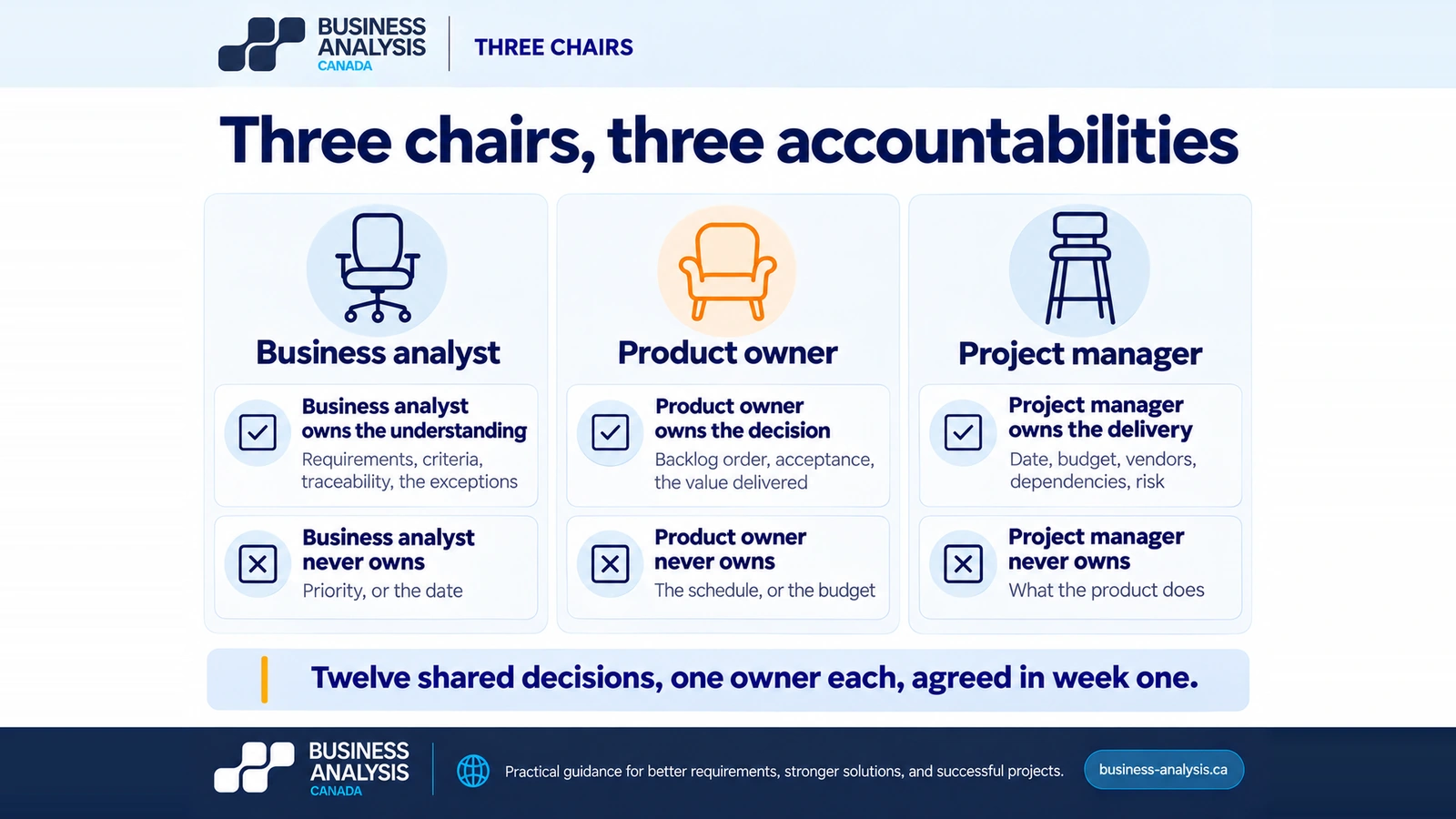
The pattern we see most often is the org chart from the introduction: one box, three roles, one exhausted person. The symptom is a backlog nobody can rank and criteria nobody can test, because the person who could do either is doing the other. ID Business Analysis Canada's role placements put a named business analyst into the second chair, with the twelve-decision split above agreed in writing with the product owner and the project manager in the first week of the engagement, so that from week two the backlog has an owner who decides and the criteria have an author who can be held to them.
Key Takeaway: Twelve decisions, three owners, written down in week one. If one name appears in two of the three columns, decide now which chair that person will leave when the program gets hard.
Can one person hold two of the roles?
Two of the three pairings work in specific conditions, and one does not work at all. A product owner and a business analyst can be one person on a small product with one team and one stakeholder group, provided that person has the time to write testable criteria and the standing to decide priority. A project manager and a business analyst can be one person on a short, single-vendor project, with the caveat that schedule pressure shapes what gets written down. A project manager and a product owner should not be the same person, on any size of project.
The reason the last pairing fails is structural rather than personal. The project manager is accountable for the date and the budget; the product owner is accountable for the value. When the same person holds both, every scope decision is made by someone whose first-order incentive is to hit the date, and the product gets smaller in ways nobody announces. Features are deferred "to phase two," criteria get looser, and the sponsor finds out at go-live that the thing they funded is the thing that fit the schedule. Separating the two chairs is how the trade-off becomes visible: the product owner argues for the content, the project manager argues for the date, and the sponsor hears both.
The product owner and analyst pairing works when the product is small enough for one head. The test is the backlog. If the product owner can write every item's criteria to the six-part standard and still have time to make decisions, one person is fine. When the criteria start arriving as restated stories, the product has outgrown the pairing, and it is time to put an analyst in the second chair. The pattern we see is that this happens around the point where a second stakeholder group or a second system joins the program, which is also the point where the product owner's calendar fills with meetings about the first one.
Key Takeaway: Product owner plus analyst can be one person while the backlog stays small enough to write criteria for. Project manager plus product owner should never be, because the date then edits the product in private.
What happens when a project has a product owner but no analyst?
It decides quickly and discovers slowly. The product owner ranks the backlog with confidence, the team builds the top of it, and the exceptions, the integration rules, and the month-end cases surface in UAT, where they cost ten times what they would have cost in a requirements workshop. The decision role was filled; the understanding role was not, and nobody noticed because the backlog looked complete.
Each missing chair has its own pattern. No analyst: criteria are stories restated, the product owner becomes the bottleneck for every clarifying question from the developers, and the first integration with another system reveals a data rule nobody wrote down. No product owner: the analyst becomes the product owner by default without the authority, stakeholders settle priority by lobbying the developers directly, and the backlog grows because nobody is allowed to say no. No project manager: dependencies between teams and vendors are unowned, the date is discovered rather than managed, and the risk register is a document that was created in week one and opened again in the post-mortem.
The missing-analyst pattern is the quiet one, because the project looks healthy for months. Velocity is good, the demos go well, and the product owner is visibly in charge. The cost arrives in test and in production, in the form of the exceptions that were never elicited. The requirements elicitation guide covers what those exceptions look like and how they are found; the point here is that someone has to be assigned to find them, and the product owner, whose job is to decide, is not that person.
Key Takeaway: A missing analyst shows up in UAT. A missing product owner shows up in the backlog's size. A missing project manager shows up in the date. Staff the chair whose failure you can least afford to find late.
Which role should you hire first?
The one whose absence is causing the current problem. If nobody can say what the business needs in testable terms, hire the analyst first; if the needs are known and nobody can decide the order, the product owner; if dates, vendors, and dependencies are the risk, the project manager. For a new initiative the sequence is usually analyst, then product owner, then project manager, because the understanding has to exist before there is anything to decide or to schedule.
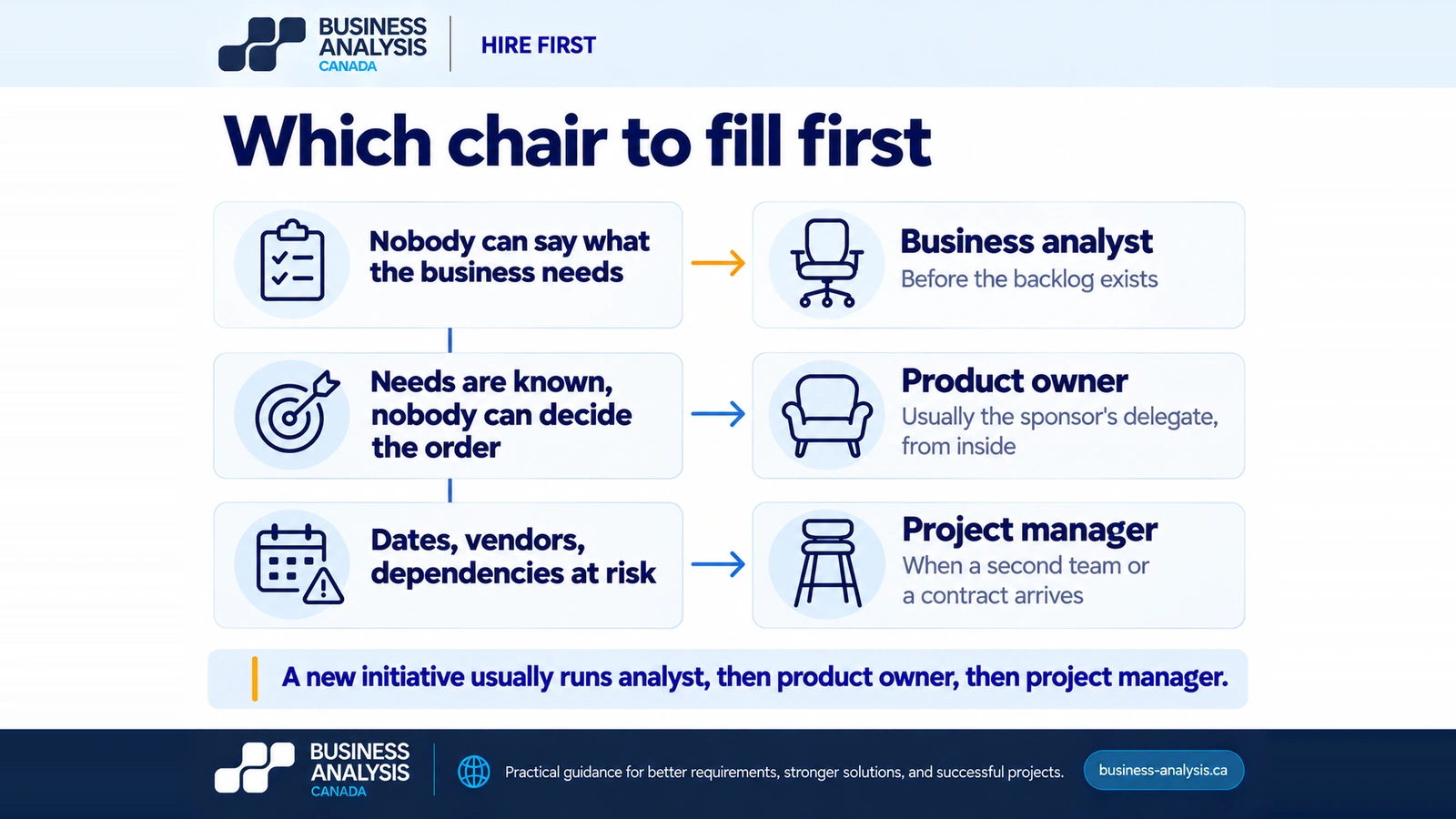
The product owner is the role most often filled from inside, because it needs the authority to decide and the knowledge of the business, and both come with the sponsor's delegate. The analyst and the project manager are the roles most often brought in, because the skill is portable and the engagement has an end date. The guide to hiring a business analyst covers the evaluation; the staff augmentation comparison covers the contract.
One hire that rarely works is the analyst brought in after the backlog already has 340 items. Their first job becomes archaeology: which of these are requirements, which are wishes, which contradict each other, and which have been built already. It is recoverable, and the first four weeks are spent recovering rather than analyzing. Hire the analyst while the backlog is still a list of problems rather than a list of features.
Key Takeaway: Hire against the problem you have now. For a new initiative that usually means the analyst first, before the backlog exists, so that it starts as requirements rather than as wishes.
Frequently Asked Questions
Is a business analyst the same as a product owner?No. A product owner decides what the product does and in what order, and is accountable for its value; a business analyst finds out what the business needs and specifies it testably. The product owner is a decision role defined by the Scrum Guide; the business analyst is an understanding role defined by the BABOK Guide and absent from Scrum. One person can hold both on a small product; on a program with several stakeholder groups or systems, that person becomes the bottleneck and the exceptions surface in UAT.
Can a business analyst become a product owner?Yes, and it is one of the most common career moves, because the analyst already knows the domain, the stakeholders, and the backlog. The change is in accountability rather than in knowledge: the product owner has to decide and be held to the decision, including saying no to stakeholders the analyst used to serve. Analysts who make the move well stop writing the detail themselves and make sure someone else does, which is the same lesson the one-person org chart teaches the hard way.
Does Scrum have a business analyst role?No. The Scrum Guide defines the product owner, the Scrum master, and the developers, and assigns the understanding of what to build to the product owner and the team. On a small product that works. On a program with several departments, external systems, or regulatory rules, the analysis work still exists and lands on whoever has time, usually the product owner at night. Most organizations running Scrum at scale add a business analyst, either inside the team as the requirements specialist or alongside the product owner.
Which should a small company hire first, and how do we start?The business analyst, if the project has not started, because the first weeks are about finding out what the business needs. Name the product owner from inside at the same time, usually the sponsor's delegate, and add a project manager when a vendor or second team arrives. ID Business Analysis Canada places business analysts through its Business Analysis Roles service for this stage: a named analyst, the twelve-decision split agreed with your product owner in week one, criteria written before the backlog fills with wishes.
Conclusion
The one box on the org chart was a staffing decision disguised as a compliment. She could decide, understand, and deliver, and she could not do all three at once for eight developers and three departments. The 340-item backlog was not her failure; it was the predictable result of putting three chairs under one person and calling it a promotion.
If your program has one name in two columns, or a backlog nobody can rank, ID Business Analysis Canada's Business Analysis Roles service places a named business analyst into the second chair, with the twelve-decision split agreed with your product owner and project manager in the first week. Book a free consultation and bring the org chart; the first thing we will do is count the names per box.
Sources
- Ken Schwaber and Jeff Sutherland, The Scrum Guide, November 2020; the product owner's accountability for maximizing value and managing the product backlog.
- International Institute of Business Analysis, PO vs BA: are they the same?, BA Connection knowledge center.
- Business Analysis Canada, Testable or Not Written: How to Write Acceptance Criteria Developers and Testers Can Use, business-analysis.ca blog, November 2026.
- Business Analysis Canada, Ask Better: Requirements Elicitation Techniques and When Each One Earns Its Hour, business-analysis.ca blog, October 2026.
- Business Analysis Canada, Hiring the Bridge: How to Hire a Business Analyst Who Can Deliver, business-analysis.ca blog, September 2026.
- Business Analysis Canada, Capacity Without Headcount: Business Analyst Staff Augmentation, Outstaffing, and Consulting Compared, business-analysis.ca blog, October 2026.
- Business Analysis Canada, Registers That Get Read: Risk Management in IT Projects, business-analysis.ca blog, September 2026.