
MoSCoW Prioritization: How to Run It Without Everything Becoming a "Must Have"



Share the page:
MoSCoW prioritization sorts requirements into Must Have, Should Have, Could Have, and Won't Have this time, against a fixed date or budget, so that the team knows what it has promised and what it will drop when time runs short. The method only works with two rules most workshops skip: every item starts as a Should and is promoted to Must by passing a test ("what happens if it is not delivered?"), and the Musts take no more than about 60 percent of the effort, with the Coulds as the contingency that protects the date. This guide gives the rules, a workshop script with six tie-breaker questions, the mistakes that turn every list into Musts, and a table for choosing between MoSCoW, RICE, and Kano.
Introduction
The version we see most often is a backlog of 160 items in which 141 are Must Have. The sponsor is proud of the list; it took three workshops. The date is fixed, the team's estimate for the Musts alone runs fourteen months against a nine-month deadline, and everyone in the room knows it, because the estimate is on the same spreadsheet as the priorities. Nobody says it, because saying it means telling a director that her item is a Should. The project goes ahead, the date moves twice, and the items that get cut in month eight are chosen by whoever is in the room that week.
If you searched for MoSCoW prioritization, you have probably been handed that list, or you are about to chair the workshop that produces it. The method is simple and the workshop is not, because prioritization is a negotiation about who gives up what, dressed as a classification exercise. What follows covers what MoSCoW is and stands for, the rules that make it work, a script for running the workshop so that the Musts stay under the cap, the mistakes we see most, and when RICE or Kano is the better tool.
What is MoSCoW prioritization, and what does MoSCoW stand for?
MoSCoW prioritization is a method for classifying requirements, features, or tasks into four categories against a fixed constraint, usually a delivery date or a budget, so that the order in which things are dropped under pressure is agreed before the pressure arrives. The letters stand for Must Have, Should Have, Could Have, and Won't Have this time; the lowercase o's are there to make the word pronounceable. The method dates from the mid-1990s and was adopted into the DSDM agile framework, whose definitions the Agile Business Consortium still publishes.
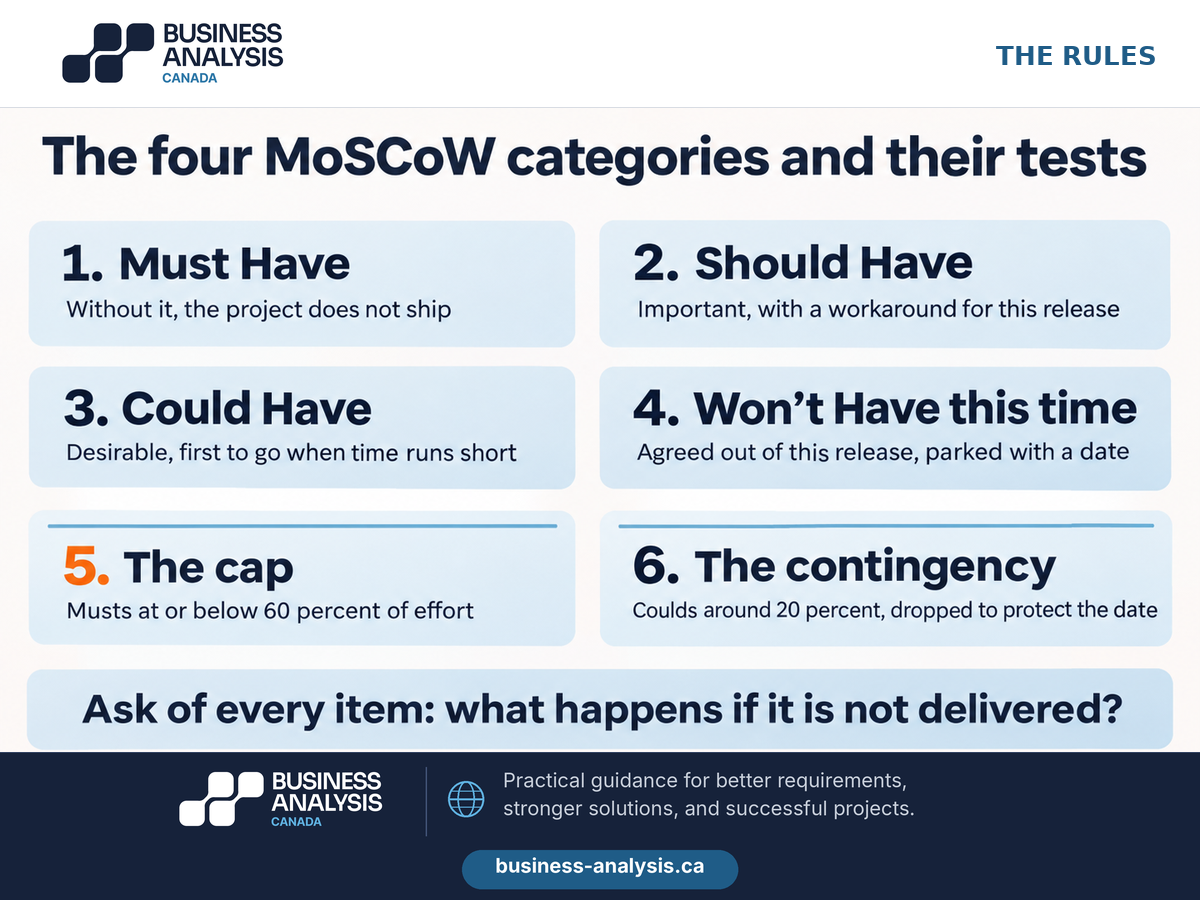
The four categories, in the consortium's terms: Must Haves are the minimum usable subset of requirements the project guarantees to deliver, which is where the acronym's "MUST" comes from. Should Haves are important but not vital; a workaround may be needed, but the solution is still viable without them. Could Haves are wanted or desirable but less important, and they form the main pool of contingency. Won't Haves this time are requirements the team has agreed will not be delivered within this timeframe, which is a decision, not a refusal.
The phrase that matters most is "this time." MoSCoW is prioritization against a constraint, and the priorities are valid for that constraint only. A Won't Have for the June release may be a Must for the December one, and a Should in a two-month timebox may be a Must in a six-month one. A list of priorities with no date or budget attached is a list of opinions.
What MoSCoW is not: it is not a ranking. Within a category, items are not ordered, and a workshop that spends an hour deciding whether item 41 is more important than item 42 has stopped doing MoSCoW. It is not a measure of value; RICE and Kano do that, and the last section compares them. And it is not a stakeholder vote; the categories are decided by the person accountable for the outcome, after hearing the room, which is a rule the next section comes back to.
Key Takeaway: MoSCoW sorts items into Must, Should, Could, and Won't Have this time against a fixed date or budget. The categories are decisions about what gets dropped under pressure, valid for this constraint only, and they are not a ranking or a vote.
What are the MoSCoW rules?
Six, and the first two carry the method. A workshop that applies all six produces a list the team can deliver; a workshop that applies only the definitions produces the 141 Musts.
- Every item starts as a Should. Nothing enters the workshop as a Must. An item is promoted to Must only by passing the test in rule two, and demoted to Could or Won't by failing to justify Should. Starting from Should reverses the burden: the person who wants a Must has to make the case, rather than the chair having to argue each one down.
- The Must test is "what happens if it is not delivered?" The consortium's own framing is to ask what happens if the requirement is not met and whether there is some way around it, even a manual and painful one. If a workaround exists, the item is a Should or a Could. If the answer is "the release would be illegal, unsafe, unusable, or pointless," it is a Must. "The director wants it" and "the users expect it" are not answers to the question.
- Musts take no more than about 60 percent of the effort. The consortium's guidance is typically no more than 60 percent Must Have effort, with typically around 20 percent as a pool of Could Haves, and the reason is stated plainly: the spread provides enough contingency to give confidence in a successful outcome. A plan with 90 percent Musts has no room for the estimate being wrong, and estimates are always wrong in one direction. The rule requires effort estimates on every item before the workshop, which is why rule six exists.
- Won't Have this time is recorded, with a reason and a date. Every Won't Have gets a line in a register: what it is, why it is out of this timeframe, and when it will be reconsidered. The register is what makes the category acceptable to the person who asked for the item, and it is what stops the item from reappearing as a "small addition" in month four. The stakeholder management plan post covers the conversation with the stakeholder whose item is in the register.
- One owner decides. The workshop hears every argument; the sponsor or product owner classifies. A vote produces the average of the room's fears, which is a list of Musts. An owner who has heard the room and signs the list has made a decision that can be revisited at the next increment, which a vote cannot.
- Priorities are set against the constraint and reset at each increment. The Musts for the whole project are fixed at the start, because they are the promise; the Shoulds and Coulds are re-sorted at each timebox or release against what is left of the date and the budget. A change request that adds a Must after the start names the Must it displaces or the date it moves. The risk management post treats the Could pool as what it is: the project's first risk response.
A note on what the rules need from the list. Each item must be small enough to classify on its own; "the reporting module" cannot be a Must or a Could, because parts of it are each. Each item needs an effort estimate, rough is fine, so the 60 percent can be summed. And non-functional requirements go through the same workshop, because the ones that are legally or operationally required are Musts whatever the feature list says, and they are the ones most often missing from it.
The failure we see is the workshop run without rule one and rule three: every item arrives as a Must, no estimates are on the table, and the chair spends three hours negotiating single items down while the total stays over the date. ID Business Analysis Canada runs MoSCoW prioritization as part of its planning engagements: a business analyst prepares the list at the right granularity with effort estimates, states the constraint in writing, chairs the workshop with every item starting as a Should, runs the tie-breakers in the next section until the Musts fit the cap, and publishes the signed list with the Won't Have this time register and the date each entry is reconsidered.
Key Takeaway: Start every item as a Should; promote to Must only by the test "what happens if it is not delivered, and is there a workaround"; keep Musts at or below about 60 percent of effort with Coulds as contingency; record every Won't Have with a reason and a date; one owner decides; reset at each increment.
How do you stop everything becoming a Must Have?
By designing the workshop so that a Must has to be earned in front of the room, with the running total visible, and by giving the person chairing it, the chair in what follows, six questions to ask when an item will not come down. The script below runs in about two and a half hours for a list of 80 to 160 items; longer lists are split by outcome or by release and run as two sessions.
Before the workshop. State the constraint in one sentence and put it at the top of the list: the date, the budget, the team, and which of them is fixed. Get an effort estimate on every item, in days or in sizes with a day value, from the people who will build it. Name the owner who will classify. Limit the room to eight people who can speak for an outcome, and circulate the four definitions and the 60 percent rule the day before, so that nobody meets them for the first time in the session. Bring the Won't Have this time register from the last round, if there was one.
First pass, forty minutes. Read each item aloud with its estimate; it is a Should unless someone in the room asks for a Must. For every Must request, ask the test question and record the answer in one line next to the item. A Must with an answer like "the regulator requires it" or "orders cannot be shipped without it" stays. A Must whose answer is "it would be embarrassing" is a Should, and the chair says so and moves on. Keep a running total of Must effort on the screen.
The cap, thirty minutes. When the first pass ends, compare the Must total with 60 percent of the available effort. It will be over. Now the tie-breakers, applied to the Musts with the weakest answers first, until the total fits. This is the part of the workshop that is a negotiation, and the six questions are what keep it a negotiation about the item rather than about the person.
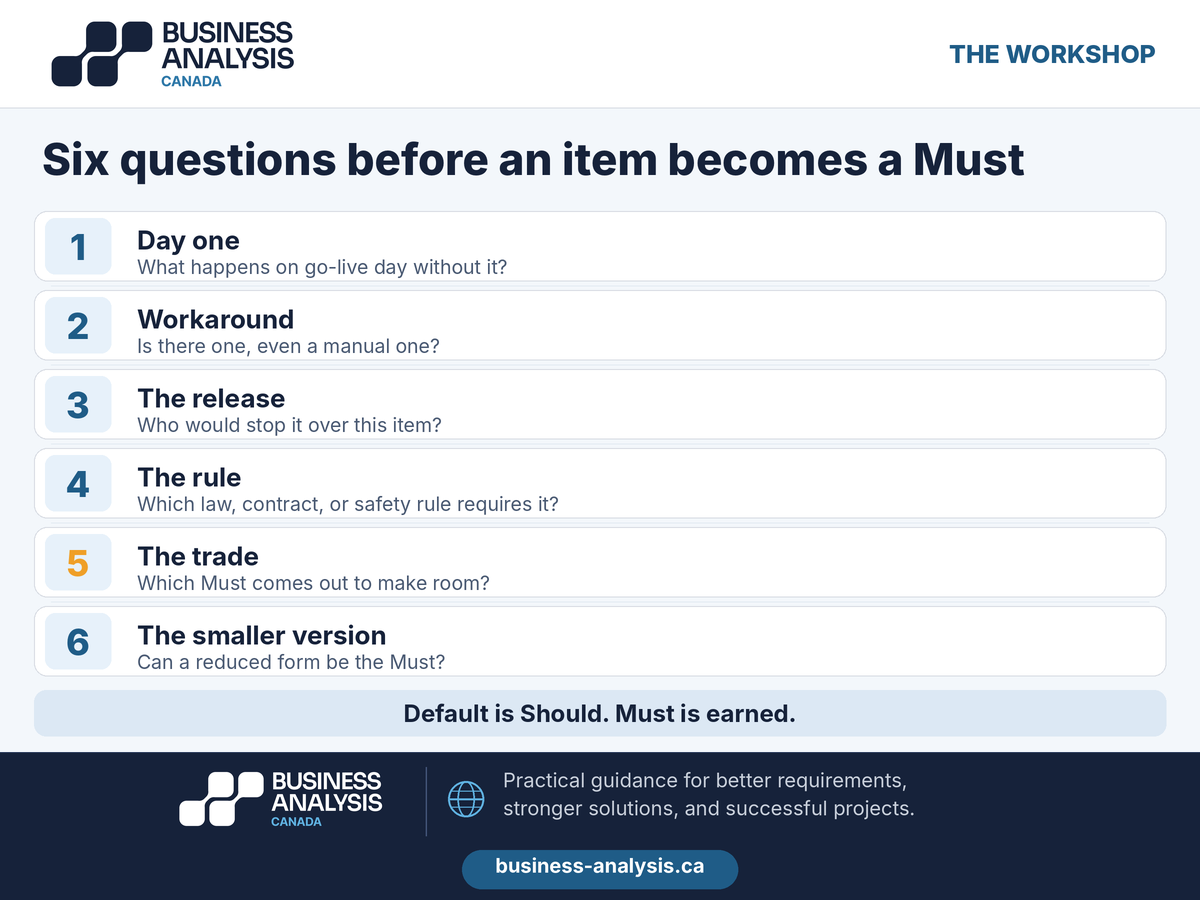
The six tie-breaker questions, in the order they usually work. What happens on go-live day if this is not there? Is there a workaround, even a manual one that someone would hate? Who outside this room would stop the release over it, and have they said so? Which law, contract, or safety rule requires it? Which other Must comes out to make room for it? Can a smaller version of it be the Must, with the rest a Should? The fifth question is the one that ends most arguments, because it changes the item's champion from an advocate into a trader, and the sixth is the one that produces the best lists, because most Musts are a core with a Should wrapped around it.
Coulds and Won'ts, thirty minutes. With the Musts under the cap, sort the rest. Shoulds are the items the room would fight to keep; Coulds are the ones it would give up without a meeting, and they should sum to roughly 20 percent of the effort. Everything that does not fit in the constraint at all goes to Won't Have this time, with its reason and a reconsideration date written in the register in front of the person who asked for it. The register entry is read back to them before the workshop ends.
Close, fifteen minutes. The owner reads the Must list aloud, with its total, and signs it. The chair publishes the four lists and the register the same day, with the constraint sentence at the top. At the next increment the Shoulds and Coulds are re-sorted in a shorter session; the Musts are reopened only by a change request that names its trade.
The two things that make this work are visible arithmetic and a default that is not Must. Teams that run MoSCoW as "which of these are Musts?" get Musts. Teams that run it as "which of these can earn a Must within 60 percent of our effort?" get a list they can deliver, and a sponsor who understands, for the first time, what the date is made of.
Key Takeaway: Default every item to Should, promote only through the test with the answer recorded, keep the Must total on screen against 60 percent of effort, and run the six tie-breakers until it fits. The fifth question, which Must comes out to make room, ends most arguments.
What are the common mistakes with MoSCoW?
Eight recur, and most of them are the rules of the second section applied in reverse.
- No effort estimates. Without them the 60 percent rule cannot be computed, so the cap is never applied and the workshop is a classification exercise with no consequence. Rough estimates from the builders are enough; the rule needs proportion, not precision.
- No fixed constraint. MoSCoW against an open date classifies by importance, which is a different question with a different answer. If the date and the budget are both open, the project needs the discovery phase before it needs prioritization.
- Voting. A vote produces the union of everyone's Musts. An owner who decides after hearing the room produces a list, and a line of accountability for it.
- Treating Won't Have as never. Stakeholders fight a refusal and accept a deferral with a date. A register with reasons and reconsideration dates is the difference, and it costs ten minutes.
- Shoulds delivered as Musts anyway. The build team, left alone, works the list top to bottom and the Coulds are never reached, which is fine, but when a Should is late the team treats it as a crisis because nobody told them it was contingency. The categories are communicated to the people doing the work, with what each one means for them.
- Prioritizing by stakeholder rank. The director's items are Musts because they are the director's. The test question is the defense: it asks about the item, not the person, and the chair asks it of every item identically.
- Reopening Musts inside the timebox. A Must added mid-increment with nothing removed and no date change is the mechanism by which the 141-Must list is rebuilt one item at a time. Rule six: name the trade. The why IT projects fail post describes where that road ends.
- Classifying solutions instead of requirements. "A dashboard" is a solution; "the manager sees yesterday's exceptions before 9 a.m." is a requirement, and it may be a Must with a dashboard as one Could among several ways to meet it. Items written as solutions inflate the Must list, because each solution carries the requirement's priority plus its own.
A ninth, which is a mistake about the method rather than in it: using MoSCoW where it does not fit. A product backlog with no release date and a stream of competing opportunities is not a MoSCoW problem; the next section covers what is.
Key Takeaway: The common failures are the rules in reverse: no estimates, no constraint, a vote instead of an owner, Won't treated as never, Shoulds built as Musts, priority by rank, Musts added without a trade, and solutions classified instead of requirements.
MoSCoW, RICE, or Kano: which fits your project?
MoSCoW when there is a fixed constraint and a defined scope to deliver against it; RICE when there is an open backlog of competing opportunities and a goal to optimize; Kano when the question is what customers will notice. They answer three different questions, and the mistake is using one of them for all three.
RICE, developed at Intercom, scores each candidate as reach times impact times confidence divided by effort, with reach counted in users per period, impact on a fixed scale, confidence as a percentage, and effort in person-time; the output is a ranked list, which is what a product team with an open roadmap needs and a project team with a date does not. Kano, from Noriaki Kano's 1984 paper on attractive quality and must-be quality, asks customers how they would feel if an attribute were present and how they would feel if it were absent, and classes the attribute from the pair of answers; its must-be category is close to MoSCoW's Must, but it is a finding about customers, not a decision about scope.
The methods combine well in sequence. Kano tells you which attributes customers consider must-be, which become Musts in a MoSCoW workshop for the release that has to contain them. RICE ranks the opportunities for the quarter after that. MoSCoW decides what the fixed-date release guarantees. An organization that uses MoSCoW for its open product backlog gets a backlog that is all Musts, because without a constraint nothing has to be a Could; one that uses RICE for a regulatory deadline gets a ranked list that does not say what happens if the date is missed.
Two notes on where MoSCoW sits in the wider requirements work. The must-have test for selecting a vendor is the same test applied to a different list, and the ERP requirements checklist post applies it to selection criteria. And each Must needs an acceptance criterion, because a Must that cannot be tested is a wish with a priority.
Key Takeaway: MoSCoW decides scope against a fixed constraint; RICE ranks opportunities on an open roadmap; Kano reports how customers react to attributes. Use Kano to find the must-be attributes, MoSCoW to guarantee the release, and RICE to order the backlog after it.
Frequently Asked Questions
What does MoSCoW stand for?Must Have, Should Have, Could Have, and Won't Have this time. The lowercase o's make the acronym pronounceable and have no meaning. In the DSDM definitions, Must Haves form the minimum usable subset the project guarantees, Should Haves are important but the release stays viable without them, Could Haves are desirable and form the contingency pool, and Won't Haves this time are agreed out of the current timeframe rather than rejected. The phrase "this time" is part of the category name for a reason.
What percentage of a project should be Must Haves?About 60 percent of the effort at most, with around 20 percent in Could Haves, which is the Agile Business Consortium's guidance for DSDM projects and the figure most practitioners use. The rule is about effort, not item count, so it needs an estimate on every item. A plan with 90 percent Musts has no contingency; when the estimates prove optimistic, the date moves or the cuts are made by whoever is in the room that week.
What is the difference between Should Have and Could Have?A Should Have is important and painful to leave out, but a workaround exists for this release, even a manual one; the team would fight to keep it. A Could Have is wanted, and the team would give it up without a meeting if the date were at risk. The distinction decides the order of dropping: Coulds go first and absorb estimate error, Shoulds go only if the Coulds were not enough. Both are re-sorted at each increment; only the Musts are fixed.
How do we run a MoSCoW prioritization workshop?State the constraint in one sentence, put an effort estimate on every item, name the owner who decides, and start every item as a Should. Promote to Must only through the test "what happens if it is not delivered, and is there a workaround," keep the Must total on screen against 60 percent of effort, and run the tie-breakers until it fits. ID Business Analysis Canada runs the workshop as part of a planning engagement and publishes the signed lists with the Won't Have this time register.
Conclusion
The 141-Must list in the opening pattern was not a prioritization. It was a record of who had attended three workshops, and the real prioritization happened in month eight, unrecorded, by whoever was present when the date gave way. The same list, run against the constraint with every item starting as a Should and the Must total on the screen, would have carried about sixty Musts, a Could pool the team could trade against the estimate, and a register that told the director when her item would be reconsidered. The date would still have been hard. It would have been made of things the sponsor had chosen.
If you are about to chair the workshop, or you have the list already and the estimate says what everyone knows, ID Business Analysis Canada's planning engagements include preparing the list, chairing the session against the effort cap, and publishing the signed result. Book a free consultation and bring the list; the first thing we will do is count the Musts and add up their effort.
Sources
- Agile Business Consortium, What is MoSCoW Prioritization?
- Anthony Murphy, The RICE framework: prioritization made simple, LogRocket Blog, September 1, 2022
- Agile Brand Guide, Kano Model
- Business Analysis Canada, Who Can Stop You: Building a Stakeholder Management Plan for IT Projects, business-analysis.ca blog, September 2026.
- Business Analysis Canada, Registers That Get Read: Risk Management in IT Projects, business-analysis.ca blog, September 2026.
- Business Analysis Canada, Guarding the Gate: The Value of a Project Discovery Phase in IT Strategy, business-analysis.ca blog, August 2026.
- Business Analysis Canada, Root Cause Analysis: Why Do IT Projects Fail (And How to Fix It), business-analysis.ca blog, August 2026.
- Business Analysis Canada, Before the Demos: ERP Requirements Checklist for Mid-Size Canadian Organizations, business-analysis.ca blog, November 2026.
- Business Analysis Canada, Testable or Not Written: How to Write Acceptance Criteria Developers and Testers Can Use, business-analysis.ca blog, November 2026.