
Functional vs Non-Functional Requirements: Examples, a Checklist, and the Canadian NFRs Most RFPs Miss



Share the page:
A functional requirement says what the system does; a non-functional requirement says how well it does it, under what conditions, and how that will be measured. Most requirement sets carry hundreds of the first and a single line of the second, which is why systems pass UAT and fail at month-end. A testable NFR has five parts: a metric, a condition, a threshold, a measurement method, and a consequence. This guide gives paired examples with numbers, the agile placement of NFRs, the five-part rule, and a checklist of the Canadian categories generic guides miss: official languages, accessibility (where 27 percent of Canadians aged 15 and over live with a disability, by Statistics Canada's 2022 survey), Quebec's privacy-by-default rule, and data residency where a statute or contract requires it.
Introduction
The version we see most often is the requirements document with 180 numbered lines about what the system must do and one line about how well: "the system must be fast, secure, and user-friendly." The vendor agrees to all 181. The system passes acceptance testing in a quiet week in October. In the first month-end it takes nine seconds to open a customer record because 4,000 invoices are posting, the French interface turns out to be machine-translated screen by screen, and the screen reader a new hire depends on cannot read the main form. The contract has nothing to say about any of it, because the requirements said nothing measurable.
If you searched for functional vs non-functional requirements, you are probably writing or reviewing a requirements set and want the distinction to be useful rather than academic. It is useful in one specific way: the non-functional requirements are the ones that decide whether the system survives contact with real volumes, real users, and Canadian law, and they are the ones most often missing. What follows covers the difference and the test for it, paired examples with numbers, where NFRs live in agile delivery, how to write one that can be tested, and the Canadian categories that belong in every checklist.
What is the difference between functional and non-functional requirements?
A functional requirement describes a behavior: given an input or an event, the system produces an output or a change of state. A non-functional requirement describes a quality of that behavior: how fast, how often available, how secure, how usable, for how many, under what load, in which languages, recoverable in how long. The test is a question. If a requirement can be demonstrated once, on one record, in a demo, it is functional. If demonstrating it needs a measurement over time, volume, or population, it is non-functional.
"A clerk can issue a permit" is functional; it can be shown once. "Issuing a permit completes in under two seconds with ninety clerks working at once" is non-functional; it needs a load test. The functional line says what the system does for the clerk. The non-functional line says whether the clerk can do her job in March.
Non-functional requirements are also called quality attributes, quality requirements, or constraints, and the categories are standardized. ISO/IEC 25010, in its 2023 edition, names nine product quality characteristics: functional suitability, performance efficiency, compatibility, interaction capability, reliability, security, maintainability, flexibility, and safety. The list is a useful checklist for a workshop, because teams reliably remember performance and security and reliably forget maintainability, flexibility (which covers portability and exit), and interaction capability (which covers accessibility and languages).
Three confusions are worth clearing at the start. Non-functional does not mean optional; the legal ones are the least optional requirements in the document. Non-functional does not mean technical; the business owner decides that the month-end close must finish by 9 a.m., and the architect works out what that implies. And the distinction is not the same as the one between business requirements and functional specifications; the technical business analyst post covers the document hierarchy, and this post is about the two kinds of line that appear in all of them.
Key Takeaway: Functional requirements describe what the system does and can be demonstrated once; non-functional requirements describe how well, under what conditions, and need measurement over time, volume, or population. ISO/IEC 25010's nine characteristics are the checklist for finding the ones you forgot.
What are examples of functional and non-functional requirements?
The useful way to see examples is in pairs, because every functional requirement that matters has at least one non-functional requirement standing behind it, and the pair is what a tester can work with. The six below come from a permit system, a finance system, and a customer portal, and the right-hand side carries numbers in every case.
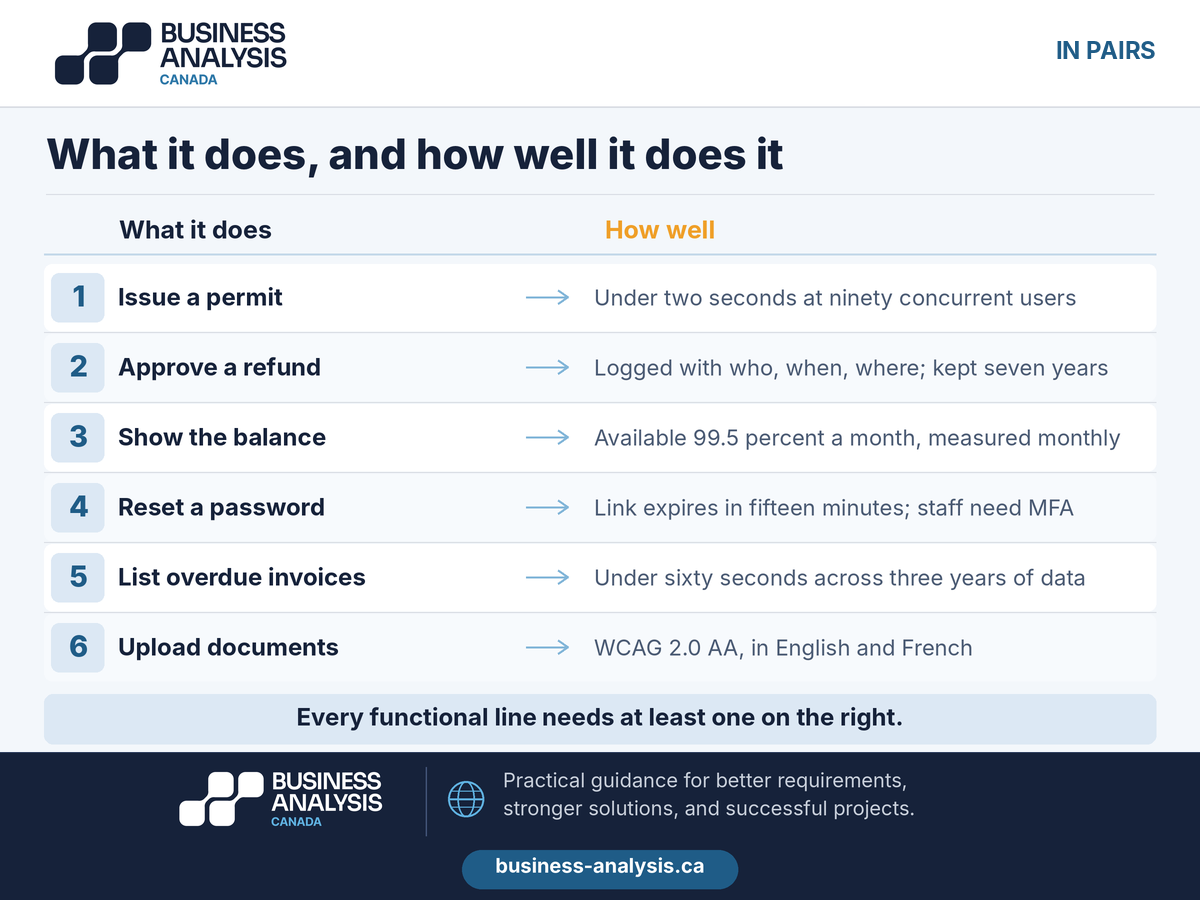
- Functional: a clerk can issue a permit from an approved application. Non-functional: issuing a permit completes in under two seconds at the 95th percentile with ninety concurrent users, measured in a load test before UAT and monthly in production.
- Functional: a manager can approve a refund above the clerk's limit. Non-functional: every approval is logged with the user, the time, the originating address, and the amount, and the log is retained for seven years and readable by internal audit without vendor assistance.
- Functional: the portal shows a customer the current account balance. Non-functional: the portal is available 99.5 percent of each calendar month, measured by the monitoring service outside a published maintenance window, with service credits below the threshold.
- Functional: a user can reset a forgotten password. Non-functional: the reset link expires in fifteen minutes, staff accounts require multi-factor authentication, and passwords are stored with a current standard hash, verified in the security assessment.
- Functional: a finance user can run the overdue invoice report. Non-functional: the report completes in under sixty seconds over three years of history, verified in the performance test with production-sized data.
- Functional: an applicant can upload supporting documents. Non-functional: every public screen meets WCAG 2.0 Level AA and is available in English and French with equal content, verified by a conformance audit and by acceptance testing in both languages.
The other common non-functional categories, each with the kind of number it carries: recovery time and recovery point objectives (restored within four hours, losing no more than one hour of data, demonstrated in a restore rehearsal); throughput (400 orders an hour sustained for the peak day); capacity (the year-three volumes from the business case without redesign); data retention and disposal (by record type, with disposal evidence); maintainability (a configuration change deployed to production within one business day without vendor code change); and portability or exit (a full data export in a documented open format within thirty days of request). The Power Apps and custom development guide shows what happens when the performance and offline lines are missing from an internal tool: the platform's limits are discovered by the users.
Functional requirements have their own common failure, which is being written as solutions. "A dashboard with a red indicator" is a design; "the manager sees yesterday's exceptions before 9 a.m." is the requirement, and several designs could meet it. The acceptance criteria guide gives the form that keeps functional requirements testable; the rest of this post does the same for the non-functional ones.
The failure we see is the non-functional requirements written last, by the architect, in a separate section nobody signs, so that the business owner never sees that the month-end performance line says "acceptable" and the French line says "where feasible." ID Business Analysis Canada writes the non-functional requirements beside the functional ones in its Requirements Engagement, through the analysis and design service: each pair reviewed with the business owner who will live with it, each NFR carrying the five parts in the next section and a verification method agreed with the tester, and the Canadian checklist in the last section run against every system that touches the public, personal information, or a federal workplace.
Key Takeaway: Write requirements in pairs: the behavior, and the quality of the behavior with a number. Performance, availability, security, auditability, recovery, capacity, accessibility, language, retention, maintainability, and exit each carry a measurable value, or they are not requirements yet.
What are NFRs in agile?
The same requirements, placed in three different homes instead of one document section, and the placement is what makes them survive. Agile teams write functional requirements as user stories with acceptance criteria; the non-functional ones end up either on every story, on the whole system, or on a story of their own, depending on what kind they are.
Story-level NFRs become acceptance criteria. If the overdue invoice report has a sixty-second limit, that limit is a criterion on the report story, in the given-when-then form, and the story is not done until the test passes with production-sized data. Performance, security, and accessibility requirements that apply to a specific feature belong here, where the developer sees them before writing code rather than in a document the developer has never opened.
System-wide NFRs go into the definition of done. Every screen passes the automated accessibility checks; every story's test includes the two official languages; no story closes with a critical finding from the static security scan; the performance suite still passes at the agreed thresholds. The definition of done is the only place a requirement can live that applies to all work without being repeated on every story, and a team whose definition of done has no non-functional lines has no non-functional requirements in practice, whatever the document says.
Capability NFRs become enabler stories, sometimes called architectural or technical stories: the disaster recovery arrangement that meets the four-hour recovery objective, the logging pipeline that meets the audit requirement, the French language resource framework. They are prioritized in the backlog like any other story, which is where they lose, because a sponsor comparing "customers can pay by card" with "logs retained seven years" funds the first. The MoSCoW test applies: the audit log is a legal Must, and the prioritization guide explains why the Must list has to carry it before the features.
Two agile habits protect NFRs. Fitness functions, automated checks in the build pipeline that fail the build when a threshold is crossed, turn the performance and security requirements into tests that run on every change rather than once before go-live. And an NFR review at each release planning session, where the thresholds are re-read against the volumes now expected, catches the capacity requirement written for year one when the product is entering year three. The UAT guide covers how the business signs off the result; the non-functional part of that sign-off is the evidence from the load test, the restore rehearsal, and the conformance audit, not a demo.
Key Takeaway: In agile, feature-specific NFRs are acceptance criteria on the story, system-wide NFRs live in the definition of done, and capability NFRs are enabler stories prioritized as Musts when the law requires them. Fitness functions in the pipeline keep them tested on every change.
How do you make a non-functional requirement testable?
By giving it five parts, and by refusing to sign one that is missing any of them: a metric, a condition, a threshold, a measurement method, and a consequence. "The system must be fast" has none of the five. "Opening a customer record completes in under two seconds at the 95th percentile (metric and threshold) with ninety concurrent users during month-end posting (condition), measured by the load test before UAT and by the monitoring service monthly in production (measurement), with the vendor remediating at its cost when the threshold is missed in two consecutive months (consequence)" has all of them, and a tester, a vendor, and a lawyer can each do their job from it.
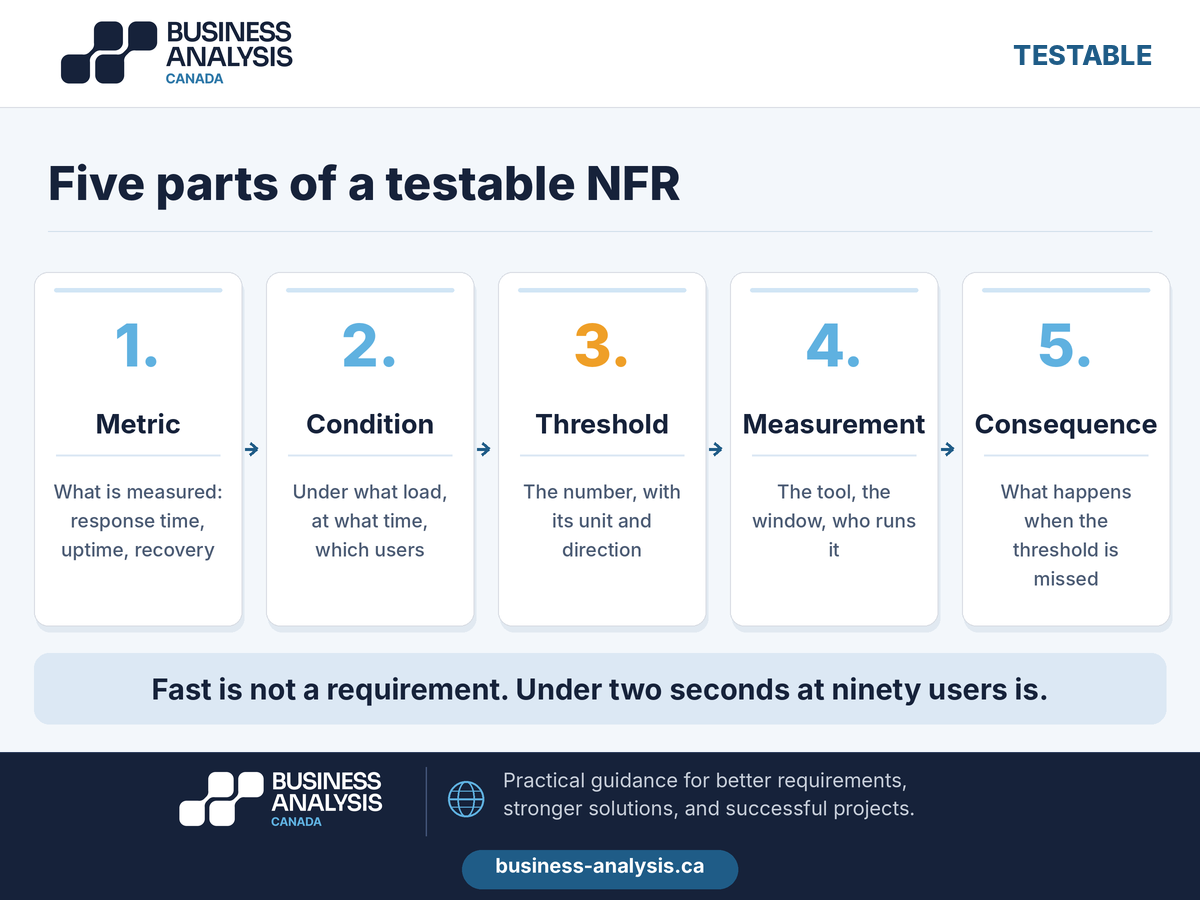
The metric names what is measured, in a unit: seconds, percent of time, number of concurrent users, hours to recover, records lost. The condition says when the metric applies, because every system is fast at 6 a.m. with one user; the month-end, the peak hour, the year-three volume, and the degraded network are the conditions that matter. The threshold is the number, with its direction, and for response times the percentile, because an average hides the ten percent of requests that take thirty seconds. The measurement method names the tool, the environment, the data volume, the window, and who runs it, which is what turns an argument about whether the system is fast into a reading. The consequence is what the organization does when the threshold is missed, which in a contract is a remedy and in an internal project is a release block.
Three rewrites show the pattern. "The system must be available 24/7" becomes "available 99.5 percent of each calendar month, excluding a published four-hour monthly maintenance window, measured by the external monitoring service, reported monthly, with service credits for each tenth of a percent below." "The system must be secure" becomes a list: multi-factor authentication for all staff accounts, encryption in transit and at rest, role-based access reviewed quarterly, a penetration test before go-live with no critical or high findings open, and a log of every access to personal information retained for the period the retention schedule names. "The system must be user-friendly" becomes "a new clerk completes the standard permit scenario without assistance within fifteen minutes of a thirty-minute orientation, measured in a usability session with five representative users before UAT, with a pass requiring four of five."
Verification methods are part of the requirement, not an afterthought, and the requirements verification post sets out the catalog. Performance is verified by a load test with production-sized data, availability by monitoring over time, recovery by a rehearsal, security by assessment and penetration test, accessibility by a conformance audit and a session with assistive technology, language by acceptance testing in both languages with the same scripts. An NFR whose verification method is "the vendor confirms" has no verification method.
Two warnings. Thresholds should come from the business and the data, not from the architect's habit: the two-second figure is right for a clerk serving a line and wrong for a monthly batch, and the year-three volume comes from the business case, not from a guess. And a threshold with no condition is a promise the vendor can meet by choosing the condition; "under two seconds" is always true at some load.
Key Takeaway: A testable NFR has a metric with a unit, a condition that names the load and the moment, a threshold with a direction and a percentile, a measurement method with a tool and an owner, and a consequence. "Fast" is not a requirement. "Under two seconds at ninety users at month-end" is.
Which non-functional requirements are specific to Canada?
Four categories that templates written elsewhere leave out, plus the retention and audit rules that sector regulators add. Each is a non-functional requirement in the sense above: a quality the whole system must have, with a threshold set by statute rather than by preference, and a verification method the regulator or the auditor will recognize.
Official languages first, because it is the category most often written as a preference and is a statutory duty for federal institutions. The Official Languages Act's section 36 requires federal institutions in the National Capital Region and other prescribed bilingual regions to make regularly and widely used documentation and work instruments available in both official languages, and to see that regularly and widely used computer systems they acquire or produce can be used in either language. For a requirements writer that means the system's interface, its documentation, and its support are in scope alongside the public website, and that a French interface produced by machine translation of English strings will fail the first acceptance test run in French. For organizations with Quebec customers or employees, the Charter of the French Language sets the parallel obligations for documents, contracts, and software, and the ERP requirements checklist carries the business-process version of the same rows.
Accessibility carries two regimes, and the level is specific. Ontario's regulation under the Accessibility for Ontarians with Disabilities Act requires organizations with 50 or more employees and designated public sector organizations to make public websites and web content meet WCAG 2.0 Level AA, with intranets excluded. Federally regulated organizations are moving to a different reference: Accessibility Standards Canada adopted the European standard EN 301 549 as a National Standard of Canada in May 2024, and the Accessible Canada Regulations' digital technologies amendments name that standard, with the first compliance dates for public sector organizations and large employers in December 2027 and most remaining requirements, including mobile applications and conformity assessments for purchased products, in December 2028. Write the level your regime names, verify it against the current regulation on the day, and buy only products whose conformance report covers the version you will deploy. The size of the population is the reason the requirement exists: Statistics Canada's 2022 Canadian Survey on Disability found that 27 percent of Canadians aged 15 and older, 8.0 million people, had one or more disabilities that limited their daily activities, up from 22 percent in 2017.
Privacy adds a requirement that is new to most teams. Under Quebec's Law 25, where a public-facing technological product offers privacy settings, those settings must provide the highest level of confidentiality by default, and functions that identify, locate, or profile a person must be off until the person turns them on; a privacy impact assessment is required for any project that acquires, develops, or overhauls a system handling personal information, and before personal information is communicated outside Quebec. Those are non-functional requirements with a configuration test: open a fresh account and check what is on. PIPEDA and the provincial equivalents supply the rest, limited collection, purpose, access logging, and retention, and the healthcare statutes add their own, which the RPA in healthcare post covers for Ontario's health privacy law.
Data residency is the category most often asserted and least often sourced. No general Canadian law requires private-sector data to stay in the country; the requirement comes from public-sector statutes in some provinces, from federal security policy for classified information, from customer contracts, and from Law 25's assessment of transfers outside Quebec. Write it when a specific obligation requires it, name the obligation in the requirement, and verify it with the vendor's written region statement including subcontractors, because a hosting region is a fact the vendor can state and a "Canadian cloud" is a marketing term. The RFP guide puts data residency among the mandatory criteria for exactly that reason, and the digital wallet post shows the regulatory assignments a payments product adds on top.
Key Takeaway: Four Canadian categories belong in every NFR checklist: official languages for federal institutions and French for Quebec, accessibility at the level your regime names, Quebec's privacy-by-default settings and impact assessment, and data residency where a specific obligation requires it. Each has a statutory threshold and a verification method the regulator recognizes.
Frequently Asked Questions
What are non-functional requirements?Non-functional requirements describe the qualities a system must have rather than the functions it performs: how fast it responds under a stated load, how often it is available, how it protects information, how quickly it recovers, how many users and records it handles, which languages and accessibility standards it meets, and how long it keeps records. They are also called quality attributes. Each one carries a metric, a condition, a threshold, a measurement method, and a consequence, or it is a wish rather than a requirement.
What are examples of functional requirements?A clerk can issue a permit from an approved application; a manager can approve a refund above a clerk's limit; a customer can see the current account balance; a user can reset a forgotten password; a finance user can run the overdue invoice report; an applicant can upload supporting documents. Each describes a behavior that can be demonstrated once, on one record, which is the test for a functional requirement. Each also needs a non-functional requirement beside it stating how fast, how securely, and for how many.
Are non-functional requirements part of acceptance criteria?Yes, when they apply to a specific feature: the sixty-second limit on a report is an acceptance criterion on the report's story, written in the given-when-then form and tested with production-sized data before the story is done. System-wide requirements such as accessibility, both official languages, and security scanning belong in the team's definition of done, so they apply to every story without being repeated. Capability requirements such as disaster recovery become their own enabler stories, prioritized as Musts when the law requires them.
How do we write the non-functional requirements for our project?Start from the functional list and ask, for each line that matters, how fast, how often, for how many, under what load, in which languages, and how long kept; then run the Canadian checklist for languages, accessibility, privacy, and residency. ID Business Analysis Canada writes the non-functional requirements beside the functional ones in its Requirements Engagement, each with the five parts and a verification method agreed with the tester, and reviews them with the business owner who will live with the thresholds.
Conclusion
The 181-line requirements document in the opening pattern was not short of requirements. It was short of the kind that decide whether a system works in March rather than in a demo, and the single line it had could not be tested, priced, or enforced. The same system, with the pairs written, would have gone to the vendor with a two-second threshold at month-end load, a French interface subject to the same acceptance scripts as the English one, and a WCAG level with a conformance report, and the first month-end would have been a test the system had already passed.
If your requirements set has hundreds of functional lines and one about quality, ID Business Analysis Canada's Requirements Engagement writes the non-functional requirements beside them, with numbers, conditions, and verification methods, and runs the Canadian checklist against the system. Book a free consultation and bring the document; the first thing we will do is count the lines with a number in them.
Sources
- Statistics Canada, Canadian Survey on Disability, 2017 to 2022, The Daily, December 1, 2023; 27% of Canadians aged 15 and older (8.0 million) with one or more disabilities, up from 22% in 2017.
- Government of Ontario, How to make websites accessible; WCAG 2.0 Level AA for public websites of organizations with 50 or more employees and designated public sector organizations, intranets excluded.
- Accessibility Standards Canada, Accessibility Standards Canada adopts the globally recognized accessibility standard for ICT products and services, May 31, 2024; CAN/ASC - EN 301 549:2024.
- Employment and Social Development Canada, Guidance overview of regulatory amendments: Digital Technologies Phase 1; covered entities, the ICT Standard, compliance dates of December 5, 2027 and December 5, 2028.
- Government of Canada, Official Languages Act, section 36, version of June 20, 2025; work instruments and computer systems in both official languages in prescribed regions.
- McCarthy Tétrault, Privacy laws: doing business in Canada 2026, September 22, 2026; Law 25's confidentiality-by-default regime, privacy impact assessments for system projects and transfers outside Quebec, automated decision notice.
- Miller Thomson LLP, Special considerations: doing business in Quebec, civil law and language compliance, September 2026; French-language obligations for documents, contracts, and software.
- Sonar, ISO/IEC 25010 explained; the nine product quality characteristics of the 2023 edition and the changes from the earlier model.