
IT Project Business Case Template: What Canadian Approvers Expect to See



Share the page:
A business case says what problem an investment solves, what doing nothing costs, which options were compared, what the recommended option costs and returns over five years, and who owns each benefit after go-live. The template on this page has nine sections, worked through one IT example with the figures shown: a permit intake system that pays back early in year three once the do-nothing baseline is counted. Finance accepts benefits with a named owner, a measured baseline, a mechanism, and a year; Canadian public-sector approvers add the status quo as a mandatory option, three viable alternatives, total cost of ownership, and a complexity assessment. The Project Management Institute reported in 2026 that 31 percent of complex projects fail to deliver their full intended benefits.
Introduction
The version we see most often is the one-line business case. A slide says the new system will save time and reduce errors, a capital number sits beside it, and the approval that follows is a vote of confidence in the sponsor rather than a decision about the investment. Two years later the finance director asks which line of the budget got smaller, and nobody can point to one. The system works. The benefits were never anyone's job.
If you searched for a business case template, you are probably writing one for an IT project and wondering what finance, an executive committee, or a Treasury Board analyst will push back on. The template below is written for that reader. It has nine sections, it is worked through one example with the figures shown, and it is built around the two things approvers reject most often: a missing do-nothing baseline and benefits with no owner. What follows covers what a business case is, the nine sections, how to estimate costs and benefits finance will accept, how the business case differs from a project charter, and what Canadian public-sector approvers look for.
What is a business case?
A business case is a decision document. It states a problem the organization has, measures what the problem costs today and what it will cost if nothing changes, compares at least three ways of solving it including doing nothing, recommends one, and shows the costs, benefits, risks, and payback of that recommendation over its life, with a named owner for every benefit. It is written before money is committed and kept alive after, because it is the baseline every later question is measured against: are we still on course, and did the benefits arrive.
Three things a business case is not. It is not a justification for a decision already made; the Treasury Board of Canada Secretariat's Business Case Guide says so in those words, and a private-sector finance director who suspects the decision was taken first will treat every number as advocacy. It is not a project plan; the plan comes after approval and lives in the charter. And it is not a cost-benefit analysis on its own, which is one section of the document, not the document.
The reason the realization section matters more than the arithmetic is on the record. The Project Management Institute's Pulse of the Profession research, released in May 2026, found that 31 percent of complex projects fail to achieve the full scope of their intended benefits, a rate the institute puts at more than twice that of projects overall. Those projects were approved on business cases. The gap between a benefit forecast and a benefit delivered is the work of the two years after go-live, and a business case that does not say who does that work has forecast a number nobody will collect.
The private-sector and public-sector versions differ in format and in the forms around them, and the last section covers the Canadian public-sector additions. The logic is the same in both. The discovery phase post describes the work that precedes the business case; a discovery that ends in "do not proceed" has produced a business case with a short recommendation section.
Key Takeaway: A business case is a decision document: the problem measured, the cost of doing nothing, at least three options, one recommendation with five-year costs and benefits, risks, and a named owner for every benefit. It is written before approval and used after it.
What sections does an IT business case need?
Nine, in this order, with the summary written last and placed first. The order follows the questions an approver asks, and an approver who has to hunt for the do-nothing baseline will assume it is missing because it is unflattering.
- Summary and recommendation. One page: the problem in a sentence, the recommended option, the one-time and annual cost, the annual benefit, the payback year, the main risk, and the decision requested. Written last, from the sections below, and the only page some approvers read.
- Problem and business need. What is failing, measured today: the volume, the hours, the error rate, the service standard missed, the regulatory exposure. "Permit applications take 34 business days against a 15-day standard, and 2.5 staff re-key paper forms" is a problem. "Our process is inefficient" is a complaint.
- Do-nothing baseline. What the problem costs now and what it will cost in each of the next five years if nothing changes: the overtime, the extra hire, the backlog, the fine, the retiring clerk whose knowledge leaves with her. Every benefit in section six is measured against this line, which is why it comes before the options rather than after them.
- Options compared. A long list screened to a short list of at least three viable options, the status quo among them, each described in two paragraphs with its five-year cost, its benefits, its risks, and the reason it was or was not recommended. Configure what you have, buy a product, build, and do nothing is the usual short list for an IT project; the Power Apps and custom development guide covers how the configure-or-build question is scored.
- Costs. One-time costs (implementation, integration, data migration, change management, training, internal staff time) and ongoing costs (subscription or license, support, hosting, enhancements) for five years, as total cost of ownership, with the assumptions behind each line and the source of each estimate. A vendor quote is a source; a guess is labeled a guess, with a range.
- Benefits, each with an owner. Every benefit stated with its mechanism (hours redeployed, cash avoided, revenue recovered, risk reduced), its baseline from section three, its value by year, and the name of the manager who will report it after go-live. The next section covers how to write these so that finance accepts them.
- Risks. Two kinds, rated separately: delivery risk, that the project is late, over budget, or does not work; and outcome risk, that the project is delivered and the benefits still do not arrive because staff were not redeployed, the volume did not materialize, or the process was not changed. Each risk has a probability, an impact, a response, and an owner.
- Financial summary. Costs and benefits side by side by year, the net by year, the cumulative position, the payback year, and a sensitivity line showing what happens if benefits arrive a year late or at seventy percent. Net present value where the organization uses it.
- Realization plan and governance. Who measures each benefit, against which baseline, at which dates after go-live, who receives the report, and what happens if a benefit is behind. The governance of the project itself (sponsor, steering, gates) is summarized here and detailed in the charter.
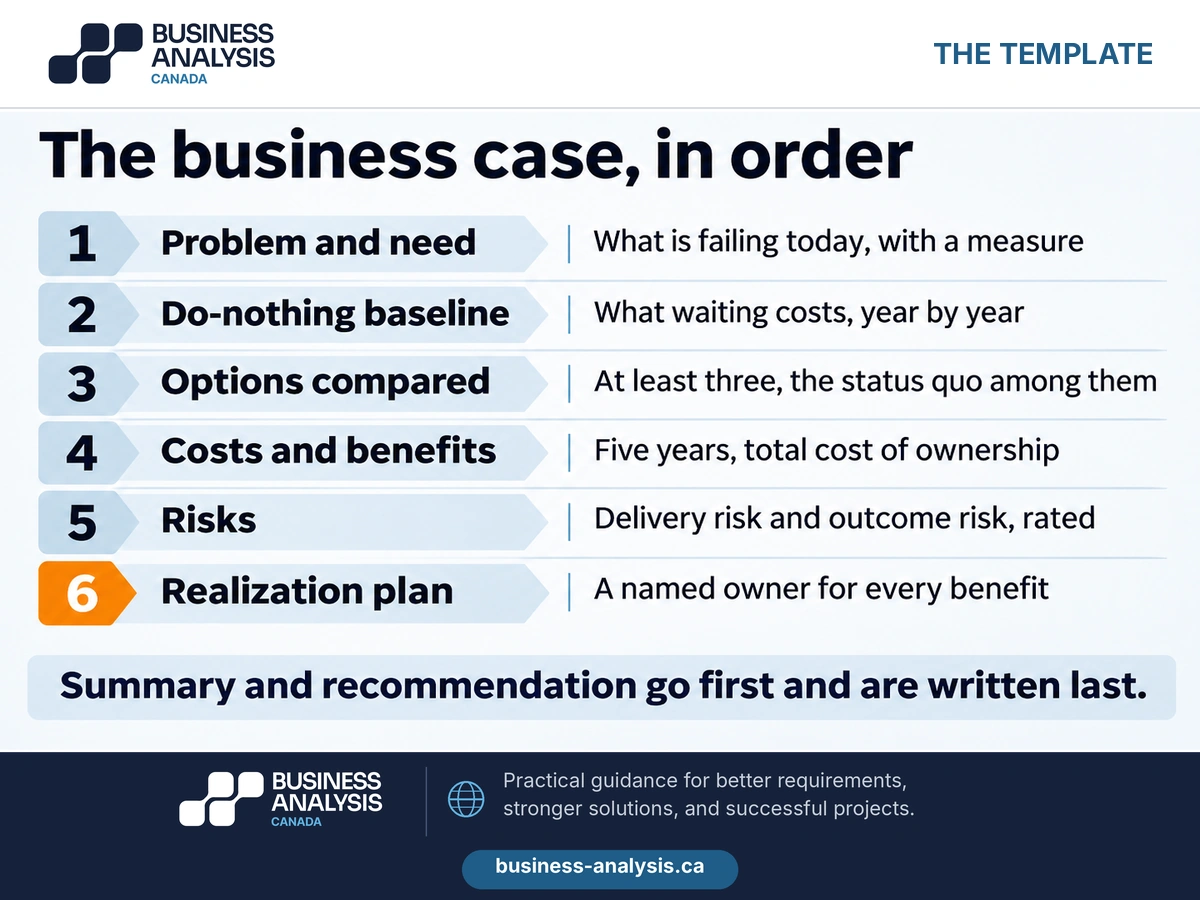
The template is the nine headings above, with the two tables later in this guide pasted under sections five, six, and eight. It fits most IT investments between a few hundred thousand and a few million dollars; above that, public bodies add their own forms, and the last section covers them. The digital wallet post has a version written for a payments product, where the regulatory section carries more weight.
The failure we see is the business case assembled by the sponsor's team in the last week before the committee, from a vendor's return-on-investment calculator and a list of benefits with no owners. ID Business Analysis Canada writes the business case as the closing deliverable of a Discovery Sprint, with the problem measured in the current-state work, the do-nothing baseline costed from the same figures, the options scored against the organization's criteria, and the benefits assigned to managers who signed them before the document reached the approver.
Key Takeaway: Nine sections in the approver's order: summary, problem, do-nothing baseline, options, costs, benefits with owners, risks, financial summary, realization plan. Write the summary last and put it first.
How do you estimate costs and benefits that finance will accept?
Costs by sourcing every line, and benefits by giving every line four things: a named owner, a measured baseline, a mechanism, and a year. Finance rejects business cases for soft benefits, not for small ones. A benefit of forty thousand dollars a year in avoided overtime, owned by the operations manager who signs the overtime, is accepted. A benefit of two million dollars in "improved decision-making" is not, however large the system.
The worked example runs through a mid-size municipality replacing paper and email permit intake with an online permitting system integrated with its property database. The figures are illustrative and rounded, and the pattern is the point. The problem, measured: about nine thousand applications a year, a 34-day average against a 15-day standard, and 2.5 staff whose work is re-keying. The do-nothing baseline: overtime running at thirty-eight thousand dollars a year and growing, a second intake clerk needed from year two at seventy-eight thousand dollars fully loaded, and a backlog that the service standard review will flag. The recommended option: a subscription permitting product configured by a partner, with one integration.
Four things in that table are what make it acceptable. The benefit lines each carry an owner and a mechanism, and the hours line is valued at a fully loaded rate with the hours stated, so finance can check the arithmetic and the owner can be asked, in year two, where the 3,600 hours went. The second-clerk line is a benefit only because the do-nothing baseline established the hire; without section three it would be invisible, and the case would pay back a year later. Year one is a half year of benefit, because go-live is mid-year and benefits do not start on the day the contract is signed. And the net line shows the shape of every honest IT business case: a deep first year, then a flat return, with the payback decided by how quickly the staff are redeployed, which is a management decision rather than a software feature.
Three rules for the lines finance will challenge. Hours redeployed are a benefit only if the realization plan says what the hours will do; "the staff will do higher-value work" is not a plan, and "2.5 FTE moves to inspections, where the backlog is 400 files" is. Avoided costs count only against a baseline that would have been incurred, with the evidence that it would have been: a budget request already submitted, a service standard already breached. And revenue or risk benefits are presented at a discount that the owner agreed to, with the full figure shown and the discount explained, because an approver who sees a hundred percent of a speculative benefit discounts the whole document.
Costs have the opposite problem: they are usually understated, because the internal lines are left out. Staff time on the project, backfill for the people in workshops, the data cleansing before migration, and the two years of enhancements after go-live are costs in every IT project and absent from most business cases. The ERP requirements checklist and the RFP guide both describe the pricing schedule that produces comparable vendor costs; the business case should quote it, with the internal lines added. The business development cases we prepared for a mining client followed the same discipline at a different scale: every line sourced, every benefit owned, and the baseline stated before the options.
Key Takeaway: A benefit is accepted when it has a named owner, a measured baseline, a mechanism, and a year. Count avoided costs only against a baseline with evidence, value hours at a loaded rate with the hours stated, and add the internal costs most business cases leave out.
How is a business case different from a project charter?
The business case decides whether to invest; the charter authorizes the project that the decision created. They are written by different people, at different times, for different approvers, and the most common confusion is a charter that tries to carry the justification, or a business case that tries to carry the plan.
The Treasury Board's own guides draw the line the same way: the charter's executive summary links the project to the outcomes stated in the business case, the charter's risk section points back to the risk assessment contained in the business case, and the business case's cost estimates are the basis for the charter's budget. One document justifies; the other authorizes and defines. When the project is delivered, the charter is closed and the business case is still open, because the benefits are still being collected.
Two practical consequences. The business case should not be rewritten into the charter; the charter cites it. And when the project changes materially during delivery, a scope cut, a cost overrun, a benefit that the operations manager now says will be half the figure, the question is whether the business case still holds, beyond whether the charter needs a change request, which is a question for the investment authority rather than the steering committee. The why IT projects fail post describes what happens when nobody asks it.
Key Takeaway: The business case decides whether to invest and lives until the benefits are collected; the charter authorizes the project and lives until closure. The charter cites the business case; it does not repeat it. A material change in delivery reopens the investment question as well as the plan.
What do Canadian public-sector approvers look for in a business case?
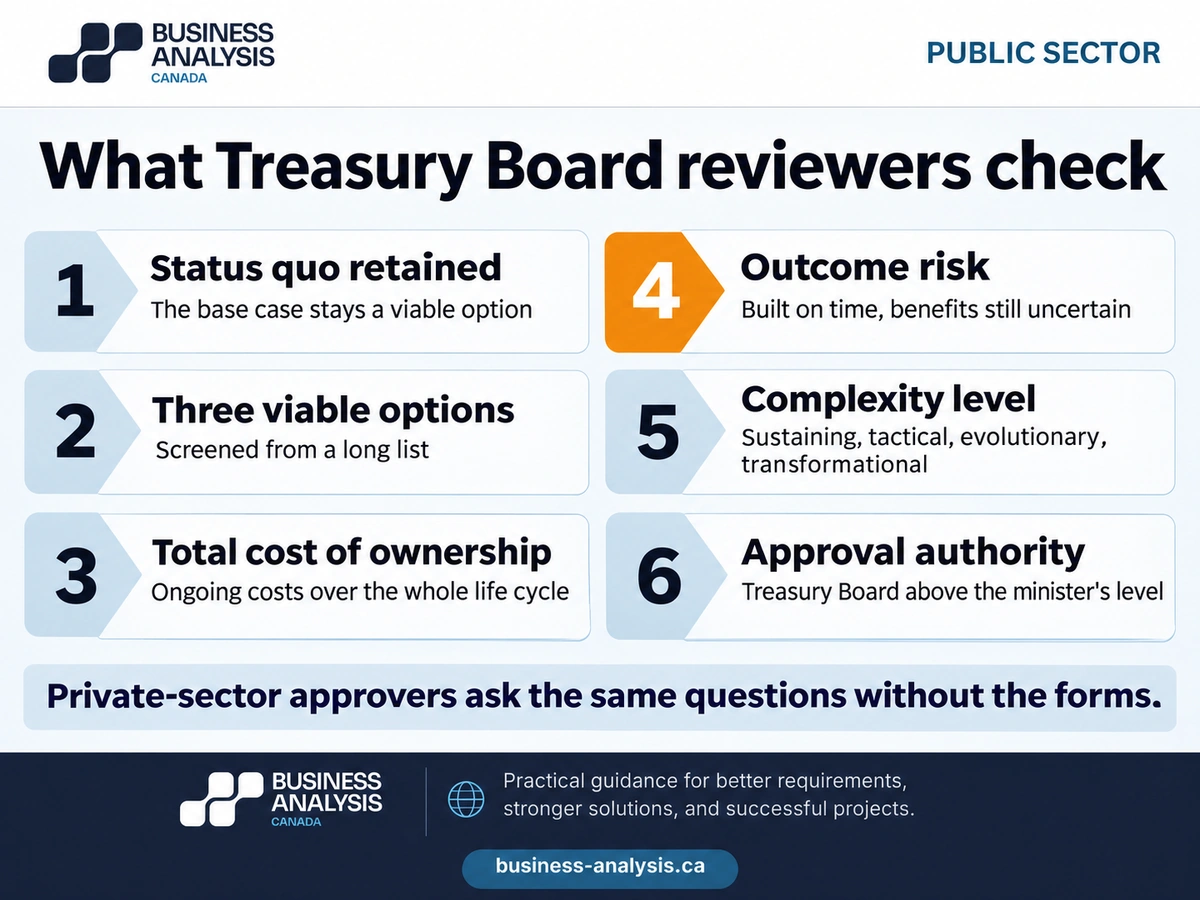
The same nine sections, with four things made mandatory that private-sector approvers only expect: the status quo as a formal option, at least three viable alternatives, total cost of ownership, and a complexity and risk assessment that decides who has the authority to approve. The forms differ by jurisdiction; the questions do not.
Federally, the Treasury Board of Canada Secretariat's Business Case Guide is the reference, and it is explicit on the points that trip up first-time authors. The status quo, which it calls the base case, must be retained as a viable option, with the long-term costs and benefits of current operations predicted, and the guide recommends at least three viable options with the status quo among them. Costs are total cost of ownership over the life cycle, including compliance costs borne by stakeholders. Benefits are measurable outcomes developed with the people who will deliver them, and the cost-benefit analysis uses net present value with the cost of identified risks added to each option. Risk is split into delivery risk and outcome risk, and the guide's own phrase for the second is the one to remember: even if you build it, the benefits may not come. The document is organized in three parts, strategic context, analysis and recommendation, and management and capacity, and the nine sections above map onto them.
The approval route depends on the project's assessed complexity. The Project Complexity and Risk Assessment places a project in one of four levels, sustaining, tactical, evolutionary, or transformational, from a scored questionnaire, and a project whose assessed level exceeds what the sponsoring minister may approve under the department's assessed capacity goes to Treasury Board. The Directive on the Management of Projects and Programmes sets the current rules; check it for the approval limits in force, because the figures and the class definitions change and the assessment has to be done before the business case is finalized, not after, since the level decides who reads the document.
Provincially, the shape is similar and the thresholds are local. Ontario's corporate chief information officer runs a gateway review of information technology projects above a financial threshold, which the Auditor General's 2024 follow-up reported was being reconsidered so that significance and risk count alongside the dollar value; other provinces attach the business case to their Treasury Board or Management Board submission rules. Municipalities usually approve through council on a staff report that is a business case in a different format, with the do-nothing baseline the item councillors ask for first. In every case, write to the jurisdiction's template where one exists and keep the nine sections as the structure beneath it, because the reviewer's questions are the same whichever form they arrive on.
Three things reviewers in the Canadian public sector reject that private-sector approvers may let through. A benefit expressed as staff savings with no statement of what happens to the positions, because a public body that will not reduce positions must show redeployment or it has no benefit. A single vendor named before the procurement, because the business case recommends an option, not a supplier, and the RFP guide covers what happens next. And a legacy replacement with no evidence of what the old system does, which is why the decision record from a legacy system assessment is usually attached as an appendix.
Key Takeaway: Public-sector approvers require the status quo as an option, three viable alternatives, total cost of ownership, risk split into delivery and outcome, and a complexity assessment that decides who approves. Write to the jurisdiction's form with the nine sections beneath it.
Frequently Asked Questions
What is the difference between a business case and a cost-benefit analysis?A cost-benefit analysis is one section of a business case: the costs and benefits of each option valued by year, usually with net present value and a payback year. A business case wraps it in the decision: the problem measured, the do-nothing baseline, the options compared, the risks rated, the recommendation, and the plan for collecting the benefits with a named owner for each. An approver can accept a cost-benefit analysis and still reject the investment, because the analysis does not say who will make the benefits happen.
How long should an IT business case be?Eight to fifteen pages for an investment of a few hundred thousand to a few million dollars, plus appendices for the cost workings, the options screening, and the risk register, with a one-page summary at the front that stands on its own. Length grows when the author argues instead of measuring; it falls when the problem, the baseline, and the benefits are stated as figures with sources. Public-sector submissions follow the jurisdiction's template and are often longer, but the one-page summary still comes first.
Who should write the business case: the sponsor, the project manager, or the business analyst?The business analyst drafts it, the sponsor owns it, finance checks it, and the managers who will deliver the benefits sign their lines before it goes to the approver. The project manager is usually not yet assigned, since the project does not exist until the case is approved, and a case written by the team that will deliver the project reads as advocacy. The sponsor's signature on the summary page is the commitment the approver is being asked to fund.
How do we start a business case for an IT project?Measure the problem first: the volumes, the hours, the error rate, the standard missed, and what each will cost over the next five years if nothing changes. That baseline is the hardest section and the one everything else depends on. ID Business Analysis Canada produces the business case as the closing deliverable of a Discovery Sprint, with the current state measured, the options scored, the five-year costs sourced, and every benefit assigned to a manager who signed it, in the format your approver expects.
Conclusion
The one-line business case in the opening pattern was not wrong about the system. It was wrong about the benefits, because it never said which budget line would get smaller or who would make it smaller, and so nobody did. The same investment, written on the nine sections, would have carried a do-nothing baseline that showed the second hire coming, a benefits table with three names on it, and a realization plan with a date in year two when the finance director's question would have had an answer, because someone had been asked to produce one.
If you have an IT investment to put in front of an approver, ID Business Analysis Canada's Discovery Sprint ends in a business case written for that approver, with the problem measured, the baseline costed, the options compared, and the benefits owned. Book a free consultation and bring the one-line version; the first thing we will do is cost what happens if nobody approves it.
Sources
- Project Management Institute, Why Complex Projects Fail: Best Practices Are Not Enough, System Thinking Gives Your Team the Edge, press release, May 12, 2026; 31% of complex projects fail to achieve the full scope of their intended benefits.
- Treasury Board of Canada Secretariat, Business Case Guide; three-part structure, status quo as a viable option, at least three viable options, total cost of ownership, net present value, delivery and outcome risk, Treasury Board approval above the minister's level.
- Treasury Board of Canada Secretariat, Business Case Template.
- Treasury Board of Canada Secretariat, Project Complexity and Risk Assessment Tool; four levels from sustaining to transformational.
- Treasury Board of Canada Secretariat, Project Charter Guide; the charter's links to the business case for outcomes, risk, and cost basis.
- Treasury Board of Canada Secretariat, Directive on the Management of Projects and Programmes; cited by name for current approval limits (page not fetched on the day).
- Office of the Auditor General of Ontario, Follow-Up on 2022 Value-for-Money Audit: Office of the Corporate Chief Information Officer, 2024 Annual Report; IT project gateway threshold under reconsideration.
- Business Analysis Canada, Guarding the Gate: The Value of a Project Discovery Phase in IT Strategy, business-analysis.ca blog.
- Business Analysis Canada, Before the RFP: Business Analysis for Digital Wallet Projects, business-analysis.ca blog, October 2026.
- Business Analysis Canada, Build, Buy or Power Apps: Low-Code vs Custom Development for Internal Tools, business-analysis.ca blog, November 2026.
- Business Analysis Canada, Before the Demos: ERP Requirements Checklist for Mid-Size Canadian Organizations, business-analysis.ca blog, November 2026.
- Business Analysis Canada, Comparable Bids: How to Write an RFP for Software That Canadian Vendors Can Price, business-analysis.ca blog, November 2026.
- Business Analysis Canada, Before the Rewrite: Legacy System Assessment for Modernization Decisions, business-analysis.ca blog, November 2026.
- Business Analysis Canada, Why Do IT Projects Fail?, business-analysis.ca blog.
- Business Analysis Canada, Prepare Business Development Cases for Mining Assets, case study.