
What Does a Business Analyst Do on an IT Project? Deliverables by Phase, and What You Get When You Hire One



Share the page:
A business analyst finds out what an organization needs from a change, writes it down in a form that can be built and tested, and keeps that definition true from the first workshop to the benefits review after go-live. On an IT project that means a named deliverable in every phase: scope boundary and decision record in discovery, requirements with acceptance criteria in analysis, change impact and traceability during build, test scripts and defect triage in UAT, and benefits measurement afterward. Job Bank lists a median wage of $45.13 an hour for the occupation in Canada. This guide gives the deliverables by phase, the skills that matter, how the role splits from project manager and product owner, and the projects that do not need one.
Introduction
The version we see most often is the analyst cut in month three. The developers are visible, the project manager has a plan with dates on it, and the analyst is in meetings all day producing documents the sponsor has not read, so when the budget is trimmed the analyst's line is the easy one. In month nine the system does what the vendor understood and not what the warehouse does, the regional office turns out to run a different version of the process, and the integration with finance was mentioned in a workshop that nobody minuted. The sponsor asks who wrote down what the business needed. The answer is that someone had started to.
If you searched for what a business analyst does, you are probably a sponsor, a hiring manager, or a project manager deciding whether the role belongs on your project and what you would get for the money. The definition is short and the work is specific, so this guide is organized by what the analyst hands over in each phase of an IT project and what each deliverable prevents. What follows covers the definition, the deliverables by phase, the skills that matter, how the role divides from project manager and product owner, and when a project does not need one.
What does a business analyst do?
A business analyst finds out what an organization needs from a change, writes the need down so that it can be built and tested, and keeps that definition true as the project runs. The International Institute of Business Analysis defines the discipline as the practice of enabling change in an enterprise by defining needs and recommending solutions that deliver value to stakeholders, and a business analyst as any person who performs business analysis, whatever their title. On an IT project, the analyst is the person who owns the question "what are we building, for whom, and how will we know it works," and who produces the artifacts that answer it.
The job has three parts that recur in every phase. Elicitation: getting the need out of the people who have it, through interviews, observation, workshops, and documents, including the people who do not come to meetings. Specification: turning what was found into requirements, models, and acceptance criteria that a developer can build from and a tester can check. And analysis proper: finding the gaps, conflicts, and consequences in what was asked for before they are built, which is where most of the value sits and least of the visibility.
An IT business analyst is a business analyst whose change is a system, and who therefore also needs to understand data, interfaces, and the limits of the platform the system will run on. A technical business analyst sits further along the same line, reading code and data models directly; the technical business analyst post describes when a program needs that seat. The spectrum matters for hiring, because an analyst who can run a workshop but cannot profile a table will miss the data findings that decide integration and migration.
What the role costs is on the public record. Job Bank's wage report for business systems specialists, the occupation the federal classification uses for the role, lists a median of $45.13 an hour across Canada, with a low of $30.67 and a high of $62.50, on 2023 to 2024 Labour Force Survey data updated in November 2025. Against the cost of a mid-size IT project, a year of the median rate is a line item; the question the rest of this guide answers is what the line item produces.
What a business analyst is not: a note-taker, a project manager with a different title, a tester, or the person who builds the slides. An analyst who spends the project transcribing meetings has been given the wrong job, and a sponsor who hired one for that reason should expect what they paid for.
Key Takeaway: A business analyst finds the need, writes it so it can be built and tested, and keeps it true through delivery, through elicitation, specification, and analysis. On an IT project the analyst owns what is being built and how success will be known; the median rate in Canada is $45.13 an hour.
What does a business analyst deliver in each project phase?
A named artifact in every phase, each signed by a business owner, and each preventing a specific failure that would otherwise arrive later and cost more. The table is the list we use to scope an analyst's engagement, and it is the answer to the sponsor in month three.
Each row has a guide of its own on this blog. Discovery is covered in the discovery phase post and the business case template; the elicitation behind it in the elicitation techniques guide and the mapping in the process mapping guide. Analysis produces the acceptance criteria and the MoSCoW priorities; where a vendor is involved, the RFP guide shows where the requirements go. UAT has its own guide. Where the system being replaced is old, the legacy system assessment is the discovery row done against the code.
Two things about the table that sponsors miss. The deliverables are cumulative: the acceptance criteria in analysis become the test scripts in UAT and the regression set after go-live, the interface inventory in discovery becomes the integration section of the RFP and the cutover checklist, and the baseline measured in discovery is the only thing the benefits can be measured against. An analyst removed in month three takes the chain with them. And the sign-off column is the point: the analyst does not decide what the business needs, the business owners do, and the artifacts exist so that the decision is made once, in writing, by the person accountable for it.
The failure we see is the role scoped as "requirements" and ended when the document is handed over, so that build, UAT, and benefits run without the person who knows what was agreed and why. ID Business Analysis Canada scopes the analyst's engagement by the five rows of the table: a Discovery Sprint for the first, and an embedded analyst through analysis, build, UAT, and hypercare for the rest, with each deliverable named in the statement of work and signed by the business owner it belongs to, so that the sponsor in month three can see what the role has handed over and what is still to come.
Key Takeaway: One named deliverable per phase, signed by a business owner: scope and decisions in discovery, requirements with acceptance criteria in analysis, change impact and traceability in build, scripts and triage in UAT, benefits measurement afterward. They are cumulative; cutting the role mid-project breaks the chain.
What skills does a business analyst need?
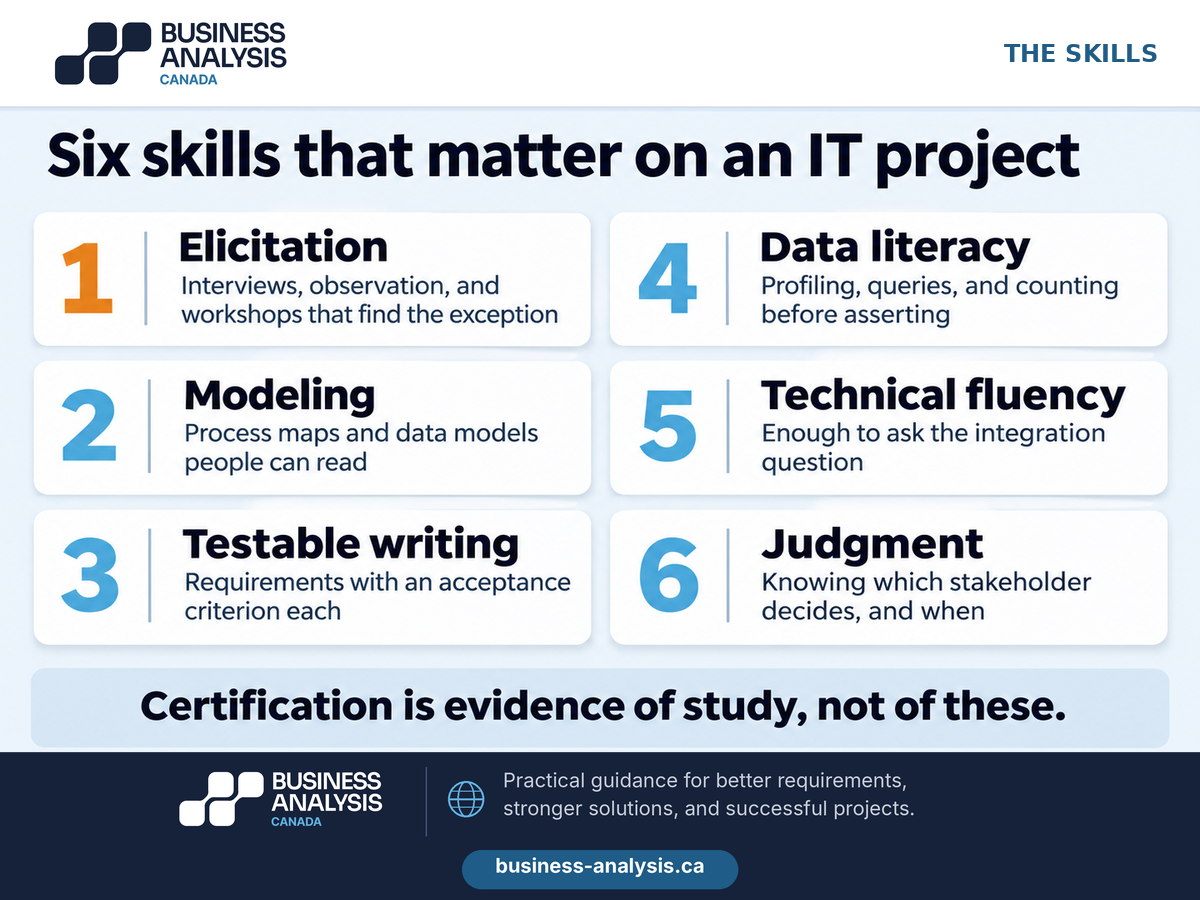
Six, and they are observable in the first two weeks of an engagement, which is how a hiring manager should assess them. Certifications are evidence that the candidate studied the discipline; the BABOK guide for hiring managers explains what the standard covers and what a certificate does and does not tell you.
- Elicitation. Interviews that ask about exceptions rather than the normal day, observation that catches the workaround nobody mentions, and workshops that end in decisions. The test is whether the analyst's first week produces findings the sponsor did not already know.
- Modeling. Process maps, data models, and context diagrams that the people in the process can read and correct. An analyst who can only write prose will produce requirements that are long and unverifiable; one who models finds the missing hand-off on the page before the developer finds it in code.
- Testable writing. Every requirement with an acceptance criterion that names the actor, the action, and the observable result. The test is to hand a requirement to a tester and ask for the script; if the tester has questions, the requirement is not finished.
- Data literacy. Profiling a table, writing a query, counting records before asserting anything about them. Integration, migration, and reporting requirements are decided by what is in the data, and an analyst who cannot look will take the operator's word for it.
- Technical fluency. Enough to ask the integration question, read an API description, and know what the platform cannot do. Not enough to build it, which is a different role; the Power Apps and custom development guide shows the kind of judgment the fluency serves.
- Judgment. Knowing which stakeholder decides, when a conflict needs the sponsor and when it needs a diagram, and when to stop eliciting and write. The stakeholder management plan post covers the first part; the rest is experience, and the way to assess it is to ask the candidate about the project where they were wrong.
Domain knowledge is the seventh, and it is overrated at hire and underrated at delivery. An analyst new to the domain learns it in the discovery phase, because that is what discovery is; an analyst who knows the domain and skips discovery because of it writes the organization's old process into the new system. Hire for the six, and for the ability to learn the domain fast, which the first two weeks also show.
The how to hire a business analyst post turns the six into an interview; the point here is that each one maps to a deliverable in the table above, so that a gap in the skills is a gap in a phase, and the sponsor can see which one.
Key Takeaway: Six observable skills: elicitation, modeling, testable writing, data literacy, technical fluency, judgment. Each maps to a phase deliverable. Assess them in the first two weeks; treat certification as evidence of study and domain knowledge as something discovery supplies.
How do business analyst, project manager, and product owner responsibilities split?
By what each one owns: the analyst owns the definition of what is being built, the product owner owns the decision about what is built first and whether it is worth it, and the project manager owns the plan that delivers it on time and within budget. The three overlap on every project, which is why they get confused, and the three-chairs comparison works through twelve recurring decisions and who takes each one. This section is the short version.
The project manager owns schedule, budget, risk, and the plan, and asks the analyst for estimates of analysis work and for the impact of changes on scope. The product owner owns the backlog's order and the value judgment, and asks the analyst for requirements written well enough to order and for the consequences of each trade. The analyst owns the requirements, the acceptance criteria, the models, and the traceability, and asks the product owner for decisions and the project manager for time to make the artifacts. When a scope change arrives, the analyst assesses its impact, the product owner decides whether it is worth it, and the project manager re-plans; a project in which one person does all three has no check on any of them.
Two combinations work and one does not. A product owner and a business analyst can be one person on a small product with a stable team, because both roles face the business. A project manager and a business analyst can be one person on a short, low-risk project, with the risk that analysis is cut when the schedule slips, which is the month-three pattern from the introduction. A project manager and a product owner should not be one person, because the person deciding what is worth building should not be the person measured on finishing on time.
When a project has a product owner and no analyst, the product owner writes the requirements, usually as one-line stories without acceptance criteria, and the developers fill the gaps with assumptions; the comparison post describes that failure pattern in detail. When a project has an analyst and no product owner, the analyst ends up making value decisions by default, which is a governance gap the sponsor should close by naming who decides.
Key Takeaway: The analyst defines what is built, the product owner decides what is built first and whether it is worth it, the project manager delivers it on time and within budget. Analyst and product owner can combine on a small product; project manager and product owner should not.
When does a project not need a business analyst?
In three cases, and they are narrower than the budget conversation usually assumes. The honest answer is that the business analysis still happens on those projects; it is done by someone with another title, and the question is whether that person has the skills and the time.
A configure-only deployment of a mature product, where the organization adopts the vendor's standard process without change, has fewer than a few dozen users, and the manager who owns the process is also its daily user, can run on the manager, the vendor's consultant, and a short checklist. A pure technical change, a server migration, an operating system upgrade, a database version, where no business process, rule, or interface changes, needs a technical lead and a test plan, not a business analyst. And a product team with an experienced product owner, a user researcher, and a stable team that writes testable acceptance criteria as a habit has the function covered under other titles; adding an analyst duplicates it.
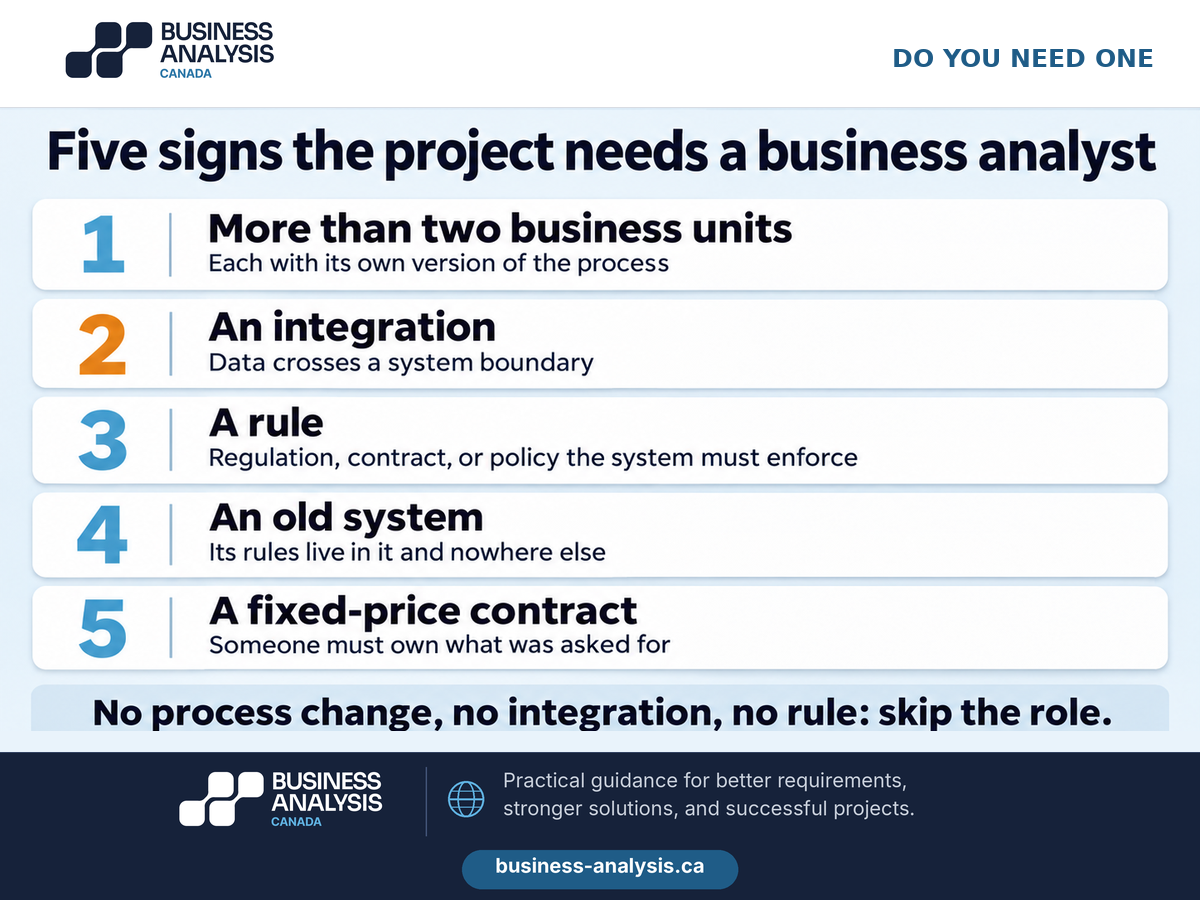
Everything else needs one, and the signs are specific. More than two business units in the process, each with its own version of it. Any integration, because data crossing a system boundary needs an owner on each side and a definition in between. A regulatory, contractual, or policy rule the system must enforce, which has to be written down before it can be built. A system in use for years, because the rules live in it and nowhere else, and recovering them is the analyst's work. A fixed-price vendor contract, because someone on the buyer's side has to own what was asked for, in writing, before the price is fixed. Where the organization has no one to put in the seat, the staff augmentation post compares the ways to fill it.
The cost comparison the sponsor is making in month three is the wrong one. The analyst's line is compared with the saving; it should be compared with the cost of the argument in month nine, which is a change order, a parallel run extended, or a regional office on paper. The role's output is the absence of that argument, which is why it is hard to see on an invoice and easy to see in a post-mortem; the why IT projects fail post is a catalog of the arguments.
Key Takeaway: Skip the role for a configure-only deployment with one owner-user, a pure technical change, or a product team that already writes testable criteria. Keep it for more than two business units, any integration, a rule to enforce, an old system, or a fixed-price contract.
Frequently Asked Questions
What is a business analyst?A business analyst is the person on a project who finds out what the organization needs from a change, writes it down so that it can be built and tested, and keeps that definition true through delivery. The International Institute of Business Analysis defines the discipline as enabling change by defining needs and recommending solutions that deliver value, and a business analyst as anyone who performs that work, whatever their title. On an IT project the analyst owns the requirements, acceptance criteria, and models that developers and testers build from.
What is the difference between a business analyst and an IT business analyst?An IT business analyst is a business analyst whose change is a system, so the role adds data, interfaces, and platform limits to the usual elicitation and specification work. A technical business analyst goes a step further and works directly with code, data models, and integration specifications, usually on complex programs. The skills in the middle of the spectrum, data literacy and technical fluency, are what separate an analyst who can scope an integration from one who takes the operator's word for it.
What are the main responsibilities of a business analyst on an IT project?One deliverable per phase: the problem statement, scope boundary, and decision record in discovery; requirements by outcome with acceptance criteria, the data model, and the prioritized backlog in analysis; clarifications, change impact assessments, and traceability during build; test scripts and defect triage in UAT; and benefits measurement after go-live. The analyst elicits and specifies; business owners decide and sign. Removing the role after the requirements document breaks the chain from criteria to tests to benefits.
How do we get a business analyst for our project?Decide which of the five phases the project needs covered and whether the seat is a short discovery or an embedded role through UAT. ID Business Analysis Canada places business analysts on contract, contract-to-hire, or project terms through its Business Analysis Roles service, and runs discovery as a fixed-scope Discovery Sprint when the project needs the first row of the table before the rest is scoped. Bring the project's phase and the system involved; the first question is which deliverables are already signed.
Conclusion
The analyst cut in month three in the opening pattern was not expensive to keep. The role was invisible because its output is a set of decisions nobody has to revisit, and that is hard to see until the month when the decisions are revisited, by a vendor, at change-order rates. The sponsor who understood the table above would have asked, in month three, which deliverables had been signed and which were still to come, and would have found that the interface inventory and the acceptance criteria were the two things the project could least afford to lose.
If you are deciding whether the role belongs on your project, or how much of it, ID Business Analysis Canada's Business Analysis Roles service places analysts on contract, contract-to-hire, or project terms, scoped by the phases the project needs. Book a free consultation and bring the project plan; the first thing we will do is mark which deliverables in the table it already has.